Which APEC Reverse Osmosis System Fits Your Water? A Model-by-Model Look
Published October 29, 2026
As an Amazon Associate we earn from qualifying purchases. This never changes which products we recommend.
Verdict
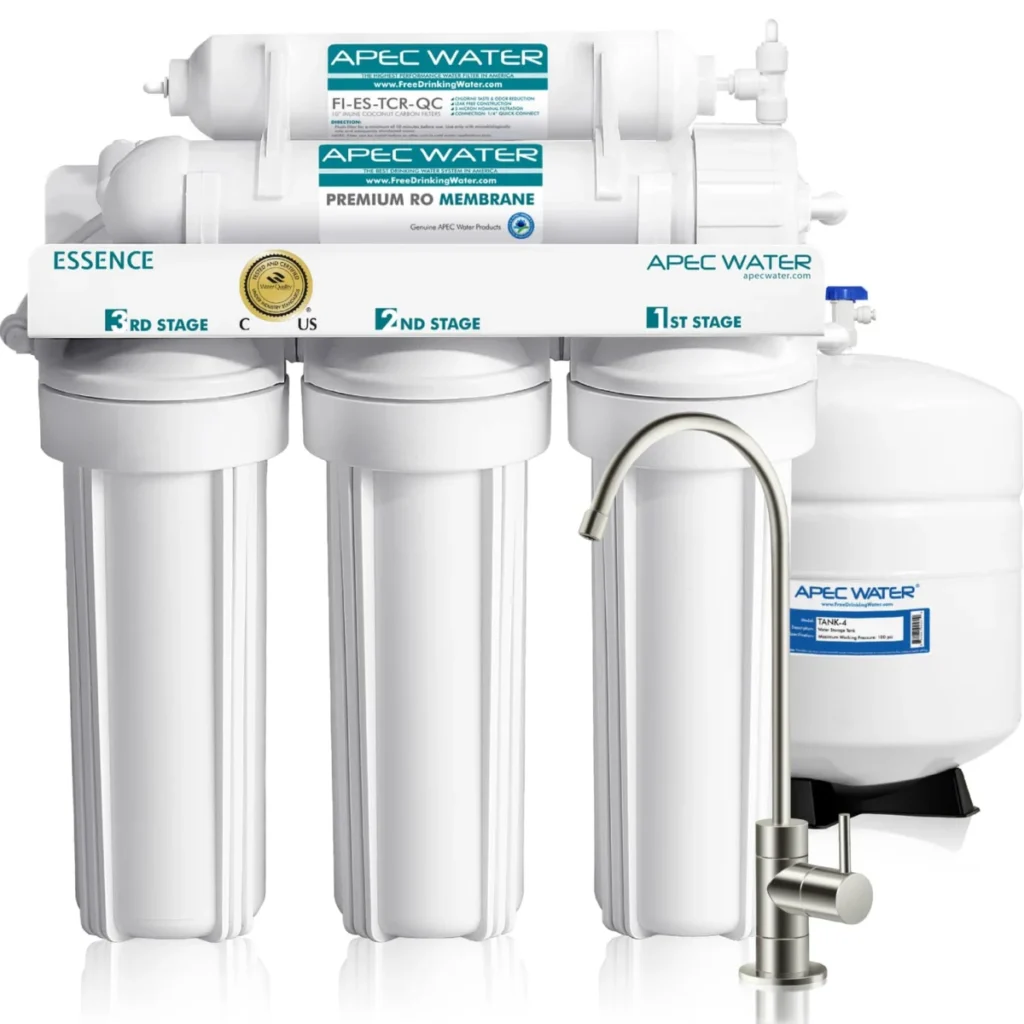
Worth considering
The APEC ROES-50 is a sensible under sink reverse osmosis system for a household that wants dissolved solids, fluoride and lead reduced at the kitchen tap and can spare the cabinet space for a storage tank. Its 50 GPD rating and 5 stages are modest next to tankless, higher-output units, so larger households or anyone short on under sink room should weigh the alternatives before buying.
- Best for: A homeowner on municipal water who wants fluoride and dissolved solids reduced at the kitchen tap, A family in an older home that wants a certified lead reduction claim at the drinking water point, A DIY installer comfortable working with quick-connect fittings under the sink
- Not for: A renter who cannot drill a faucet hole or tap the cold line, A household on a private well with bacteria, since RO does not disinfect water
Key takeaways
- The ROES-50 is a 5-stage, 50 GPD under sink reverse osmosis system that ships with a tank, faucet and installation kit.
- The listing names NSF/ANSI 372 and 58, so the lead-free material and reverse osmosis claims have a certification basis, but confirm the exact scope on the performance data sheet.
- A 50 GPD rating with a storage tank means a reserve of treated water rather than instant flow at the faucet, which matters for larger households.
- The main drawback is that reverse osmosis does not disinfect water, so well water needs a lab test and any needed pretreatment before an RO system goes in.
Table of contents12 sections · tap to expand
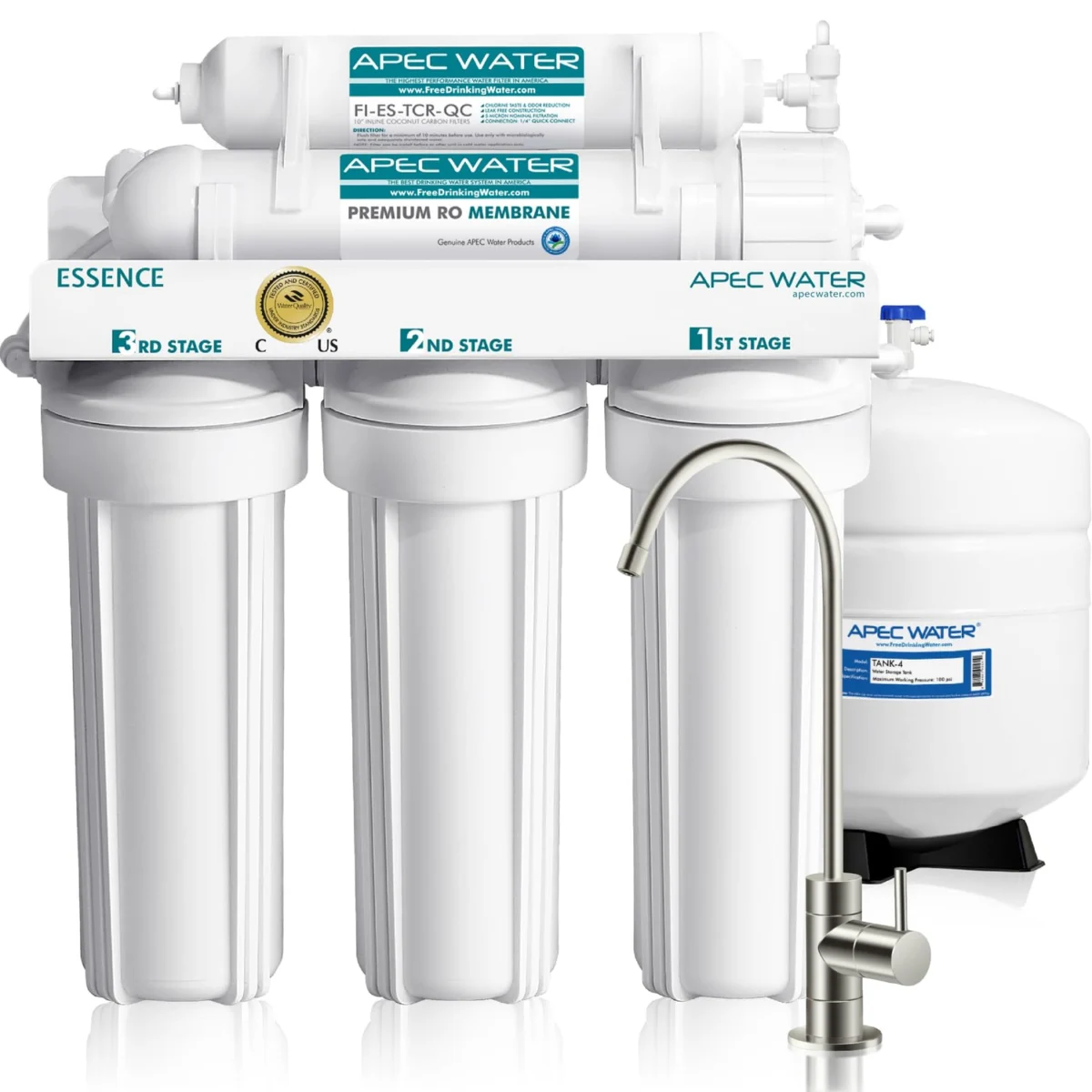
The APEC ROES-50 is a 5-stage under sink reverse osmosis system rated at 50 gallons per day, sold with a storage tank, a brushed nickel faucet and an installation kit. It is the entry point in the APEC reverse osmosis lineup, and the model most buyers land on when they want reverse osmosis at one tap without a plumber.
Is it worth it? For a household that wants dissolved solids, fluoride and lead reduced at the kitchen sink and has the cabinet space for a tank, the ROES-50 is a reasonable buy. It is not the right pick for a renter who cannot cut a faucet hole, or for well water that has not been tested, because reverse osmosis does not disinfect bacteria.
Specifications
Key specifications
| Specification | Detail | Why it matters |
|---|---|---|
| Type | Reverse osmosis system | It reduces dissolved contaminants that carbon pitchers and faucet filters generally leave behind. |
| Stages | 5 stages | Sediment and carbon stages protect the membrane, and a post stage polishes taste at the faucet. |
| Flow rate | 50 GPD | The daily production rate sets how quickly the storage tank refills after heavy use. |
| Capacity | 50 gallons | This is the rated daily output, not a tank volume, so plan around refill time rather than instant flow. |
| Installation | DIY install | Quick-connect fittings and color-coded tubing mean a confident DIYer can avoid a plumber. |
| Product Dimensions | 15.5"L x 5.25"W x 17"H | The unit needs a tall, narrow footprint under the sink, plus room for the separate storage tank. |
| Included Components | RO System, Tank, Filter Set, Owners Manual | A complete kit means no separate faucet or tank purchase before installation. |
What does the APEC ROES-50 reduce, and what does it leave behind?
The listing names chlorine, lead, PFAS, fluoride, microplastics, arsenic and sediment as targets, and the reverse osmosis membrane is what separates this system from a carbon-only under sink filter. An activated carbon block alone improves taste and reduces chlorine, but dissolved fluoride, arsenic and much of the total dissolved solids pass through it. The RO membrane is the stage that rejects those dissolved contaminants, which is why an RO system is the usual choice when a water report shows fluoride or elevated TDS.
Certification is where buyers should slow down. The listing states NSF certification and names NSF/ANSI 372 and 58, which cover lead-free materials and reverse osmosis performance respectively. That is a stronger basis than a manufacturer-only test claim, but it does not by itself prove a specific reduction figure for every contaminant named. Ask APEC for the performance data sheet, then compare it with your local water quality report before assuming a particular contaminant is handled.
How much water does the APEC ROES-50 send down the drain?
Reverse osmosis pushes feed water across a membrane and sends the concentrated remainder to the drain, so some wastewater is inherent to the design. The published specifications for the ROES-50 do not state a wastewater ratio, so treat any figure you see elsewhere with caution and ask APEC directly if water use matters to you. A tankless unit such as the Frizzlife PD800-TAM4 publishes a 2:1 pure-to-drain ratio, which is the kind of number to compare against.
Tank refill time is the practical side of the same question. At 50 GPD, the system produces roughly two gallons an hour, so a storage tank emptied by cooking and several glasses refills over a stretch of hours rather than minutes. That is fine for a couple or a small family drawing water through the day, but a busy kitchen that empties the tank at breakfast will notice the wait.
Installation, space and what the ROES-50 asks of your cabinet
The ROES-50 is built for DIY installation, with quick-connect fittings and colored tubing that reduce the guesswork. You still need a cold water feed, a spot for the faucet on the sink or counter, and room under the sink for both the 15.5 by 5.25 by 17 inch unit and the separate storage tank. Measure the cabinet before ordering, because the tank is often what makes an RO system fail to fit.
A plumber is not strictly required, but a few conditions change that. If your sink has no spare faucet hole and you are not willing to drill one, or if feed pressure is low enough that the membrane struggles, an RO system becomes a bigger project. Renters should treat the faucet hole and the line tap as the deciding constraints, since both are permanent changes to the property.
Filter life, membrane replacement and running cost
The listing recommends replacing filters every 6 to 24 months depending on incoming water quality, and the system ships with one Filter-Max-ES50 set. The wide range reflects the fact that the sediment prefilter and activated carbon block stages wear out faster on cloudy or heavily chlorinated feed water, while a cleaner municipal supply stretches them toward the long end. The reverse osmosis membrane is a separate, longer-lived part that typically lasts a few years.
Budget for the membrane as well as the annual filter set, because a membrane replacement is the larger single expense in any RO system's life. The ROES-50 uses standard-style cartridges rather than a sealed proprietary housing, which generally makes replacement simpler and gives buyers more choice. Track your actual change interval against the manufacturer's schedule rather than the calendar alone.
Taste, minerals and what RO water is like to drink
Reverse osmosis water is low in dissolved solids, which most people describe as clean and flat rather than mineral-rich. Some drinkers notice the difference after years of hard tap water and like it; others miss the mineral taste. The ROES-50 has no remineralization or alkaline stage, so if you want minerals added back, that is a separate consideration the Frizzlife PD800-TAM4 addresses with an alkaline stage.
Taste also depends on the post-filter doing its job. A spent carbon stage can let a faint taste through even when the membrane is fine, which is one reason the 6 to 24 month filter schedule matters. If taste changes before the schedule says to replace, change the carbon stages first and see whether the membrane needs attention.
City water versus well water: when the ROES-50 fits and when it does not
On municipal water, the ROES-50 fits the common case: a household that has read its consumer confidence report, seen fluoride or dissolved solids, and wants them reduced at the drinking tap. On a private well, the decision starts with a lab test for bacteria, nitrates, arsenic, iron and hardness. Reverse osmosis does not disinfect water, so a well with bacteria needs disinfection regardless of what RO system is installed.
Well water also stresses an RO system in ways city water does not. Iron and sediment foul the membrane quickly, and hard water scales it, so pretreatment such as a sediment prefilter or softener may be needed before the ROES-50. If a lab test shows those problems, plan the pretreatment first and treat the RO system as the final polishing stage rather than the whole solution.
Strengths and weaknesses
Pros and cons
Pros
- Five stages with a reverse osmosis membrane reduce dissolved contaminants that carbon-only under sink filters leave behind.
- The listing names NSF/ANSI 372 and 58, giving the lead-free and reverse osmosis claims a certification basis.
- Quick-connect fittings and colored tubing make DIY installation realistic for a confident homeowner.
- The kit includes the tank, faucet and a Filter-Max-ES50 filter set, so nothing extra is needed to start.
- Standard-style cartridges keep replacement straightforward compared with sealed proprietary housings.
Cons
- The 50 GPD rating with a storage tank means refill time matters for larger households.
- No wastewater ratio is published for this model, so water use is hard to judge without asking APEC.
- There is no remineralization or alkaline stage, so RO water stays low in minerals.
- Reverse osmosis does not disinfect water, so well water needs testing and possibly pretreatment first.
Other options
Alternatives to consider
Frizzlife PD800-TAM4

Choose the Frizzlife if you want a tankless design, a published 2:1 pure-to-drain ratio and an alkaline remineralization stage, and can accept a higher-output system.
Express Water RO5DX
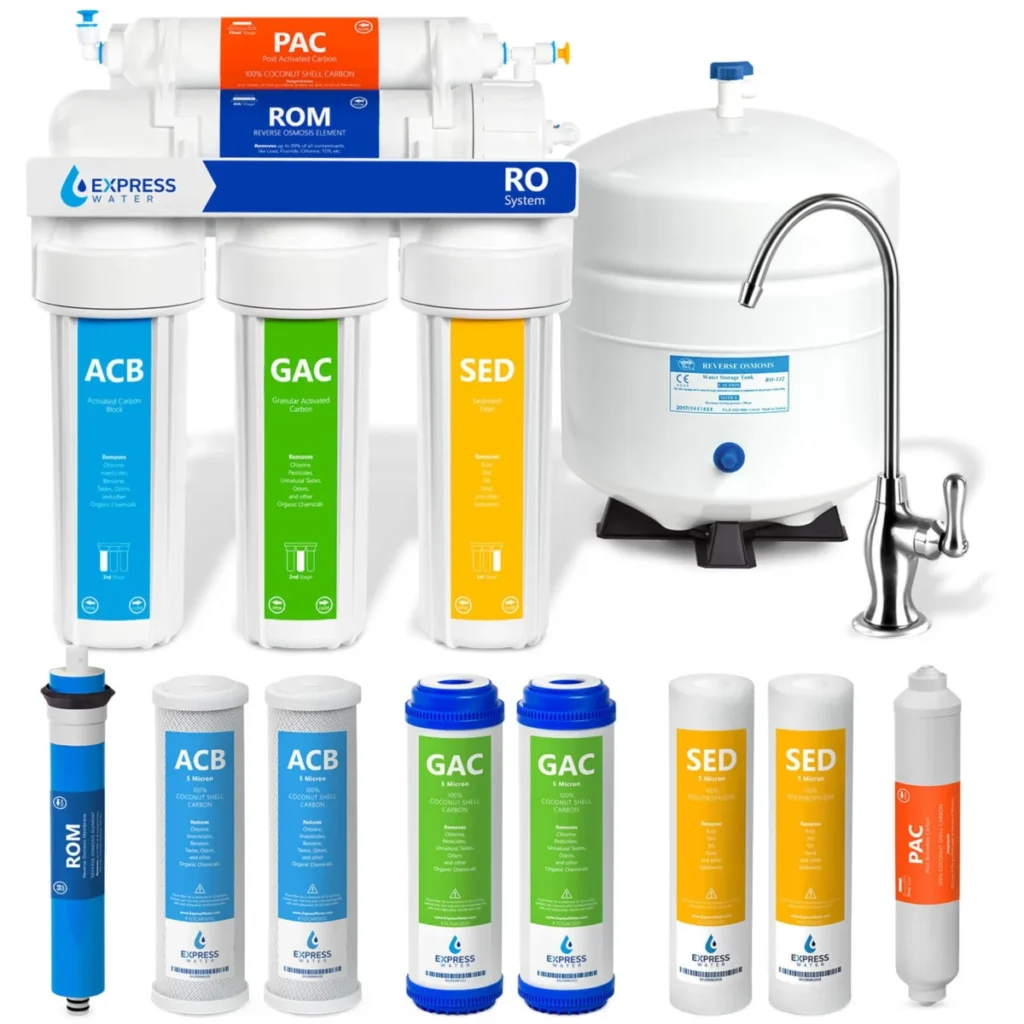
Choose the Express Water RO5DX if you want a comparable 5-stage, 50 GPD layout and are prepared to bring in a plumber for installation.
Common questions
Frequently asked questions
How often do you change the filters on an APEC ROES-50?
APEC recommends replacing filters every 6 to 24 months depending on incoming water quality. Sediment and carbon stages wear faster on cloudy or heavily chlorinated water, while the reverse osmosis membrane is a separate part that typically lasts a few years.
Does the APEC ROES-50 remove fluoride?
The listing names fluoride among the contaminants the system reduces, and the reverse osmosis membrane is the stage responsible. Confirm the specific reduction on APEC's performance data sheet and compare it with the fluoride level in your local water quality report.
Do I need a plumber to install an APEC ROES-50?
Most confident DIYers can install the ROES-50 using the included quick-connect fittings and colored tubing. You will need a cold water feed, a faucet hole and cabinet space for the unit and tank, so hire a plumber if drilling or line work is beyond your comfort.
Is the APEC ROES-50 NSF certified?
The listing names NSF/ANSI 372 and 58, covering lead-free materials and reverse osmosis performance. Ask APEC for the performance data sheet to see exactly which contaminants the certification covers.
How much wastewater does the APEC ROES-50 produce?
The published specifications do not state a wastewater ratio for this model, so ask APEC directly if drain water matters to you. Reverse osmosis systems always send some concentrate to the drain, and tankless units often publish a ratio for comparison.
Can the APEC ROES-50 be used on well water?
It can, but only after a lab test for bacteria, nitrates, arsenic, iron and hardness. Reverse osmosis does not disinfect water, and iron or hardness can foul the membrane, so pretreatment may be needed before the RO system goes in.
Bottom line
Should you buy the APEC ROES-50?
Buy the APEC ROES-50 if you are on municipal water, want fluoride and dissolved solids reduced at the kitchen tap, and have the cabinet space for a tank. It is a straightforward five-stage system with a complete kit and a certification basis for its core claims.
Skip it if you rent and cannot cut a faucet hole, or if your well water has not been lab tested. In those cases, fix the constraint first, then decide whether a tank-based RO system or a tankless alternative such as the Frizzlife PD800-TAM4 fits better.