Alexapure vs Berkey: Certified Claims, Capacity and Yearly Filter Cost
Published October 29, 2026
Choose Alexapure if you want a gravity filter with a published NSF/ANSI 42 and 53 certification for chlorine taste and odor and lead reduction, and you prefer a system that is straightforward to set up and maintain. Choose Berkey if you need a larger reservoir for a bigger household, want a modular system that can scale with additional filters, and are comfortable with a brand that relies on manufacturer testing rather than third-party certification for many contaminant claims.
The single deciding tradeoff is certification transparency versus capacity and modularity: Alexapure gives you documented NSF/ANSI 42 and 53 performance for a defined set of contaminants, while Berkey offers larger sizes and a reputation for thorough filtration but with less third-party certification to back its broader claims.
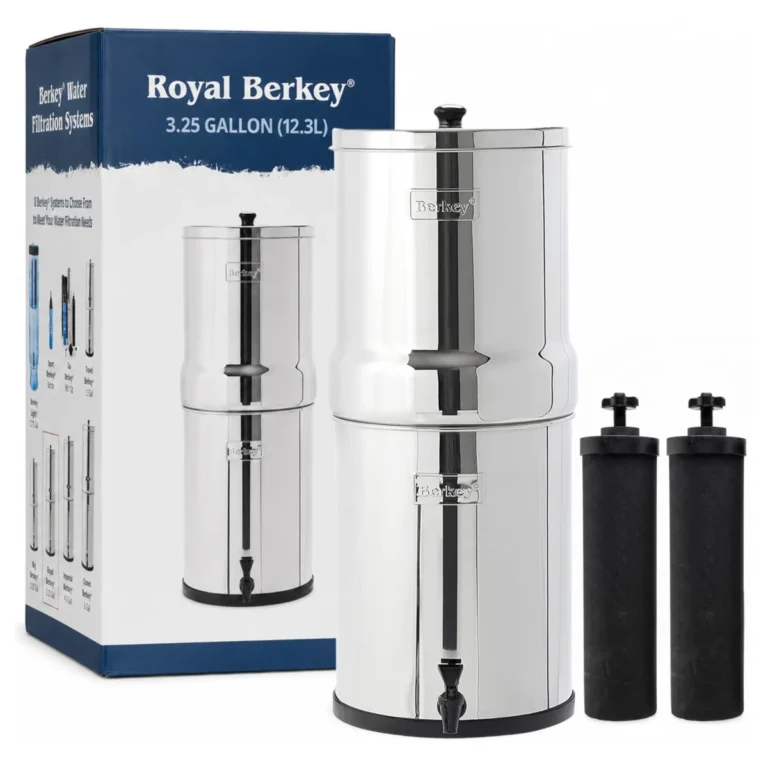
Gravity-fed stainless steel filters sit on the counter, need no plumbing or electricity, and use activated carbon or ceramic elements to reduce contaminants as water drips from an upper chamber to a lower one. They are popular with renters, well owners, and preppers because they are portable and work during power outages.
But they are not reverse osmosis systems: they do not remove dissolved fluoride or soften hard water, and their flow rate is slow. This comparison examines Alexapure and Berkey across the criteria that matter most: contaminant reduction claims and certification, filter type and micron rating, capacity, filter life and running cost, flow rate, footprint, well water and emergency suitability, and support and parts availability.
Quick verdict
Alexapure and Berkey both offer gravity-fed stainless steel water filters that require no plumbing or power, but they differ in certification, capacity, and cost structure. Alexapure emphasizes NSF/ANSI 42 and 53 certification for chlorine and lead reduction, while Berkey offers larger reservoirs and a modular design with a broader set of manufacturer-stated contaminant claims.
Alexapure
Certified for chlorine and lead, simple setup
Choose Alexapure if you want a gravity filter with published NSF/ANSI 42 and 53 certification for chlorine taste and odor and lead reduction, and you prefer a simpler, single-filter setup.
Berkey
Larger capacity, modular, broad claims
Choose Berkey if you need a larger reservoir for a big household, want the option to add filters for faster flow or extended life, and are comfortable relying on manufacturer testing for many contaminant claims.
Key takeaways
- Alexapure holds NSF/ANSI 42 and 53 certification for chlorine taste and odor and lead reduction, while Berkey relies on manufacturer testing for most contaminant claims.
- Berkey offers larger reservoir capacities (up to 6 gallons) and modular filter configurations, while Alexapure's standard system is 2.25 gallons.
- Both use carbon block filter elements with a micron rating of 0.2 microns (Alexapure) or 0.2 microns (Berkey), but filter life and replacement costs differ.
- Neither system removes dissolved fluoride or softens hard water, so well owners with those issues need additional treatment.
Table of contents9 sections · tap to expand
What is Alexapure?
Alexapure is a gravity-fed stainless steel countertop water filter system that uses a carbon block filter element and holds NSF/ANSI 42 and 53 certification for chlorine taste and odor and lead reduction.
What is Berkey?
Berkey is a gravity-fed stainless steel countertop water filter system that uses a carbon block filter element (with optional ceramic or media filters) and offers a range of sizes, with manufacturer testing for a long list of contaminants but limited third-party certification.
At a glance
Alexapure vs Berkey at a glance
| Criterion | Alexapure | Berkey |
|---|---|---|
| Contaminant reduction claims and certification | NSF/ANSI 42 and 53 certified for chlorine taste and odor and lead reduction; manufacturer claims for other contaminants | Manufacturer testing for a broad list of contaminants (including chlorine, lead, sediment, VOCs, etc.); no NSF |
| Filter element type and micron rating | Carbon block filter, 0.2 micron rating | Carbon block filter (standard), 0.2 micron rating; optional ceramic or media filters available |
| Reservoir capacity and household size | 2.25 gallons, suits 1-4 people | 2.25 to 6 gallons depending on model, suits 1-8+ people |
| Filter life and replacement cost per year | Filter life up to 1,000 gallons (approx. | Filter life up to 3,000 gallons per pair (approx. |
| Flow rate and refill routine | Approximately 1 gallon per hour; refill every 1-2 days for a family of four | Approximately 1 gallon per hour (standard); refill frequency depends on size, larger models less often |
| Countertop footprint and assembly | Compact footprint (approx. 10 x 10 x 20 in); simple assembly, no tools required | Larger footprint for bigger models (e.g., 6-gallon model approx. 12 x 12 x 30 in); assembly straightforward |
| Well water and emergency suitability | Works without power; carbon block reduces sediment and some chemicals, but does not remove dissolved | Works without power; carbon block reduces sediment and some chemicals, but does not remove dissolved |
| Support, warranty and parts availability | Limited lifetime warranty; replacement filters widely available online and in stores | Limited lifetime warranty; replacement filters widely available online and from authorized dealers |
Key differences
8 key differences between Alexapure and Berkey
1. Contaminant reduction claims and the certification behind them
Alexapure's key difference is its NSF/ANSI 42 and 53 certification for chlorine taste and odor and lead reduction. That means an independent certifier has verified those specific claims, which matters if you want documented performance for lead, a contaminant with no taste or smell.
Berkey, by contrast, publishes manufacturer test data for a longer list of contaminants, including chlorine, lead, sediment, VOCs, and more, but it does not hold NSF/ANSI 42 or 53 certification for most of those claims. For a reader who values third-party verification over a broader but self-reported list, Alexapure provides clearer assurance on the contaminants it certifies.
Neither brand's gravity filters remove dissolved fluoride or soften hard water. That is a limitation of the carbon block technology itself, not a brand failing. If your water report shows fluoride or high hardness, you will need a reverse osmosis system or a softener in addition to a gravity filter. For well water, a lab test is essential to know what you are dealing with; a gravity filter can reduce sediment and some chemicals but is not a microbiological treatment.
2. Filter element type and micron rating
Both Alexapure and Berkey use carbon block filter elements with a 0.2 micron rating as their standard filtration. A 0.2 micron carbon block is tight enough to reduce sediment, rust, and many cysts, and the activated carbon inside adsorbs chlorine, some VOCs, and other chemicals. Berkey also offers optional ceramic or media filters that can be added for specific concerns, such as fluoride (with a separate media) or extended filter life. Alexapure keeps it simple with a single carbon block design.
The practical consequence is that Berkey gives you more customization options, which can be useful if you have a specific contaminant concern beyond the standard carbon block. Alexapure's simpler approach means fewer decisions and a straightforward replacement routine. Neither brand's standard filter removes dissolved fluoride; Berkey's optional fluoride filter is an additional purchase and is not part of the standard setup.
3. Reservoir capacity and household size
Berkey offers a wider range of reservoir sizes, from 2.25 gallons up to 6 gallons, while Alexapure's standard system is 2.25 gallons. For a household of one to four people, a 2.25-gallon system is usually adequate, requiring a refill every one to two days. For larger households or for emergency preparedness, Berkey's larger sizes reduce the frequency of refills and provide more water on hand.
The tradeoff is countertop space: a 6-gallon Berkey takes up significantly more room than a 2.25-gallon Alexapure. If counter space is tight, the smaller Alexapure or a smaller Berkey model is more practical. Match the reservoir size to your daily consumption and available space rather than buying the biggest system by default.
4. Filter life, replacement cost and yearly running cost
Alexapure rates its filter for up to 1,000 gallons, which for a typical family of four using about 2 gallons per day works out to roughly 1.5 years, but many households replace annually. Berkey rates its standard carbon block filters for up to 3,000 gallons per pair, and since the system uses two filters, that works out to about 1,500 gallons per filter, or roughly 2 years for the same family.
However, Berkey recommends replacing the filters annually for best performance, so the practical replacement interval is similar.
That makes Alexapure somewhat cheaper to run on an annual basis, but the difference is modest. The larger factor is whether you need the extra capacity and modularity of Berkey; if you do, the higher filter cost is part of the package.
5. Flow rate and refill routine
Both systems rely on gravity, so flow rate is limited. Alexapure and Berkey both flow at approximately 1 gallon per hour under standard conditions, meaning a 2.25-gallon reservoir takes a couple of hours to filter a full batch. That is slower than a faucet filter or reverse osmosis system, but it is continuous and requires no power. The refill routine is similar: fill the upper chamber, wait for it to drip through, and draw from the lower spigot.
Berkey's larger models hold more water, so you refill less often, but the flow rate per hour is essentially the same. If you need fast water for cooking or filling large pots, a gravity filter will feel slow. For drinking water and everyday use, the pace is usually acceptable, especially if you keep the reservoir topped up.
6. Countertop footprint and assembly
Alexapure's 2.25-gallon system has a compact footprint, roughly 10 x 10 x 20 inches, and assembles without tools. Berkey's smaller models are similar in size, but its larger 6-gallon model is substantially bigger, around 12 x 12 x 30 inches, and requires more counter space. Assembly for both brands is straightforward: attach the spigot, seat the filters, and stack the chambers. Neither requires plumbing or electricity.
For renters or anyone with limited counter space, the smaller footprint of Alexapure or a small Berkey is easier to live with. For a dedicated water station in a pantry or on a sturdy counter, a larger Berkey is manageable. Consider the height clearance under cabinets as well, since you need to lift the upper chamber to refill.
7. Well water, city water and emergency use
Both Alexapure and Berkey are suitable for city water where the main concerns are chlorine taste and odor, sediment, and lead (Alexapure is certified for lead reduction; Berkey claims lead reduction based on manufacturer testing). For well water, neither system is a complete solution: they do not remove dissolved fluoride, nitrate, arsenic, or soften hard water, and they are not designed to treat bacteria or viruses. A well owner should test the water first and then choose a system that addresses the specific contaminants found.
In emergencies or power outages, both systems work without electricity, which is a major advantage over reverse osmosis or under-sink filters that rely on line pressure. Berkey's larger capacities make it a popular choice for preparedness, while Alexapure's certified lead reduction may be more relevant in older homes with lead plumbing. Neither should be used to make microbiologically unsafe water safe; follow local boil-water notices.
8. Support, warranty and parts availability
Both brands offer a limited lifetime warranty on their stainless steel housings and have replacement filters widely available online and through retailers. Alexapure replacement filters are sold direct and through major online marketplaces, and Berkey filters are available from authorized dealers and online. Customer support for both is generally responsive, though response times can vary.
The main difference is that Berkey has a larger aftermarket ecosystem, with more third-party accessories and filter options, while Alexapure keeps a simpler product line. For long-term parts availability, both are well established, but Berkey's broader dealer network may make it easier to find filters locally in some areas.
Alexapure: strengths and limitations
Alexapure is a gravity-fed stainless steel water filter that holds NSF/ANSI 42 and 53 certification for chlorine taste and odor and lead reduction, making it a strong choice for city water users who want documented performance. Its 2.25-gallon capacity suits small to medium households, and its simpler single-filter design is easy to maintain.
Strengths
- NSF/ANSI 42 and 53 certification provides independent verification for chlorine and lead reduction.
- Compact footprint and straightforward assembly with no tools required.
- Lower annual replacement filter cost compared to Berkey.
- Works without power, suitable for emergencies and renters.
Limitations
- Only one reservoir size (2.25 gallons), which may be too small for large households.
- Does not remove dissolved fluoride or soften hard water.
- No modular filter options for additional contaminant reduction.
Berkey: strengths and limitations
Berkey is a gravity-fed stainless steel water filter available in multiple sizes up to 6 gallons, with a modular design that allows optional filters for specific concerns. It relies on manufacturer testing for a broad list of contaminants but lacks NSF certification for most claims, making it a good fit for larger households and preppers who value capacity and flexibility.
Strengths
- Larger reservoir options (up to 6 gallons) suit big families and emergency preparedness.
- Modular design allows adding filters for faster flow or specific contaminant reduction.
- Widely available replacement filters and accessories through a large dealer network.
- Works without power and is portable.
Limitations
- Most contaminant reduction claims are based on manufacturer testing, not third-party certification.
- Higher annual replacement filter cost compared to Alexapure.
- Larger models take up significant counter space.
- Does not remove dissolved fluoride or soften hard water without optional add-ons.
Decision guide
Which should you choose?
| If you… | Choose | Why |
|---|---|---|
| Renter with city water who wants better-tasting water than a pitcher and cannot modify plumbing | Either | Both are countertop gravity filters that need no installation, but Alexapure's NSF/ANSI 42 certification for chlorine taste and odor gives documented assurance for city water. |
| Household on a private well with sediment and rust, wanting drinking water without plumbing | Berkey | Berkey's larger reservoir and modular design can handle higher volumes, and its carbon block filters are rated for sediment and rust reduction, though neither system removes dissolved fluoride or softens hard water. |
| Family preparing for boil-water notices or power outages | Either | Both work without electricity and are portable, but Berkey's larger sizes suit bigger families, while Alexapure's certified lead reduction may be valuable if lead is a concern. |
| Large household (5+ people) that does not want to refill constantly | Berkey | Berkey offers larger reservoir capacities (up to 6 gallons) than Alexapure's standard 2.25-gallon system, reducing refill frequency. |
| Someone comparing a gravity stainless steel system against a reverse osmosis system for fluoride removal | Either | Neither Alexapure nor Berkey removes dissolved fluoride, so for fluoride removal you need a reverse osmosis system; gravity filters are not a substitute. |
Choose Alexapure if
- You want a gravity filter with NSF/ANSI 42 and 53 certification for chlorine taste and odor and lead reduction, and you have city water with those concerns.
- You have a small household (1-4 people) and limited counter space, so a compact 2.25-gallon system is sufficient.
- You prefer a simpler, single-filter design with lower annual replacement costs.
- You are a renter who cannot modify plumbing and wants a no-install, no-power solution with documented lead reduction.
Choose Berkey if
- You have a large household (5+ people) or want a larger reservoir to reduce refill frequency, and you have the counter space for a bigger system.
- You are preparing for emergencies and want the option to scale capacity or add filters for specific concerns.
- You value a modular system that lets you customize filtration with optional ceramic or media filters.
- You are comfortable relying on manufacturer test data for a broad range of contaminants rather than third-party certification.
See also: AlexaPure Water Filter: Honest Look at Claims, Cartridge Cost and Fit; Berkey Water Filter Review: What the Gravity System Removes and Who It Suits; Waterdrop vs Berkey: Which Filter Fits Your Water and Your Kitchen.
Common questions
Frequently asked questions
Which is better, Alexapure or Berkey?
Neither is universally better; the choice depends on your priorities. Alexapure offers NSF/ANSI 42 and 53 certification for chlorine and lead reduction and a lower annual filter cost, while Berkey provides larger capacities and a modular design for bigger households or preparedness. Match the system to your water concerns, household size, and counter space.
Do Alexapure and Berkey filters remove fluoride?
No, neither Alexapure nor Berkey's standard carbon block filters remove dissolved fluoride. Fluoride requires a reverse osmosis system or a specialized fluoride filter (Berkey offers an optional fluoride filter as an add-on). If fluoride is a concern, check the manufacturer's performance data sheet for specific reduction claims.
How often do you replace the filters in a Berkey or Alexapure system?
Alexapure recommends replacing its filter about once a year or after 1,000 gallons, while Berkey rates its standard filters for up to 3,000 gallons per pair but suggests annual replacement for best performance. Actual replacement frequency depends on water quality and daily use; follow the manufacturer's guidance.
Are these gravity filters NSF certified?
Berkey does not hold NSF certification for most of its contaminant claims; its performance is based on manufacturer testing. Always check the specific certification listed on the product's performance data sheet.
Can a Berkey or Alexapure filter well water?
Both can reduce sediment, rust, and some chemicals from well water, but neither removes dissolved contaminants like fluoride, nitrate, or arsenic, nor do they soften hard water or treat bacteria and viruses. For well water, test first and choose a system that addresses the specific contaminants found; a gravity filter may be part of a multi-step treatment plan.
Bottom line
The verdict
Alexapure and Berkey are both capable gravity-fed stainless steel water filters, but they serve different priorities. Choose Alexapure if you want documented NSF/ANSI 42 and 53 certification for chlorine and lead reduction, a compact footprint, and lower annual filter costs. Choose Berkey if you need a larger reservoir for a big household or emergency preparedness, and you value a modular system that can be customized with optional filters.
Neither system removes dissolved fluoride or softens hard water, so if those are concerns, plan for additional treatment such as reverse osmosis or a softener. For well water, always test first and consult the manufacturer's performance data sheet to ensure the filter meets your specific needs.