Express Water RO5DX Review: What Its Five Stages Reduce and What It Costs
Published October 29, 2026
As an Amazon Associate we earn from qualifying purchases. This never changes which products we recommend.
Verdict
Worth considering
The Express Water RO5DX is a solid choice for city-water households that want fluoride and dissolved solids cut at the kitchen tap and have the cabinet space for a tank. Its 50 GPD flow and 4 gallon tank suit a couple or small family, but larger households may find refill waits annoying. The biggest limitation is that the listing does not specify which NSF standard applies, so buyers should confirm the performance data sheet for the contaminants they care about.
- Best for: City-water households wanting fluoride and TDS reduction at the kitchen sink, Renters or homeowners with a standard under sink cabinet and a spare faucet hole, Buyers who prefer a tank-based system over tankless pumps for reliability
- Not for: Large families needing high continuous flow or fast recovery between draws, Private well owners with bacteria or unknown contaminants (test first), Anyone wanting minerals retained in the finished water without adding a remineralization stage
Key takeaways
- Five stages include sediment, carbon, RO membrane and post-carbon, but the listing does not detail each stage's exact media.
- The system is NSF certified according to the listing, but the specific standard (58, 42, 53 or 372) is not stated, so verify the data sheet for your contaminants of concern.
- Running costs depend on replacement intervals that are not published; plan on several cartridges per year plus a membrane every few years.
- The 4 gallon tank and 50 GPD recovery mean it is best for smaller households; larger families may outrun the stored supply.
Table of contents12 sections · tap to expand
The Express Water RO5DX is a five-stage under sink reverse osmosis system rated at 50 gallons per day, with a 4 gallon storage tank and a chrome faucet. It is designed to reduce a long list of contaminants including fluoride, lead, PFAS and dissolved solids, and the listing says it is NSF certified. This review focuses on what the published specifications actually tell you, where the gaps are, and whether it fits your kitchen and water supply.
Is it worth it? For a small household on municipal water that wants better-tasting, lower-TDS water without a tankless pump, this system is a reasonable candidate. But the certification wording is vague, the flow rate is modest, and the listing does not give replacement intervals, so you will need to confirm those details before buying. It is not the right choice for well water with bacteria or for anyone who wants minerals left in the water.
Specifications
Key specifications
| Specification | Detail | Why it matters |
|---|---|---|
| Type | Reverse osmosis system | Reverse osmosis reduces dissolved solids like fluoride and arsenic that carbon filters leave behind. |
| Flow rate | 50 GPD | 50 gallons per day is on the lower end for under sink RO, so recovery after heavy use may be slow. |
| Stages | 5 stages | |
| Tank | Tankless | The listing says tankless, yet the specs also list a 4 gallon capacity and a tank, so clarify with the manufacturer before buying. |
| Capacity | 4 gallons | A 4 gallon tank provides a buffer for drinking and cooking, but larger households may drain it quickly. |
| Product Dimensions | 14"L x 5"W x 15"H | The compact footprint fits many cabinets, but you still need room for the tank and tubing. |
What does the Express Water RO5DX reduce and what does it leave
The Express Water RO5DX is built to reduce a broad list of contaminants: chlorine, lead, PFAS, fluoride, microplastics, arsenic and mercury are all named in the listing. Reverse osmosis is particularly effective at removing dissolved solids like fluoride and arsenic, which carbon filters cannot.
However, the listing does not state the exact reduction percentages or the specific NSF standard, so you should check the manufacturer performance data sheet for the contaminants you care about. The system does not add minerals back; if you want remineralized water, you would need a separate stage or a different model.
The system is NSF certified according to the listing, but the standard is not specified. Without knowing which standard applies, you cannot be sure which claims are certified. For city water, this may be less critical because your utility already treats for many contaminants, but for private well water, certification details matter more. Always cross-check with your local water quality report.
How much does the Express Water RO5DX cost to keep running?
Running costs for this RO system depend on replacement intervals, which are not published in the listing. A typical five-stage reverse osmosis system uses three pre-filters (sediment, carbon block, and sometimes a second carbon), an RO membrane and a post-carbon filter. Pre-filters usually need changing every 6 to 12 months, the membrane every 2 to 3 years, and the post-filter annually.
That translates to roughly three to five cartridges per year plus a membrane every few years. Without specific intervals from Express Water, you should budget for these typical replacements.
The listing mentions an extra filter set included, which helps with the first replacement but does not change long-term costs. Compared with tankless systems that may have proprietary cartridges, the RO5DX uses standard-style filters that are often less expensive. However, the lack of published intervals makes it harder to estimate yearly cost precisely. Ask the manufacturer for a maintenance schedule before buying, and factor in the cost of a plumber if you are not installing it yourself.
How much water does the Express Water RO5DX send to drain?
The wastewater ratio for the RO5DX is not stated in the listing. Reverse osmosis systems typically send 2 to 4 gallons of water to drain for every gallon of treated water, though some modern systems are more efficient. Without a published ratio, you cannot estimate the extra water cost for this unit. That is worth considering if you pay for water and sewer.
The 50 GPD flow rate and 4 gallon tank suggest the system recovers slowly. After drawing a few gallons, the tank needs time to refill, and the wastewater produced during that refill adds up. If you are comparing with tankless systems that claim a 1:1 ratio, this tank-based design may use more water. However, tank-based systems often have simpler, more reliable pumps (or no pump at all), which can mean fewer repairs. The tradeoff is water waste versus mechanical simplicity.
How hard is it to install the Express Water RO5DX?
Installation requires a cold water feed line, a drain saddle connection, and a hole in the countertop for the faucet. The listing says plumber recommended, but many DIYers with basic plumbing skills can handle it. You will need to shut off the water, drill a hole for the faucet (if one does not exist), and connect the tubing.
The system includes quick-connect fittings, which simplify the process. The compact dimensions (14"L x 5"W x 15"H) mean it fits under most sinks, but you also need space for the 4 gallon tank, which is not included in those dimensions.
If you rent, drilling a faucet hole may not be allowed, and a drain saddle requires clamping to the drainpipe. In that case, a countertop or tankless system might be more renter-friendly. For homeowners, the installation is a one-time project that typically takes a few hours. The included leak detector is a nice safety addition. If you are not comfortable with plumbing, budget for a professional installer.
Does the Express Water RO5DX remove fluoride and PFAS?
Yes, the listing states that the Express Water RO5DX reduces fluoride and PFAS, along with lead, chlorine, arsenic, mercury and microplastics. Reverse osmosis membranes are effective at removing fluoride and PFAS because they filter at the molecular level. However, the exact reduction rates are not published, and the NSF certification standard is not specified. For fluoride, NSF/ANSI 58 is the relevant standard for RO systems; for PFAS, NSF/ANSI 53 or 58 may apply. Check the performance data sheet to confirm the reduction claims.
If fluoride or PFAS are your main concern, this system is a reasonable option, but you should verify the certification. Some manufacturers list NSF/ANSI 58 certification for the RO membrane, which covers a range of contaminants. Without that detail, you cannot be certain. For city water, your utility's consumer confidence report will tell you if fluoride or PFAS are present. For private wells, a lab test is the only way to know what you need to remove.
Is the Express Water RO5DX suitable for well water?
The Express Water RO5DX can be used on well water, but only after a lab test confirms what is in the water. Reverse osmosis reduces many dissolved contaminants, but it does not disinfect. If your well water contains bacteria, you need a UV purifier or chlorination before the RO system. Similarly, if there is sediment or iron, a pre-filter is essential to protect the membrane. The system's sediment filter helps, but well water often requires more robust pretreatment.
For well owners, the lack of specific certification details is a bigger concern because you are solely responsible for water safety. The CDC recommends testing private wells annually for bacteria, nitrates, and other contaminants. If your test shows fluoride, arsenic, or PFAS, this RO system may help, but confirm the reduction data. If bacteria are present, do not rely on this system alone. In that case, a whole-house UV system or a different treatment train is needed.
Strengths and weaknesses
Pros and cons
Pros
- Five-stage reverse osmosis design reduces a wide range of contaminants including fluoride, lead, and PFAS, as named in the listing.
- Includes a 4 gallon storage tank and faucet, providing a buffer for drinking and cooking without waiting for each glass.
- NSF certified according to the listing, which is a stronger assurance than uncertified systems.
- Compact footprint (14"L x 5"W x 15"H) fits many under sink cabinets.
- Comes with an extra filter set and leak detector, adding value for the first replacement cycle.
Cons
- The specific NSF standard is not stated, so you cannot tell which contaminants are certified without checking the data sheet.
- Flow rate of 50 GPD is lower than many competitors, and the 4 gallon tank may not keep up with larger households.
- Replacement intervals and wastewater ratio are not published, making running costs and water waste harder to estimate.
- Installation requires a faucet hole and drain connection, which may not suit renters or those without DIY skills.
Other options
Alternatives to consider
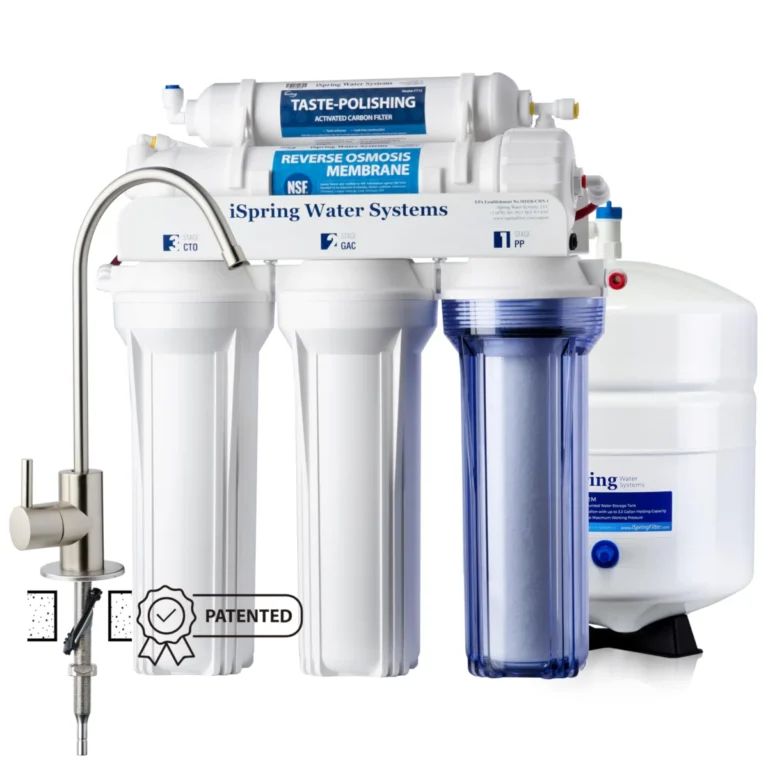
iSpring RCC7-BN
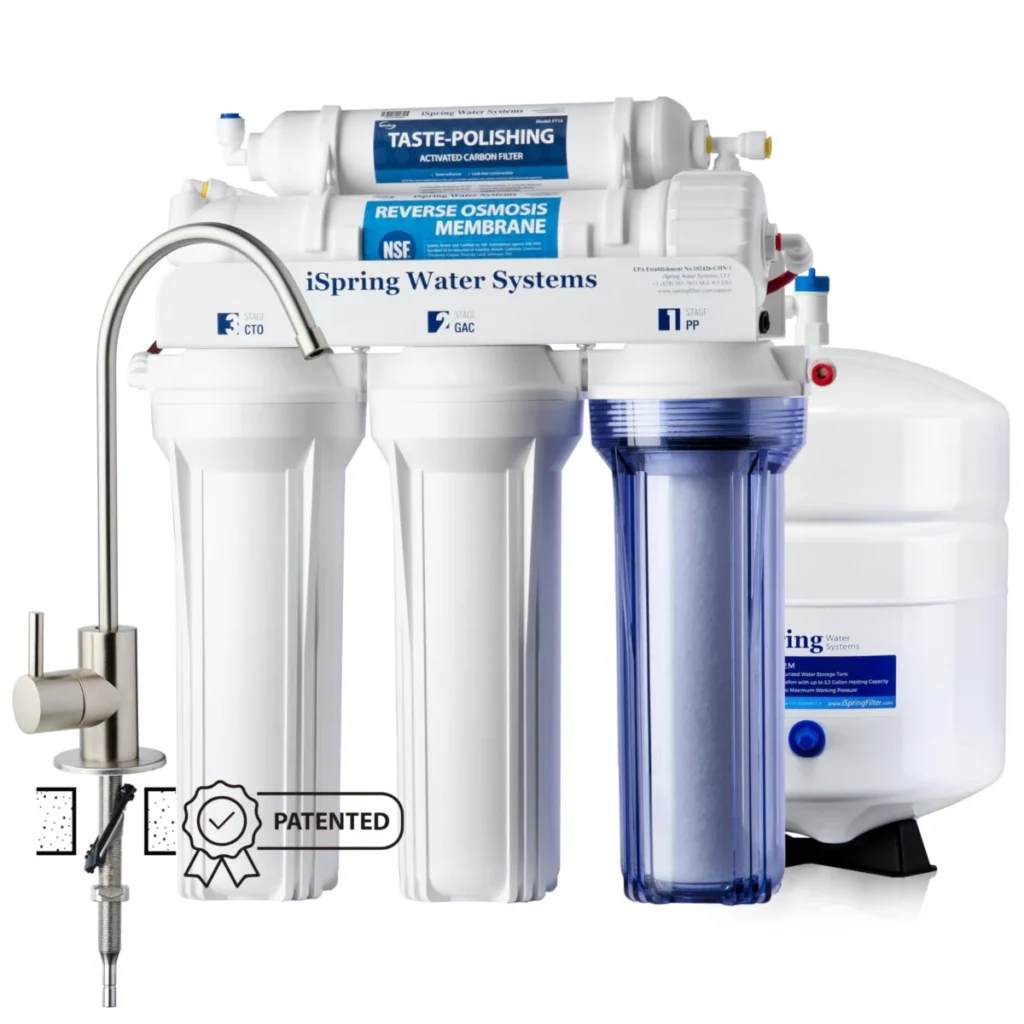
Choose the iSpring RCC7-BN if you want a higher 75 GPD flow rate and a clearly stated NSF/ANSI 58 certification, and you prefer a brushed nickel faucet.
iSpring RCC7-BLK
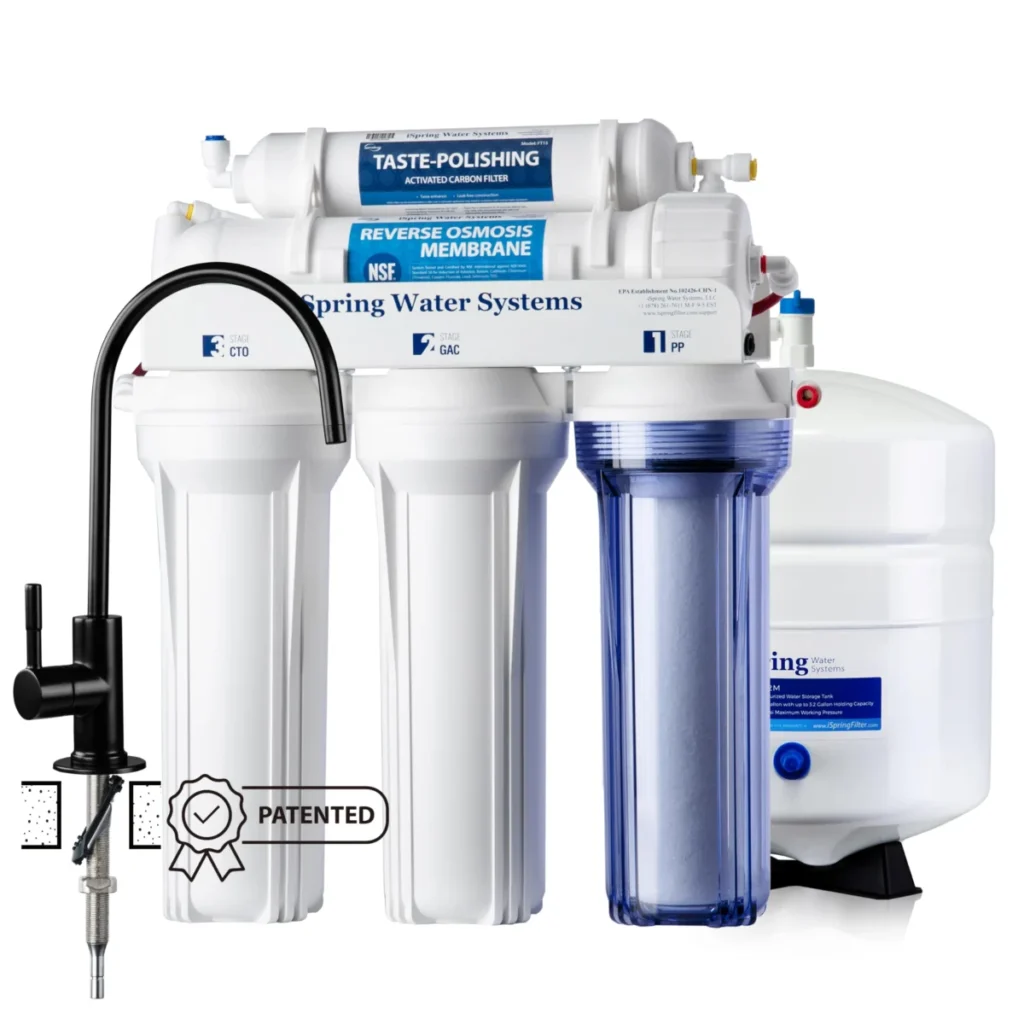
Choose the iSpring RCC7-BLK if you want the same 75 GPD performance and NSF/ANSI 58 certification but with a black faucet to match your kitchen decor, and you value a published 3.2 gallon tank capacity.
The Express Water RO5DX also appears in
Common questions
Frequently asked questions
How often do you change the filters on an Express Water RO5DX?
The manufacturer does not publish replacement intervals in the listing, but typical five-stage RO systems need pre-filter changes every 6 to 12 months, a post-filter annually, and a membrane every 2 to 3 years. Check the owner's manual or contact Express Water for the specific schedule.
Does the Express Water RO5DX remove fluoride?
Yes, the listing states that the system reduces fluoride. Reverse osmosis is effective at removing fluoride, but the exact percentage and certification standard are not specified. Review the performance data sheet to confirm the reduction rate for your water.
Is the Express Water RO5DX NSF certified?
The listing says it is NSF certified, but it does not state which standard (such as NSF/ANSI 58, 42, 53, or 372). NSF certification is a credible third-party verification, but you should confirm the specific standard and covered contaminants on the manufacturer's data sheet.
How much wastewater does a reverse osmosis system send to drain?
The RO5DX's wastewater ratio is not published. Most reverse osmosis systems send 2 to 4 gallons to drain for every gallon of treated water, though efficient models can be closer to 1:1. Without a stated ratio, you cannot estimate the extra water use precisely.
Do you need a plumber to install an under sink reverse osmosis system?
The listing recommends a plumber, but many homeowners with basic DIY skills can install it themselves. You will need to connect to the cold water line, install a drain saddle, and drill a faucet hole if one does not exist. If you are unsure, hiring a plumber is safer.
Does reverse osmosis water taste flat, and can you add minerals back?
Reverse osmosis removes most dissolved minerals, which can make water taste flat to some people. The RO5DX does not include a remineralization stage, so if you prefer mineral taste, you would need to add a separate remineralization filter or choose a system with that feature.
Bottom line
Should you buy the Express Water RO5DX?
The Express Water RO5DX is a capable five-stage reverse osmosis system for city-water households that want fluoride, lead, and PFAS reduction at the kitchen tap. Its 4 gallon tank and 50 GPD recovery suit couples or small families, and the included extra filters add value. However, the vague certification wording, unpublished replacement intervals, and modest flow rate mean it is not the best fit for everyone.
If you have a larger household, want a clearly stated NSF/ANSI 58 certification, or need a higher flow rate, consider the iSpring RCC7-BN or RCC7-BLK, both rated at 75 GPD. If you are on well water, test first and address bacteria before installing any RO system. For the right buyer, this under sink unit is a reasonable choice, but confirm the certification details and maintenance schedule before you buy.
Keep reading
Which APEC Reverse Osmosis System Fits Your Water? A Model-by-Model Look
See what an APEC reverse osmosis system reduces, how much under sink room the tank needs, and which households should choose a…

ISpring Water System Review: Who It Suits and Who Should Skip It
ISpring water system reviews explained: what the WGB32B's three stages reduce, its 15 GPM flow and 100,000-gallon filter life, and why it…

Best Reverse Osmosis Systems: 7 Picks Ranked by Waste Ratio, Filter Life and Cabinet Fit
The Home Master TMAFC-ERP Artesian is our top pick among 7 reverse osmosis systems, compared on certification, type and flow rate in,…