Waterdrop 10UA vs 15UA: Which Under Sink Filter Fits Your Kitchen and Budget
Published October 29, 2026
As an Amazon Associate we earn from qualifying purchases. This never changes which products we recommend.
The Waterdrop 10UA vs 15UA decision comes down to filter life and certification depth: the 10UA is rated for 11,000 gallons with NSF/ANSI 42 certification and a lower-cost replacement cartridge, while the 15UA's RF15 replacement filter is rated for 2 years or 19,000 gallons and carries NSF/ANSI 42, 53 and 372 certifications. Choose the 10UA if you want the cheaper cartridge and a shorter, simpler replacement cycle; choose the 15UA if you want the longer service interval and the broader certification set.
Both are under sink systems that connect to a cold water line and use a twist-and-lock cartridge that swaps in seconds without tools. Neither is a reverse osmosis system, so neither removes dissolved minerals or fluoride as a category; both are carbon block filters aimed at chlorine taste and odor, with lead and PFAS reduction named for the 10UA and for the RF15 cartridge that serves the 15UA.
Quick verdict
The Waterdrop 15UA uses the RF15 cartridge rated for 2 years or 19,000 gallons, certified to NSF/ANSI 42 and 372 and tested to NSF/ANSI 53 for lead.

Waterdrop 10ua
Cheaper cartridge, yearly change
Choose the Waterdrop 10UA if you want the lower cartridge price and a once-a-year change you can do yourself in seconds.
15UA
Longer life, broader certification
Choose the 15UA if you want to go up to two years between cartridge changes and want the NSF/ANSI 53 lead claim on the filter you install.
Key takeaways
- The 10UA is rated for 11,000 gallons or 12 months; the 15UA's RF15 cartridge is rated for 2 years or 19,000 gallons on municipal water.
- The 10UA carries NSF/ANSI 42 certification; the RF15 cartridge adds NSF/ANSI 372 and third-party testing to NSF/ANSI 53 for lead.
- Both are cold-water-only under sink units with twist-and-lock cartridges, so installation difficulty is similar.
Table of contents9 sections · tap to expand
What is Waterdrop 10ua?
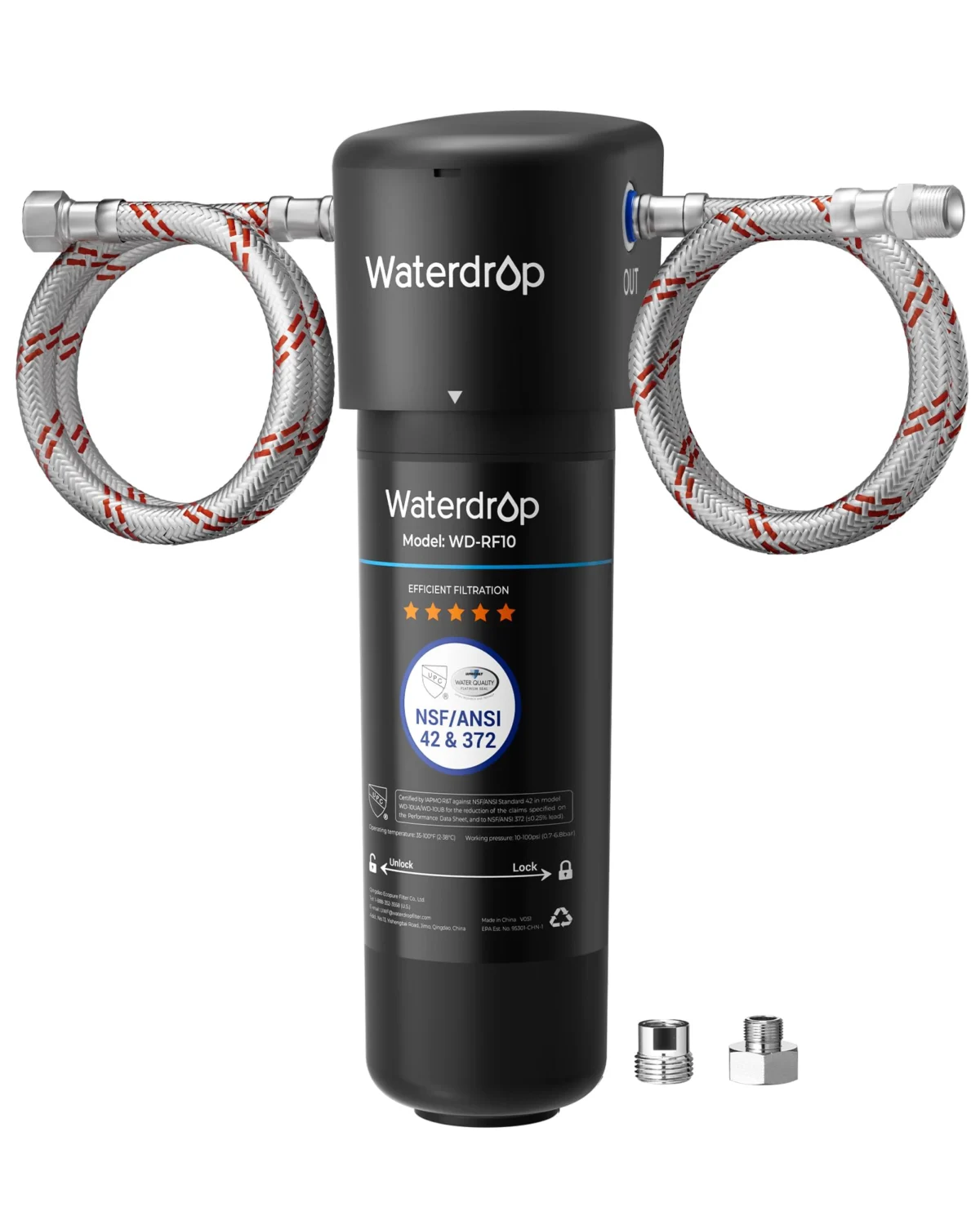
Waterdrop 10UA is an under sink carbon block water filter rated for 11,000 gallons or 12 months, NSF/ANSI 42 certified, and built around a twist-and-lock cartridge that swaps in seconds.
What is 15UA?
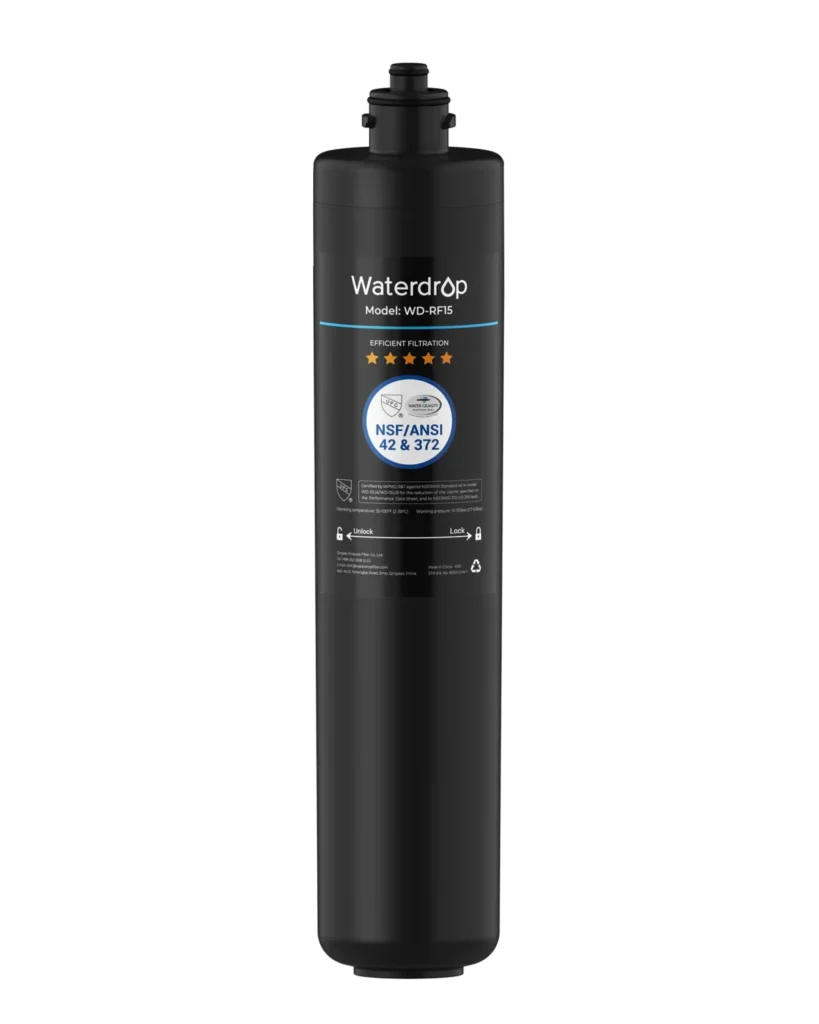
The Waterdrop 15UA is an under sink water filter that takes the RF15 replacement cartridge, rated for 2 years or 19,000 gallons on municipal water and certified to NSF/ANSI 42 and 372 with third-party testing to NSF/ANSI 53 for lead.
At a glance
Waterdrop 10ua vs 15UA at a glance
| Criterion | Waterdrop 10ua | 15UA |
|---|---|---|
| Type | Under sink carbon block filter | Under sink filter using RF15 cartridge |
| Rated filter life | 11,000 gallons or 12 months | 2 years or 19,000 gallons (municipal water) |
| Certifications | NSF/ANSI 42 | NSF/ANSI 42, NSF/ANSI 372; tested to NSF/ANSI 53 for lead |
| Contaminants named | Chlorine, lead, PFAS (PFOA/PFOS) | Chlorine, lead, PFAS, sediment, heavy metals |
| Replacement cartridge | RF15 | |
| Cartridge changes per year | About one | About one every two years |
| Installation | Cold water line, push-to-connect, 3-minute install | Cold water line, twist-and-lock, 3-second cartridge swap |
| Published unit dimensions | 3.9"L x 3.6"W x 12.3"H | Not stated in the listing reviewed |
| Power source | Mechanical water pressure | Mechanical water pressure |
| Best fit | Budget-focused, yearly maintenance | Long intervals, lead claim |
Key differences
6 key differences between Waterdrop 10ua and 15UA
1. Filter life and how often you actually change the cartridge
The 10UA is rated for 11,000 gallons or a maximum 12-month service life, while the RF15 cartridge used with the 15UA is rated for 2 years or 19,000 gallons on municipal water. For a household drinking a few gallons a day, that means the 10UA is an annual chore and the 15UA is roughly a biennial one.
The practical consequence is maintenance rhythm rather than daily performance: the 15UA asks less of you, but when the cartridge does come due it is the more expensive part. Neither rating is a promise about your water; heavy sediment or high chlorine load can shorten real-world life, so track taste and flow as well as the calendar.
2. Certifications: what each standard actually covers
The 10UA carries NSF/ANSI 42 certification, which covers aesthetic effects such as chlorine taste and odor. The RF15 cartridge for the 15UA is certified by IAPMO against NSF/ANSI 42 and NSF/ANSI 372 (lead-free materials) and tested by a third-party laboratory against NSF/ANSI 53, the health-effects standard that includes lead.
That difference matters if lead is your concern: NSF/ANSI 53 is the standard to look for, and the 15UA's cartridge states it while the 10UA listing names only NSF/ANSI 42. Note the wording distinction: the RF15 is certified to 42 and 372 but tested to 53, so read the manufacturer performance data sheet before relying on any lead claim.
3. Cartridge cost and cost per gallon
Spread across 11,000 gallons, that is a fraction of a cent per gallon, and it is the cheaper cartridge of the two.
The RF15 costs more per cartridge but covers 19,000 gallons, so the cost per gallon depends on the price you actually pay for each part. Do the arithmetic with current prices before deciding: a cheaper cartridge changed yearly can still beat a pricier one changed every two years, or lose to it, depending on the gap.
4. Flow rate, pressure and daily use
Both units run on mechanical water pressure with no pump or electricity, and both are carbon block designs, so flow depends on your home's line pressure and the condition of the cartridge. Neither listing states a GPM figure, so treat flow as comparable until you confirm it on the performance data sheet.
In daily terms, an under sink carbon filter at normal household pressure fills a glass in seconds, far faster than a pitcher. If flow drops noticeably, the usual cause is a spent or clogged cartridge, not the model choice.
5. Installation, connections and cabinet space
The 10UA uses push-to-connect fittings and a twist-and-lock cartridge, and Waterdrop describes a three-minute installation and three-second replacement. It ships with two hoses, a 3/8 inch to 1/2 inch converter set, screws and Teflon tape, and it must be fed from a cold water line only.
The 15UA's RF15 cartridge also uses twist-and-lock for tool-free changes, and the cartridge listing notes compatibility with three connection methods: your original faucet, a dedicated drinking water faucet, or a refrigerator line. The 10UA's published dimensions are 3.9 by 3.6 by 12.3 inches; the 15UA unit dimensions are not stated in the listing reviewed, so measure your cabinet and confirm before ordering.
6. Renters, owners and water source
Renters can use either model because both attach to the cold water line with removable fittings and need no permanent modification; the 10UA's lower cartridge price suits a shorter expected tenancy. Owners planning to stay put get more from the 15UA's two-year interval and its broader certification set.
On city water, both are aimed at chlorine taste and odor, and you should match the choice to your local water quality report. On private well water, neither is the right first purchase: test the well for bacteria, nitrate, iron and hardness, because a carbon block filter does not disinfect and does not soften.
Waterdrop 10ua: strengths and limitations
It suits buyers who want low cartridge cost and a simple annual change.
Strengths
- 11,000-gallon or 12-month rating covers a year of drinking water for most households
- Push-to-connect fittings and twist-and-lock cartridge make installation and swaps tool-free
- Published dimensions (3.9 by 3.6 by 12.3 inches) let you check cabinet fit before buying
Limitations
- Certification listed as NSF/ANSI 42 only, with no NSF/ANSI 53 lead claim stated
- Cartridge needs changing about once a year, twice as often as the RF15
Waterdrop 10UA Under Sink Filter
It is the budget-side option in this comparison.
15UA: strengths and limitations
It suits buyers who want long intervals and a lead-reduction claim on the installed filter.
Strengths
- Two-year or 19,000-gallon cartridge rating means fewer changes
- NSF/ANSI 42 and 372 certification plus third-party testing to NSF/ANSI 53 for lead
- RF15 cartridge works with original faucet, dedicated faucet or refrigerator connection
- Twist-and-lock design allows a three-second cartridge swap without tools
Limitations
- RF15 cartridge costs more per change than the WD-RF10
- Unit dimensions are not stated in the listing reviewed, so cabinet fit needs confirming
Waterdrop RF15 Replacement Filter
This listing is the RF15 cartridge that serves the 15UA, rated for 2 years or 19,000 gallons and certified to NSF/ANSI 42 and 372 with third-party testing to NSF/ANSI 53 for lead. It represents the 15UA side's longer interval and broader certification.
Decision guide
Which should you choose?
| If you… | Choose | Why |
|---|---|---|
| Renter who wants better tasting tap water without a permanent plumbing change | Either | Both connect to the cold water line with push-to-connect fittings and swap cartridges without tools, so either can be removed at move-out. |
| Household that wants the lowest cost per cartridge change | Waterdrop 10ua | |
| High-use kitchen that wants to change the cartridge as rarely as possible | 15UA | The RF15 is rated for 2 years or 19,000 gallons, roughly double the 10UA's 11,000-gallon rating. |
| Buyer who specifically wants an NSF/ANSI 53 lead claim on the installed filter | 15UA | The RF15 is tested to NSF/ANSI 53 for lead reduction; the 10UA lists NSF/ANSI 42 only. |
| Small under sink cabinet with limited room | Either | Both are compact inline units; check the 10UA's published 3.9 by 3.6 by 12.3 inch dimensions against your cabinet before ordering. |
| Private well water with bacteria, iron or nitrate concerns | Either | Neither is a disinfection or whole-house treatment system; test the well first and treat the specific problem. |
Choose Waterdrop 10ua if
- You want the lowest cartridge price and do not mind an annual change.
- You are renting and expect to move before a two-year cartridge interval pays off.
- Your main complaint is chlorine taste and odor, which NSF/ANSI 42 covers.
- You have a small cabinet and want published dimensions to check fit.
Choose 15UA if
- You want to change the cartridge as rarely as possible, up to two years.
- You specifically want an NSF/ANSI 53 lead-reduction claim on the filter you install.
- You want the option of feeding a dedicated drinking water faucet or a refrigerator line.
- You own your home and plan to keep the system in place long term.
See also: Waterdrop vs Brita: Pitcher Convenience or Plumbed Filtration?; Waterdrop Review: Who It Suits and Who Should Skip It.
Common questions
Frequently asked questions
What is the difference between the Waterdrop 10UA and 15UA?
The 10UA is rated for 11,000 gallons or 12 months and lists NSF/ANSI 42 certification, while the 15UA's RF15 cartridge is rated for 2 years or 19,000 gallons and adds NSF/ANSI 372 certification and third-party testing to NSF/ANSI 53 for lead. Cartridge price and change frequency follow from those ratings.
How often do you change the filter on a Waterdrop 10UA or 15UA?
Plan on about once a year for the 10UA, which is rated for 11,000 gallons or a maximum 12-month service life. The RF15 cartridge for the 15UA is rated for 2 years or 19,000 gallons on municipal water, though heavy sediment or chlorine load can shorten either interval.
Does the Waterdrop 10UA remove lead and PFAS?
Check the manufacturer performance data sheet and your local water quality report before relying on it for lead.
Is the Waterdrop 10UA or 15UA hard to install?
Neither is difficult: both connect to a cold water line and use twist-and-lock cartridges, and Waterdrop describes a three-minute installation for the 10UA with push-to-connect fittings. If you are not comfortable tapping a supply line, a plumber can fit either.
Will either filter work on well water?
A carbon block filter is not a well water treatment plan on its own, because it does not disinfect or remove hardness. Test the well with a certified lab for bacteria, nitrate, iron and hardness first, then choose treatment for what the results show.
Is an under sink Waterdrop worth it compared with a pitcher filter?
An under sink unit delivers filtered water straight from the tap at normal household flow, while a pitcher needs refilling and dispenses slowly. The tradeoff is installation: the 10UA and 15UA both need a cold water line connection, which a pitcher does not.
Bottom line
The verdict
Choose the Waterdrop 10UA when the cartridge price and a simple annual change matter more than certification depth, and when chlorine taste and odor is the main thing you want to fix.
If your water report flags lead or PFAS specifically, read the manufacturer performance data sheet for whichever model you pick and confirm the reduction claim before buying. If you are on a private well, test first: neither model is a substitute for treatment matched to your lab results.