Waterdrop vs ZeroWater: Matching the Right System to Your Water
Published October 29, 2026
As an Amazon Associate we earn from qualifying purchases. This never changes which products we recommend.
Choose Waterdrop if you want a plumbed-in reverse osmosis system that reduces fluoride, lead and PFAS and produces up to 600 gallons per day with a 2:1 wastewater ratio. Choose ZeroWater if you need a no-install countertop pitcher that removes dissolved solids and suits renters or small households. The single deciding tradeoff is installation and flow versus simplicity and portability.
This Waterdrop vs ZeroWater comparison looks at the exact models available: the Waterdrop G3P600 tankless reverse osmosis system and a ZeroWater five-stage pitcher filter. It covers what each reduces, how it is certified, what it costs to run and who each one suits.
Quick verdict
Waterdrop G3P600 is a tankless under sink reverse osmosis system rated at 600 GPD with NSF/ANSI 58 certification for TDS reduction. ZeroWater is a countertop pitcher that uses a five-stage ion exchange filter to remove dissolved solids and needs no installation.
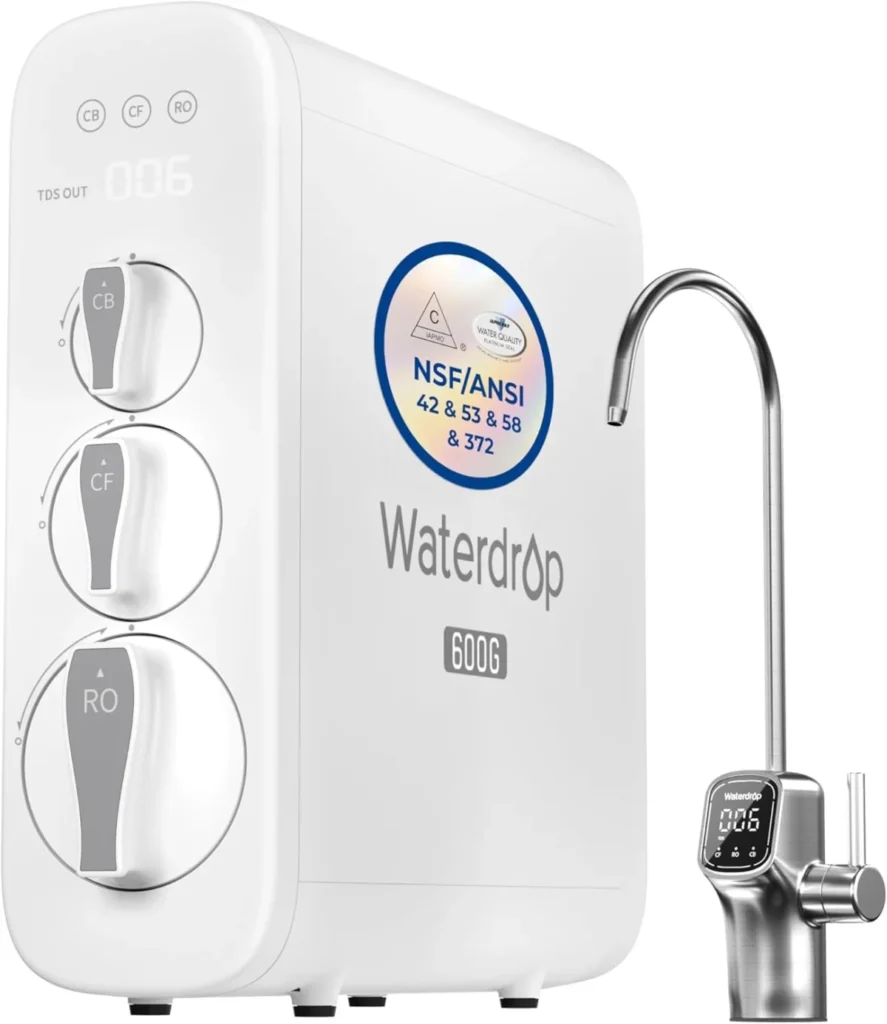
Waterdrop
plumbed in, fast, thorough
Choose Waterdrop if you want a high-capacity under sink system that reduces fluoride, lead and PFAS and can supply several taps.
ZeroWater
no install, slow, portable
Choose ZeroWater if you rent, have limited space or want a portable pitcher that removes dissolved solids without plumbing.
Key takeaways
- Waterdrop G3P600 is a tankless reverse osmosis system that reduces fluoride, lead and PFAS and is certified to NSF/ANSI 58 for TDS reduction, while ZeroWater is a pitcher that removes TDS via ion exchange but lacks stated certification for those specific contaminants.
- ZeroWater needs no installation and suits renters, while Waterdrop requires a cold water line and under sink space but delivers up to 600 gallons per day.
- Waterdrop produces wastewater at a 2:1 ratio and may need remineralization for taste, whereas ZeroWater produces no wastewater but has a slower flow rate and smaller capacity.
- Ongoing costs differ: Waterdrop's filter life is rated at 600 gallons, while ZeroWater's filter life is not specified in the available evidence, so annual cost comparison requires checking current cartridge prices.
Table of contents9 sections · tap to expand
What is Waterdrop?
Waterdrop is a brand of water filtration systems that includes under sink reverse osmosis units like the G3P600, which uses an 8-stage process with a reverse osmosis membrane to reduce dissolved solids and other contaminants.
What is ZeroWater?
ZeroWater is a brand of countertop water pitchers that use a five-stage ion exchange filter to remove total dissolved solids (TDS) and improve taste without any installation.
At a glance
Waterdrop vs ZeroWater at a glance
| Criterion | Waterdrop | ZeroWater |
|---|---|---|
| Contaminants reduced | Chlorine, lead, PFAS, fluoride, arsenic, sediment, iron (as listed) | Total dissolved solids (TDS) and associated taste and odor |
| Certifications | NSF/ANSI 42, 58, 372 | Not specified in available evidence |
| Filter type and installation | Under sink reverse osmosis, requires cold water line and cabinet space | Countertop pitcher, no installation |
| Filter life | 600 gallons | Not specified in available evidence |
| Flow rate | 600 GPD | Pitcher speed, typically slow (not rated in GPD) |
| Wastewater | 2:1 ratio (1 cup waste per 2 cups filtered) | None |
| Footprint | Under sink, 18.12"L x 5.67"W x 17.72"H | Countertop, space for pitcher |
| Renter suitability | Low (requires plumbing) | High (no installation) |
| Well water suitability | Good for dissolved contaminants if tested | Limited to TDS reduction, not for bacteria or viruses |
Key differences
7 key differences between Waterdrop and ZeroWater
1. What each one filters and how it is certified
Waterdrop G3P600 is certified to NSF/ANSI 58 for TDS reduction and NSF/ANSI 372 for lead-free materials, and it has been tested and certified to NSF/ANSI 42 for chlorine reduction. The system also lists reduction of lead, PFAS, fluoride, arsenic and sediment, though these specific claims are not all backed by the named certifications. ZeroWater's five-stage filter removes total dissolved solids, but the published specifications do not specify which certifications it holds.
For readers who need verified contaminant reduction, Waterdrop's NSF/ANSI 58 certification provides third-party assurance for TDS reduction, and its NSF/ANSI 42 certification covers chlorine taste and odor. ZeroWater's lack of stated certifications means you should check the manufacturer's performance data sheet for specific contaminant claims. Neither system is certified for bacteria or viruses, so well water should be tested and, if needed, disinfected separately.
2. Installation and space: under sink versus countertop
Waterdrop G3P600 is an under sink reverse osmosis system that requires a cold water line connection and cabinet space measuring at least 18.12"L x 5.67"W x 17.72"H. Installation typically requires basic plumbing skills or a professional, and the tankless design saves 70% under sink space compared with tank-based systems. ZeroWater is a countertop pitcher that needs no installation and can be moved easily.
Renters or those unable to modify plumbing will find ZeroWater far easier to adopt, while homeowners with under sink space can benefit from Waterdrop's higher flow and continuous supply. The Waterdrop system also includes a smart display faucet that shows TDS and filter life, which adds convenience but requires mounting the faucet.
3. Filter life and replacement cadence
Waterdrop G3P600 has a rated filter life of 600 gallons, which for a typical household using 2 gallons per day would last about 10 months. The system uses multiple filter stages, and replacement intervals may vary by stage; the published specification lists 600 gallons as the overall capacity. ZeroWater's filter life is not specified in the available evidence, but the brand generally recommends replacement when the TDS meter reads above a certain level or when flow slows.
Because ZeroWater's filter life is not stated, you cannot directly compare replacement frequency from the available data. Waterdrop's 600-gallon rating provides a clear baseline for estimating annual cartridge needs, while ZeroWater users should monitor the included TDS meter and follow the manufacturer's guidance.
4. Ongoing cost per year and per gallon
Waterdrop G3P600's filter life of 600 gallons allows you to calculate cost per gallon once you know the replacement filter price. The system uses three pre-installed filters, and replacement costs will depend on how many stages need changing and how often. ZeroWater's filter life is not specified, so annual cost is harder to estimate without the manufacturer's recommended replacement interval.
To compare running costs, divide the price of replacement cartridges by the rated gallons for Waterdrop, and for ZeroWater, estimate based on your household's daily consumption and the TDS meter readings. Neither system's cartridge prices are included here, so check current retail prices. Over a year, a high-volume household may find Waterdrop's per-gallon cost lower if the 600-gallon rating holds, while a low-volume user might spend less on ZeroWater filters.
5. Flow rate, convenience and wastewater
Waterdrop G3P600 produces up to 600 gallons per day, which is enough to fill a glass quickly and supply multiple taps simultaneously. It operates on a 2:1 wastewater ratio, meaning it sends one cup of waste water for every two cups of filtered water, which is relatively efficient for reverse osmosis. ZeroWater is a pitcher that filters water slowly by gravity and requires refilling, so it is less convenient for high-volume use.
The tankless design of Waterdrop means no storage tank to refill, but it requires a consistent water supply and electricity. ZeroWater produces no wastewater and needs no power, making it simpler and more portable. For large families or those who want instant filtered water at the tap, Waterdrop's flow rate is a significant advantage.
6. Taste, remineralization and total dissolved solids
Waterdrop G3P600 uses reverse osmosis, which removes dissolved solids and can leave water tasting flat; some users add a remineralization stage, but this model's specifications do not mention one. ZeroWater removes TDS via ion exchange, which also strips minerals and can affect taste. Both systems reduce chlorine and improve taste compared with untreated tap water, but neither adds minerals back.
ZeroWater's TDS meter helps you monitor when the filter is exhausted, but it does not restore minerals. For most people, the taste difference is minor, but those sensitive to flat-tasting water should consider remineralization.
7. City water versus well water suitability
For city water, both systems can reduce chlorine and improve taste, but Waterdrop's reverse osmosis also addresses lead, fluoride and PFAS if present. ZeroWater's TDS reduction may help with overall taste but does not specifically target those contaminants. Check your local water quality report (Consumer Confidence Report) to know what is in your water.
For private well water, the EPA recommends testing for bacteria, nitrates, iron, hardness and pH before choosing a filter. Waterdrop's reverse osmosis can reduce many dissolved contaminants, but it does not disinfect, so bacteria require a separate UV or chemical treatment. ZeroWater is not designed for well water with high sediment or bacteria and should be used only after testing confirms it is appropriate.
Waterdrop: strengths and limitations
Waterdrop G3P600 is a tankless under sink reverse osmosis system that reduces a wide range of contaminants including fluoride, lead and PFAS, and is certified to NSF/ANSI 58 for TDS reduction. It offers high capacity and a smart display faucet but requires plumbing and produces wastewater.
Strengths
- Certified to NSF/ANSI 58 for TDS reduction and NSF/ANSI 42 for chlorine reduction
- Reduces fluoride, lead, PFAS and arsenic as listed
- High flow rate of 600 GPD and tankless design saves under sink space
- Smart display faucet shows TDS and filter life
Limitations
- Requires cold water line and under sink space, not suitable for renters without permission
- Produces wastewater at a 2:1 ratio
- May require remineralization for taste
Waterdrop G3P600 Tankless RO System
This tankless reverse osmosis system is certified to NSF/ANSI 58 for TDS reduction and NSF/ANSI 42 for chlorine reduction, and it lists fluoride, lead and PFAS reduction. It produces 600 gallons per day and includes a smart display faucet.
ZeroWater: strengths and limitations
It is portable and renter-friendly but has a slower flow rate and its certification and filter life are not specified in the available evidence.
Strengths
- No installation required, suitable for renters and small spaces
- Removes total dissolved solids (TDS)
- Portable and can be used anywhere
- Produces no wastewater
Limitations
- Filter life and certifications not specified in available evidence
- Slow flow rate and limited capacity
- Does not specifically target lead, PFAS or fluoride as far as the published specifications show
ZeroWater 5-Stage Pitcher Filter
This countertop pitcher uses a five-stage ion exchange filter to remove total dissolved solids and improve taste without installation. It is portable and suitable for renters, though its filter life and certifications are not specified in the available evidence.
Decision guide
Which should you choose?
| If you… | Choose | Why |
|---|---|---|
| Renter with city water and no under sink space | ZeroWater | ZeroWater sits on the counter and needs no plumbing, so you can take it with you when you move. |
| Family worried about lead in an older building's pipes | Waterdrop | Waterdrop G3P600 is certified to NSF/ANSI 58 for TDS reduction and lists lead among the contaminants it reduces, while ZeroWater's certification for lead is not stated in the available evidence. |
| Household on chlorinated city water that dislikes taste and smell | Either | Both systems use activated carbon to reduce chlorine taste and odor, but Waterdrop adds reverse osmosis for dissolved solids. |
| Someone who wants fluoride and dissolved solids reduced | Waterdrop | Waterdrop G3P600 uses a reverse osmosis membrane and lists fluoride and TDS reduction, while ZeroWater removes TDS but its fluoride reduction is not specified in the available evidence. |
| Camper or dorm resident who needs a countertop option | ZeroWater | ZeroWater requires no installation and can be used anywhere with a water source, while Waterdrop needs a cold water line and cabinet space. |
| Well owner deciding between a pitcher and an under sink system | Either | The right choice depends on a lab test: if TDS and dissolved contaminants are high, Waterdrop's reverse osmosis is more thorough; if only taste and sediment are issues, ZeroWater may suffice. |
Choose Waterdrop if
- You own your home and can install an under sink system with a cold water line.
- You want verified reduction of fluoride, lead and PFAS and need a high flow rate for a family.
- You have space under the sink and prefer a tankless design that saves space.
- You want a system with NSF/ANSI 58 certification for TDS reduction.
Choose ZeroWater if
- You rent and cannot modify plumbing or install under sink equipment.
- You have a small household or limited counter space and need a portable solution.
- You want to remove total dissolved solids without any installation or wastewater.
- You are looking for a low upfront cost option and can monitor filter life with a TDS meter.
See also: ZeroWater vs Pur: What Each Filter Is Certified to Remove and What a Year of Cartridges Costs.
Common questions
Frequently asked questions
Is Waterdrop or ZeroWater better for removing lead?
Waterdrop G3P600 lists lead reduction and is certified to NSF/ANSI 58 for TDS reduction, which supports its overall performance. ZeroWater's available evidence does not specify lead reduction or certification, so check its performance data sheet. For lead, choose Waterdrop if you need verified reduction.
Does ZeroWater remove fluoride and does Waterdrop?
Waterdrop G3P600 lists fluoride reduction as part of its 8-stage filtration. ZeroWater's available evidence does not state fluoride reduction, so it is not confirmed. If fluoride removal is important, Waterdrop's reverse osmosis is the more appropriate choice.
How often do you change a ZeroWater filter compared with a Waterdrop cartridge?
Waterdrop G3P600 has a rated filter life of 600 gallons, which for a typical household lasts about 10 months.
Which is cheaper to run over a year, ZeroWater or a Waterdrop system?
Running cost depends on cartridge prices and your daily water use. Waterdrop's 600-gallon rating allows a per-gallon calculation once you know filter prices. ZeroWater's filter life is not specified, so annual cost is harder to estimate. Compare current prices and your consumption to decide.
Can I use a Waterdrop or ZeroWater filter with well water?
Both can be used with well water, but you should test first for bacteria, nitrates, iron and hardness. Waterdrop's reverse osmosis reduces many dissolved contaminants but does not disinfect. ZeroWater removes TDS but is not designed for bacteria or high sediment. Follow local guidance for well water treatment.
Do I need a plumber to install a Waterdrop under sink or reverse osmosis system?
Waterdrop G3P600 requires a cold water line connection and under sink space, which typically involves basic plumbing. Some homeowners can install it themselves, but a plumber may be needed if you are unsure. ZeroWater requires no installation at all.
Bottom line
The verdict
Waterdrop G3P600 is the more thorough choice if you want verified reduction of fluoride, lead and PFAS, need a high flow rate and can install an under sink system. ZeroWater is the practical choice for renters, small households or anyone who wants a portable pitcher that removes dissolved solids without plumbing.
Neither system is universally better; your water source, space and contaminant concerns should guide the decision. Test your water, check certifications and consider ongoing costs before choosing.