British Berkefeld vs Berkey: Ceramic Candles or Carbon Blocks?
Published October 29, 2026
As an Amazon Associate we earn from qualifying purchases. This never changes which products we recommend.
Choose British Berkefeld when you want a ceramic candle element with a stated lead and heavy metal claim and a shorter, cheaper replacement cycle, and when you want a brand that is widely stocked and supported outside the US. Choose Berkey when you want a large stainless steel reservoir, a very long rated element life and the option to expand to four elements, and when you have confirmed that the system and spare parts are legally available in your country.
The single deciding tradeoff is element philosophy: a cleanable ceramic candle you replace roughly twice a year versus a proprietary carbon-based element rated for thousands of gallons.
The British Berkefeld vs Berkey question matters most for households that cannot plumb in an under sink filter or reverse osmosis system: renters, well owners who want a no-electricity backup, and families storing water for outages. Both are gravity dispensers that need no plumbing and no power.
Neither is a fluoride, PFAS or lead solution unless a specific element states that reduction, and neither replaces a lab test on a private well. What follows compares the two listings side by side on the criteria that change the purchase.
Quick verdict
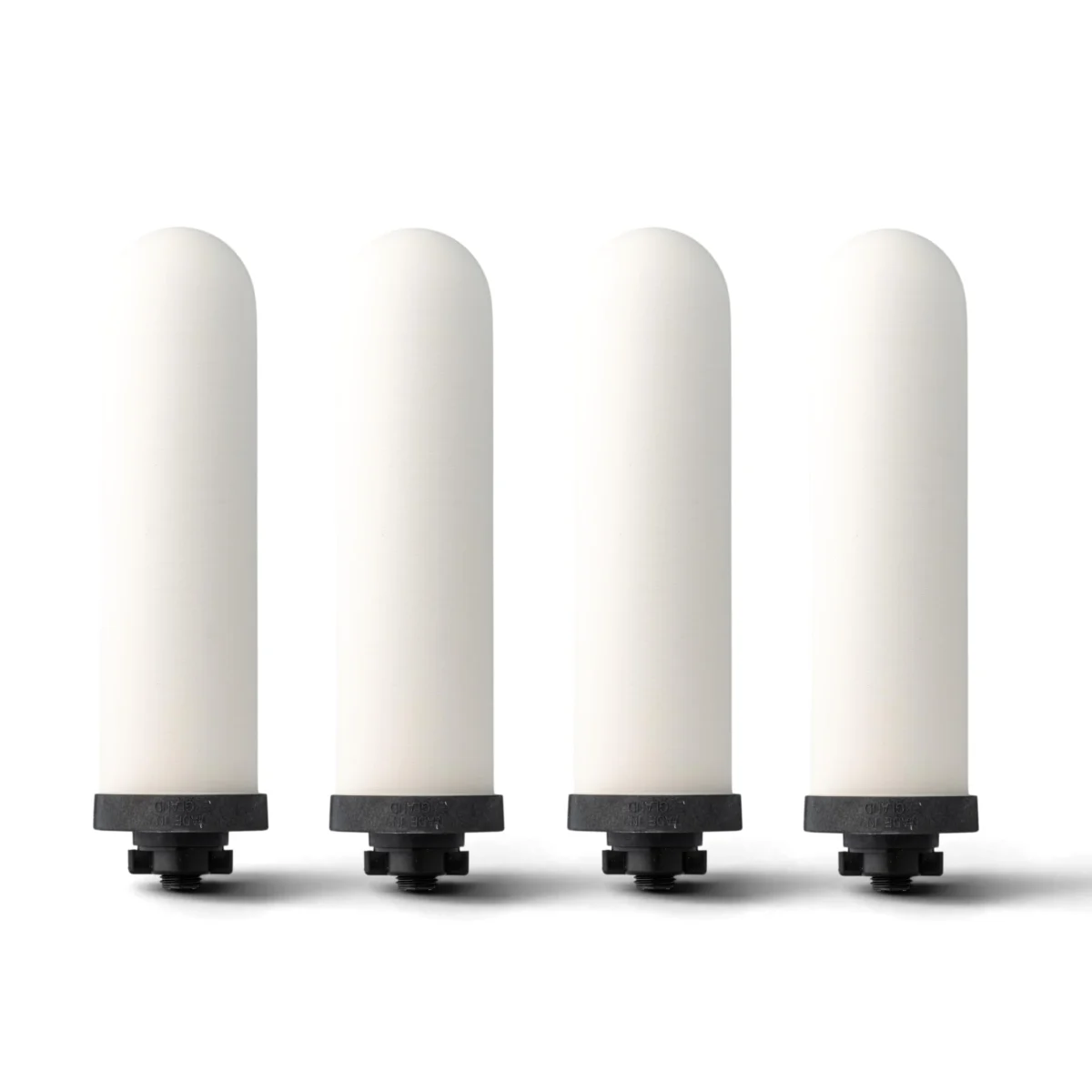
British Berkefeld is represented here by a four-pack of 7 inch Ultra Sterasyl ceramic candles rated for six months of use, and Berkey by the Royal Berkey 3.25 gallon stainless steel system with two Black Berkey BB9-2 elements rated for 6,000 gallons per pair. The choice turns on whether you want a cleanable ceramic candle with a stated lead claim and frequent, inexpensive swaps, or a larger reservoir with a very long element life and expandable capacity.
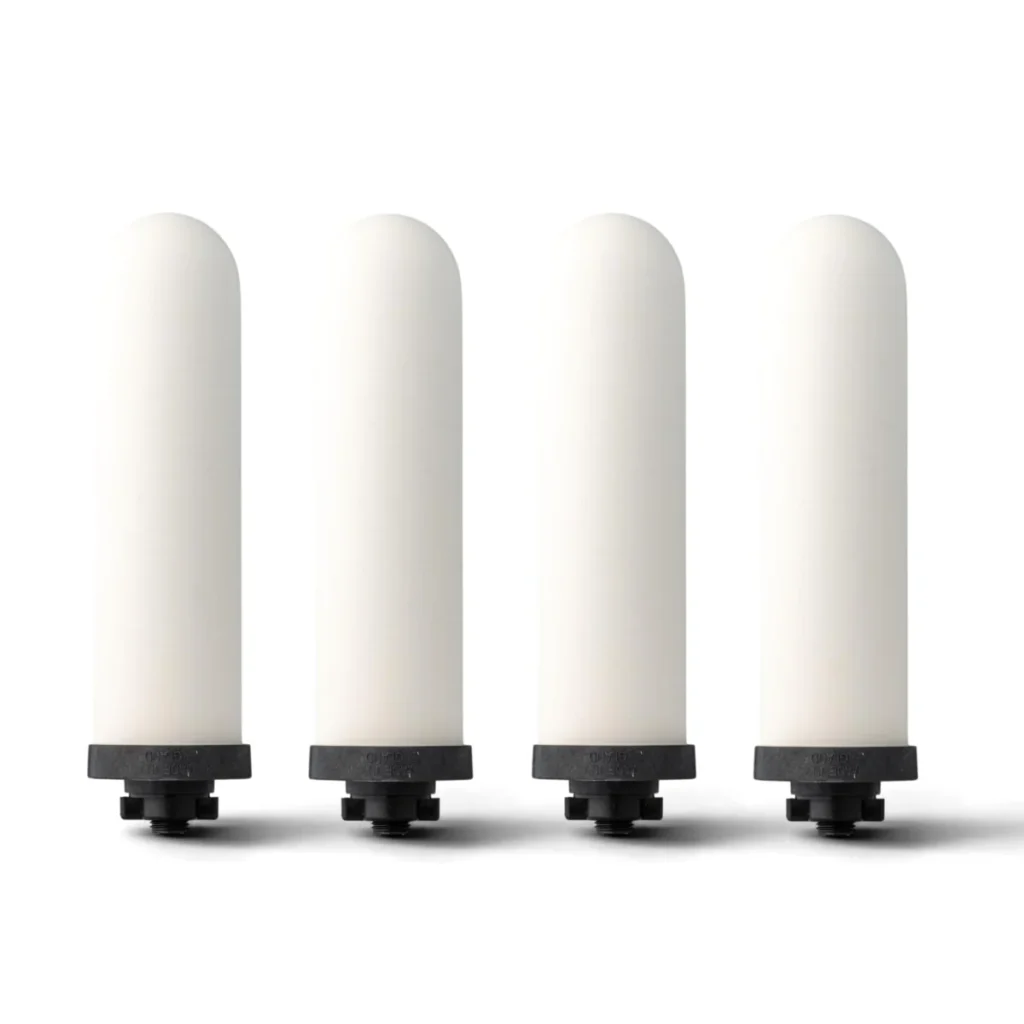
British Berkefeld
ceramic candles, frequent swaps
Choose British Berkefeld if you want ceramic candle filtration with a stated lead and heavy metal claim, a six-month replacement rhythm and a brand that is broadly stocked and supported outside the US.
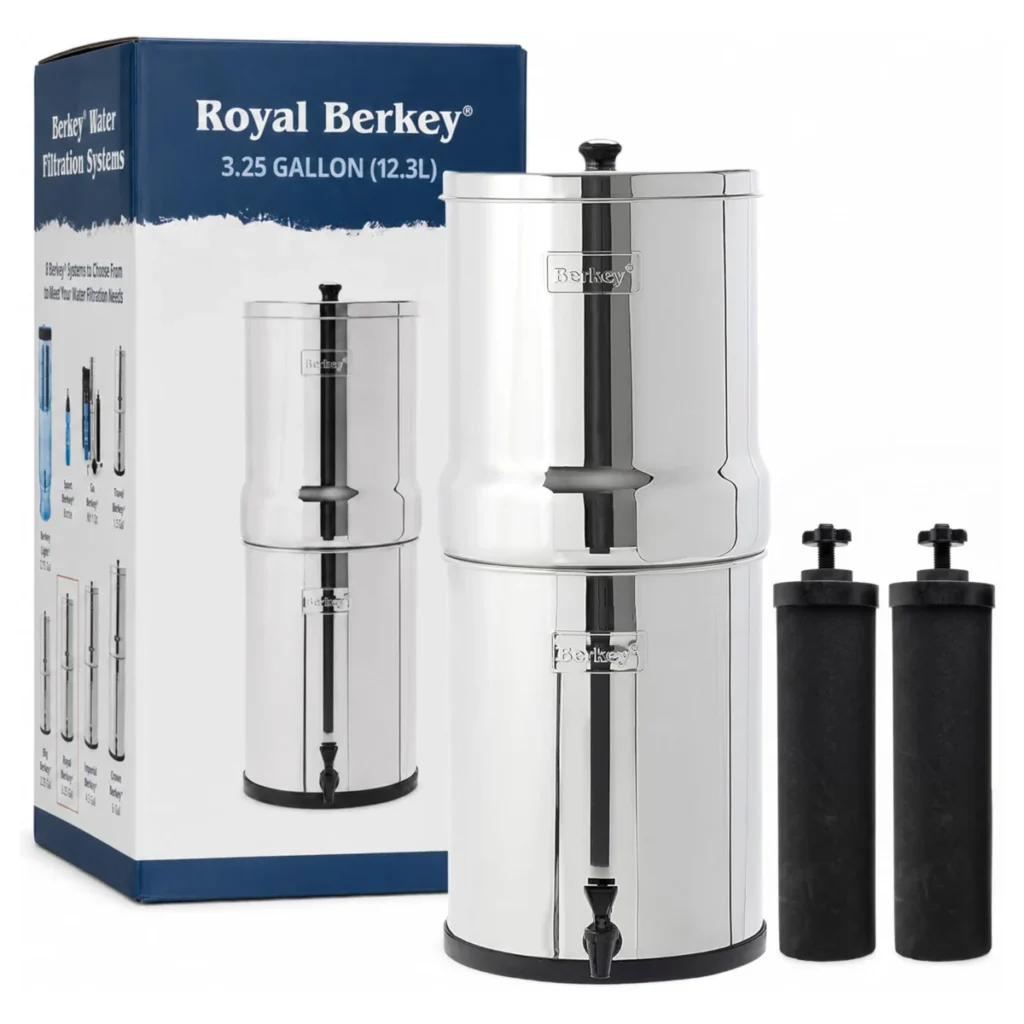
Berkey
big reservoir, long element life
Key takeaways
- British Berkefeld uses ceramic candles rated for six months and sold in a four-pack, so replacement is frequent but each change is inexpensive.
- The British Berkefeld listing states lead and heavy metal reduction and carries an NSF certification reference; Berkey's element is described as independently tested by third parties rather than certified to a named NSF/ANSI standard.
- Neither system is a fluoride, PFAS or reverse osmosis substitute, and Berkey's US regulatory status means buyers should confirm availability and spare parts before ordering.
Table of contents9 sections · tap to expand
What is British Berkefeld?
British Berkefeld is a gravity-fed countertop filter brand whose Ultra Sterasyl elements are ceramic candles made from diatomaceous earth ceramic, cleanable on the outside and rated for about six months of use.
What is Berkey?
Berkey is a gravity-fed stainless steel dispenser brand built around its proprietary Black Berkey element, a multi-media carbon block rated for thousands of gallons per pair and expandable to four elements per system.
At a glance
British Berkefeld vs Berkey at a glance
| Criterion | British Berkefeld | Berkey |
|---|---|---|
| Filter element type | Diatomaceous earth ceramic candle (Ultra Sterasyl), cleanable outer shell | Proprietary multi-media carbon block (Black Berkey BB9-2) |
| Stated reductions | Chlorine, lead, cysts, bacteria, sediment, bad taste and odor | Listing states 250+ contaminant types; no individual contaminants named |
| Certification wording | NSF certification referenced on the listing | Independently tested by accredited third parties; no NSF/ANSI standard named |
| System capacity | Candle sold for countertop gravity systems; capacity set by the housing | |
| Element count supported | Four candles in this pack | Two included, expandable to four |
| Rated element life | 6 months | 6,000 gallons per pair |
| Replacement rhythm | Twice a year per candle set | Years for most households at typical daily use |
| Build | Ceramic candle elements; housing sold separately | Polished AISI 304 stainless steel body, standard spigot included |
| Availability and support | Widely distributed water-treatment brand with spare candles | US regulatory status means buyers should verify legal sale and parts |
| Water source fit | City water and tested well water; cleanable shell suits sediment-heavy supplies | City water and tested well water; large reservoir suits stored-water use |
Key differences
7 key differences between British Berkefeld and Berkey
1. Ceramic candle versus carbon block: what changes in use
The core difference is the element. British Berkefeld's Ultra Sterasyl is a ceramic candle made from diatomaceous earth ceramic, and its outer shell can be scrubbed with a brush or scouring pad to restore flow between changes. Berkey's Black Berkey element is a proprietary blend of multiple media in a carbon block form, and it is not designed to be scrubbed back to life the same way.
That changes daily ownership. A ceramic candle in a sediment-heavy supply clogs visibly and can be cleaned, which stretches the interval before you actually replace it, but the manufacturer still recommends a change every six months. A carbon block element is rated by volume, 6,000 gallons per pair here, so the change is rare but the element is not user-serviceable in the same sense. Neither design removes dissolved fluoride or PFAS on its own.
2. Certifications versus self-tested claims
The two listings describe their testing differently, and the wording matters. The British Berkefeld candle carries an NSF certification reference and the description states added lead and heavy metal removal capability. The Royal Berkey listing says its elements are independently tested by accredited third-party laboratories and claims reduction of 250+ contaminant types, without naming an NSF/ANSI standard.
For a buyer, that means the British Berkefeld claim is easier to check against a named certification, while the Berkey claim is broader and needs the manufacturer's performance data sheet to interpret. NSF/ANSI 42 covers aesthetic effects such as chlorine taste and odor, NSF/ANSI 53 covers health effects such as lead and cysts, NSF/ANSI 58 covers reverse osmosis, NSF/ANSI 401 covers some emerging contaminants and NSF/ANSI 372 covers lead-free materials.
Ask which of these, if any, a specific element is certified to before you rely on a reduction claim.
3. Capacity, household size and refill effort
Capacity is where the two sides are least comparable, because one listing is an element pack and the other is a complete system. The Royal Berkey holds 3.25 gallons in its stainless steel upper and lower chambers and ships with two elements, with room for four. A 3.25 gallon reservoir covers a small household's drinking and cooking water for a day, and adding elements speeds the draw-off rather than increasing stored volume.
The British Berkefeld candles are sized for countertop gravity housings, and the usable capacity depends entirely on which housing you pair them with. A two-candle housing holds less than a four-candle housing, and a four-pack of candles lets you run a larger housing or keep a spare set on hand. If capacity is your main concern, choose the housing first and then match the candle count to it.
4. Element life and the real yearly replacement math
Running cost is driven by rated life and pack size, and the two sides sit at opposite ends. British Berkefeld rates its candles for six months, so a household running a four-candle housing buys a four-pack roughly twice a year. Berkey rates a pair of Black Berkey elements for 6,000 gallons, which for a household drawing two to three gallons a day is measured in years rather than months.
The catch is that the Berkey figure is per pair, and a four-element system divides that life across two pairs. The British Berkefeld figure is per candle set regardless of how many candles the housing takes. Compare cost per gallon rather than sticker price: a cheap element changed twice a year can cost more over five years than an expensive element changed once, and the reverse is also true if your daily draw is high.
5. Build, spigot and what comes in the box
The Royal Berkey is a finished appliance: polished AISI 304 stainless steel chambers, a standard spigot included, and a freestanding countertop footprint of roughly 9.5 inches by 9.5 inches by 23 inches. The British Berkefeld listing is the filtration element only, so the stainless steel body, lid, spigot and stand come from whichever gravity housing you already own or buy separately.
That difference decides how much of a project this is. Buying Berkey means one order delivers a working dispenser. Buying British Berkefeld candles means checking that your housing takes 7 inch short-mount candles and that your existing spigot and lid are sound, which suits someone replacing elements in a system they already trust rather than starting from scratch.
6. Availability and spare parts where you live
Availability is not symmetrical, and it is the factor most likely to override the specification comparison. Berkey's US regulatory status has been contested, so a US buyer should confirm before ordering that the system and genuine Black Berkey elements can legally be sold and shipped to them, and should ask the seller in writing what support applies to spare parts. British Berkefeld and Doulton elements are distributed through established water-treatment channels in many countries, which makes replacement candles easier to source.
For either brand, verify three things before you pay: that the seller is authorized, that the terms of sale are honored in your country, and that replacement elements will be available for the life of the system. A gravity filter is a long-term purchase, and an element you cannot replace turns a stainless steel dispenser into a storage bucket.
7. City water, well water and what neither filter does
Both systems suit treated city water and both can be used on a private well, but neither should be chosen before the water is characterized. City water is tested and reported in the annual Consumer Confidence Report, so you can match the element to the contaminants actually listed. Private well water is not regulated, and the EPA and CDC advise testing for bacteria, nitrates, iron, hardness and pH before selecting treatment.
Neither gravity filter is a fluoride, PFAS or arsenic solution unless a specific element states that reduction, and neither is a reverse osmosis system. Reverse osmosis is the technology that removes dissolved fluoride and many dissolved contaminants, at the cost of plumbing, wastewater and slower output. If a lab test shows high fluoride, arsenic or PFAS, choose reverse osmosis or a certified under sink filter instead of either gravity dispenser.
British Berkefeld: strengths and limitations
British Berkefeld's Ultra Sterasyl ceramic candle is a cleanable diatomaceous earth element rated for six months and sold in a four-pack, with a stated lead and heavy metal claim and an NSF certification reference. It suits buyers who already own a compatible gravity housing and want a short, inexpensive replacement cycle.
Strengths
- Ceramic candle can be scrubbed clean to restore flow between changes
- Stated lead and heavy metal reduction plus chlorine, cysts, bacteria and sediment
- Six-month rating and four-pack sizing make the replacement rhythm predictable
- Broad distribution through water-treatment channels aids spare-part sourcing
Limitations
- Element only: no stainless steel body, lid, spigot or stand included
- Six-month life means more frequent changes than a long-life carbon block
- No stated fluoride or PFAS reduction
British Berkefeld Ultra Sterasyl 4-Pack
Four 7 inch short-mount ceramic candles rated for six months, with a stated lead and heavy metal claim and an NSF certification reference. This is the element side of the comparison, so the housing, lid and spigot come from your existing gravity system.
Berkey: strengths and limitations
It suits buyers who want one order, a large reservoir and a long gap between element changes.
Strengths
- Complete system with chambers, two elements and a standard spigot in one purchase
- 3.25 gallon capacity and expandability to four elements
- 6,000 gallon rated life per element pair
- Polished AISI 304 stainless steel construction
Limitations
- Element testing is described as third-party independent testing rather than a named NSF/ANSI certification
- US regulatory status means buyers must verify legal availability and spare parts
- No individual contaminants named beyond a 250+ types claim
Royal Berkey 3.25 Gal System
It delivers a working system in one order, subject to confirming availability and parts support in your country.
Decision guide
Which should you choose?
| If you… | Choose | Why |
|---|---|---|
| Renter in an apartment who cannot plumb in an under sink or reverse osmosis system | Either | Both are freestanding gravity dispensers that need no plumbing, no electricity and no permanent change. |
| Household on a private well that wants a no-electricity backup and has not yet tested the water | Either | Both work without power, but a lab test for bacteria, nitrates, iron and hardness should come before any element choice. |
| Family storing drinking water for outages or boil-water notices | Berkey | The Royal Berkey holds 3.25 gallons in one stainless steel body and can take up to four elements for faster refill turnaround. |
| City-water drinker mainly bothered by chlorine taste who wants cheap, frequent element changes | British Berkefeld | The Ultra Sterasyl candle is rated for six months and sold in a four-pack, so the swap rhythm is short and the outlay per change is small. |
| Buyer outside the US who needs spare-part support locally | British Berkefeld | British Berkefeld and Doulton elements are stocked through established water-treatment distribution, which matters when a candle cracks. |
| US buyer who wants the largest possible gap between element changes | Berkey | The Black Berkey pair is rated for 6,000 gallons, far longer than a six-month candle cycle, provided genuine elements are legally available to you. |
Choose British Berkefeld if
- You already own a gravity housing that takes 7 inch short-mount candles and want to refresh the elements.
- You want a stated lead and heavy metal reduction claim backed by an NSF certification reference.
- You prefer a cleanable ceramic element you can scrub when flow slows.
- You live outside the US and need a brand with established spare-part distribution.
- You want a small outlay per change rather than a large one every few years.
Choose Berkey if
- You want a complete stainless steel dispenser delivered in one order.
- You need 3.25 gallons of stored drinking water for outages or a large household.
- You want the longest possible interval between element changes.
- You want the option to run four elements for faster refill turnaround.
- You have confirmed that the system and genuine elements are legally sold and supported in your country.
See also: Berkey Water Filter Review: What the Gravity System Removes and Who It Suits; The Water Machine vs Berkey: What Each Gravity Purifier Really Removes.
Common questions
Frequently asked questions
Does a Berkey or British Berkefeld filter remove fluoride?
Neither the Ultra Sterasyl candle nor the Black Berkey element states fluoride reduction. Fluoride is dissolved and needs reverse osmosis or a media specifically rated for it. Check the manufacturer performance data sheet and your local water report before assuming any gravity element handles fluoride.
Are Berkey filters NSF certified?
The Royal Berkey listing describes its elements as independently tested by accredited third-party laboratories and does not name an NSF/ANSI standard. The British Berkefeld candle listing carries an NSF certification reference. Ask the seller which specific standard, such as NSF/ANSI 42 or 53, applies to the element you are buying.
How often do you replace gravity filter candles or elements?
British Berkefeld recommends changing its Ultra Sterasyl candles every six months, though the outer shell can be brushed to extend usable life. Black Berkey elements are rated for 6,000 gallons per pair, which is years for most households. Sediment-heavy water shortens both intervals.
Can British Berkefeld or Berkey be used on well water?
Both can be used on a private well, but only after a lab test for bacteria, nitrates, iron, hardness and pH, as the EPA and CDC advise for unregulated well supplies. A gravity element is a poor match for high nitrate, arsenic or PFAS, which call for reverse osmosis or a certified under sink system.
Is Berkey still available to buy in the US?
Berkey's US regulatory status has been contested, so availability varies by seller and over time. Before ordering, confirm that the seller is authorized, that the terms of sale are honored in your country and that genuine replacement elements will remain available.
How many people does a 2 gallon gravity filter serve?
A two gallon reservoir typically covers drinking and cooking water for one to two people for a day, assuming one refill. The Royal Berkey's 3.25 gallons suits a small household, and adding elements speeds refill rather than increasing stored volume.
Bottom line
The verdict
Choose British Berkefeld when you already have a compatible gravity housing, want a cleanable ceramic candle with a stated lead claim and an NSF certification reference, and prefer a small outlay every six months.
Neither system is the right answer if a lab test or water report shows fluoride, arsenic or PFAS above the level you want to address; that is a reverse osmosis decision, not a gravity one. For chlorine taste, sediment and stored-water readiness, both sides do the job, and the tiebreaker is replacement rhythm and local support rather than filtration philosophy.