Slow Fridge Water Dispenser: What to Check First, and What to Replace
Published October 29, 2026
Quick answer
If you are asking Why Is My Fridge Water So Slow, the most common cause is a clogged or exhausted filter cartridge, followed by trapped air after a cartridge change, a kinked or frozen 1/4 inch water line, low household water pressure at a partly closed saddle valve, and finally a failing water inlet valve or dispenser switch. Work through them in that order: each check is cheap, and the first two explain most trickling dispensers. A slow pour is a flow symptom, so the fix is about restriction and pressure, not about what the filter removes.
Table of contents11 sections · tap to expand
Key takeaways
- A gradual slowdown over weeks or months points to a loaded carbon block; a sudden slowdown right after a cartridge change usually means air in the line or a cartridge that is not seated.
- Pull the cartridge or fit the filter bypass plug as a one-minute test: if flow recovers, the cartridge was the restriction.
- Trace the 1/4 inch line for pinches, ice at the door hinge and excess coiled length before you suspect the refrigerator itself.
- If every tap in the house is weak, fix household pressure first, because no cartridge will restore flow that the supply never delivered.
- Replace the cartridge on its rated life in gallons or months and match the OEM part number exactly, since a wrong-model cartridge can restrict flow or leak.
Our pick for this
Frigidaire ULTRAWF Refrigerator Filter

- Why we pick it: It is listed to NSF/ANSI 42 and NSF/ANSI 53 and named for chlorine, lead, mercury, nitrates and pesticides, so it addresses taste and health-related claims in one cartridge, and the push-to-click install reduces the risk of a partly seated filter.
- Best for: Replacing a loaded cartridge on a Frigidaire refrigerator with the PureSource Ultra system when the bypass test shows the filter is the restriction.
- Keep in mind: It fits only Frigidaire refrigerators with the PureSource Ultra system, so it is not a universal replacement, and the reminder light must be reset manually.
As an Amazon Associate we earn from qualifying purchases. This never changes which products we recommend.
Recommended products
Products that fit this
| Product | Best for | Where to buy |
|---|---|---|
| Frigidaire ULTRAWF Refrigerator Filter | Replacing a loaded cartridge on a Frigidaire refrigerator with the PureSource Ultra system when the bypass test shows the filter is the restriction. | Check price on Amazon |
| Frigidaire EPTWFU01 PureSource Ultra II | Replacing a cartridge on a Frigidaire refrigerator that takes the PureSource Ultra II housing, especially where the old cartridge was hard to seat. | Check price on Amazon |
| Waterdrop WD-F13 3-Pack | Keeping a GE refrigerator on schedule with spare cartridges on hand so a slow dispenser is never left waiting for a replacement. | Check price on Amazon |
Start here: is the filter cartridge the cause?
A spent refrigerator filter is the first thing to rule out because it is the most frequent restriction and the easiest to test. A refrigerator cartridge is typically an activated carbon block: water is forced through a dense matrix of carbon particles, and as chlorine, sediment and fine particles load the block, the open pores close and the pressure needed to push water through rises. The dispenser delivers at a fixed line pressure, so the visible result is a thinner stream.
The test takes a minute. Remove the cartridge and either run the dispenser with the filter bypass plug fitted (many refrigerators ship with one) or, on models that allow it, dispense with the housing empty. If the stream returns to normal, the cartridge was the restriction and nothing else needs checking. If flow stays weak with no cartridge in the path, move on to the line and the supply.
Filter life is rated in gallons or months, and the calendar reminder is a guide, not a measurement. A household that dispenses several glasses a day, or that has sediment or high chlorine in its supply, can load a carbon block well before the reminder light turns red. If the dispenser has been slowing for weeks and the cartridge is near or past its rated life, replace it before investigating anything else.
This is also where the first buying decision appears. A filter with a tighter micron rating or a denser carbon block can restrict flow more than the cartridge it replaces, so a replacement that is not matched to the refrigerator can feel slower even when it is new. Buy by the OEM part number printed on the old cartridge or in the manual, not by a generic description.
- Note how the flow behaves: gradual decline over months, or sudden drop after a change.
- Remove the old cartridge and fit the filter bypass plug, or dispense with the housing empty if the model permits.
- Run two glasses. If flow is normal without the cartridge, replace the cartridge.
- If flow is still weak, leave the cartridge out and go to the water line check.
Did the slowdown start right after a filter change?
A slow first glass after a cartridge change is usually normal, not a fault. Installing a new cartridge pushes air into the housing and the line, and the refrigerator's chilled water reservoir has to refill after being drained. Expect sputtering, spitting and a weak stream for the first few glasses until the air is purged and the reservoir is full again.
The standard remedy is to flush. Dispense and discard several glasses, or run the dispenser in short bursts with pauses, until the flow steadies and the water runs clear without air bursts. Frigidaire, for example, instructs owners to run water through a new PureSource Ultra cartridge after installation, and the same flush logic applies to any brand.
If the stream stays weak after a full flush, suspect the installation rather than the refrigerator. A cartridge that is only partly turned into its lock ring, or one that is the wrong model for the housing, can sit slightly off its seal and choke the flow. Frigidaire's push-and-twist cartridges, such as the EPTWFU01, must be pushed firmly and turned 90 degrees until they click; a cartridge that never clicks is not seated.
Finally, reset the reminder light so the next change is timed correctly. On many Frigidaire models the light does not clear on its own and is reset by holding the Water Filter button on the dispenser control for about three seconds. A light that stays red after a fresh cartridge is a reminder setting, not evidence of a blockage.
- Flush the new cartridge by dispensing and discarding several glasses, pausing between them.
- Check that the cartridge is turned fully to its stop and has clicked into place.
- Confirm the cartridge model matches the OEM part number for your refrigerator.
- Reset the filter reminder light per the refrigerator manual.
Helpful tool
Frigidaire EPTWFU01 PureSource Ultra II
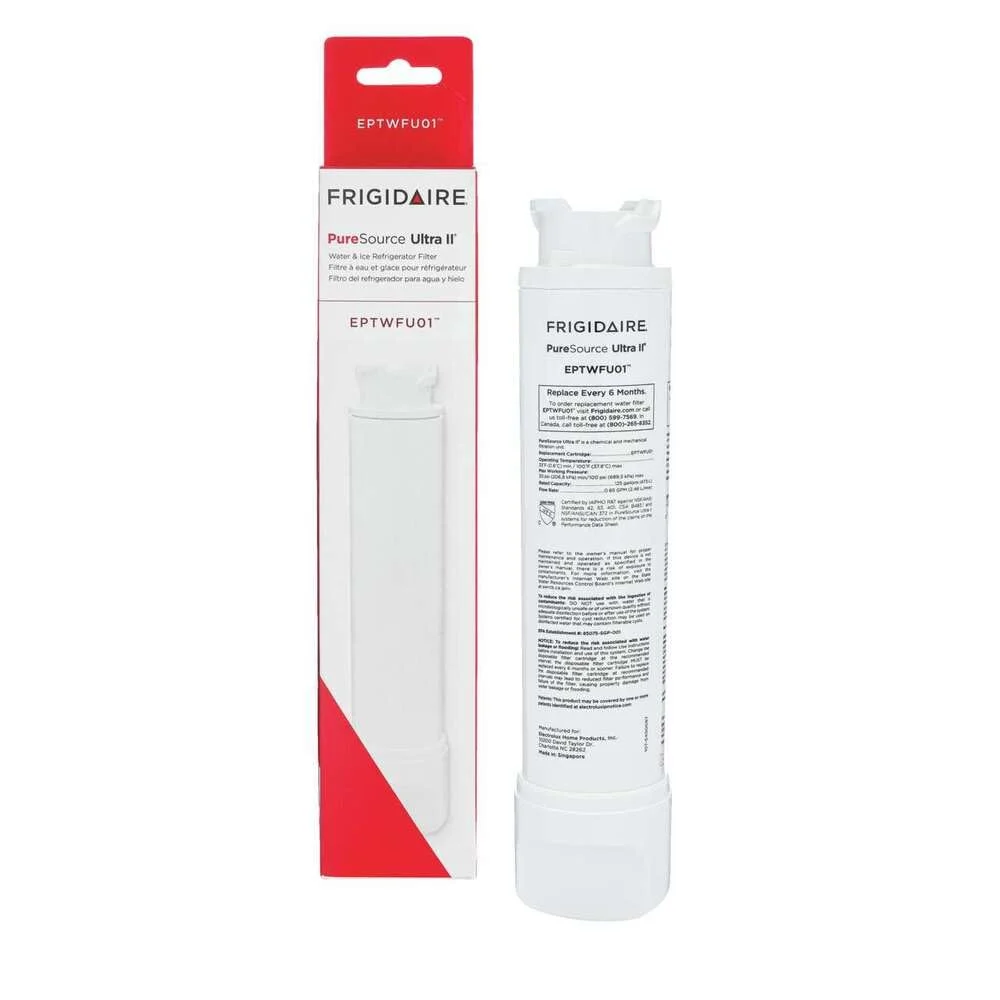
- Helps with: Replacing a cartridge on a Frigidaire refrigerator that takes the PureSource Ultra II housing, especially where the old cartridge was hard to seat.
- Why it fits: The push-and-twist design turns 90 degrees until it clicks, which makes correct seating easy to confirm, and the listing names chlorine, lead, mercury and nitrates as targets.
- Keep in mind: It is a single cartridge with a WQA listing rather than an NSF/ANSI 53 listing, so check the performance data sheet for the specific contaminants you care about.
Want to skip the research? The Frigidaire ULTRAWF Refrigerator Filter is the model we would start with.
Check the water line for kinks, ice and length
The supply line is the next restriction to inspect, and it is usually a 1/4 inch plastic or braided tube running from a valve to the back of the refrigerator. Pull the refrigerator out far enough to see the whole run, then trace it hand over hand from the valve to the cabinet entry. Look for a sharp bend behind the unit, a loop pinched under a foot or a coil crushed against the wall.
Ice is a common and easily missed cause. If the line passes through a cold zone, or the door hinge area where the line crosses to the dispenser, a plug of ice can narrow the bore. A line that feels stiff or shows frost at one point is suspect. Let it thaw fully, then confirm the line is routed away from cold surfaces and not pinched at the hinge.
Length matters too. An excessively long line coiled behind the refrigerator adds restriction and traps air, and a coil that is kinked at the tie point does the same. Keep the run as short as the installation allows and avoid tight coils. If the line is old, brittle or has a visible crimp, replacing the line is cheaper than chasing the symptom.
If the line and cartridge are both clear and flow is still poor, the restriction is upstream at the supply valve or downstream inside the refrigerator, which the next two sections cover.
- Unplug the refrigerator or switch off its power before moving it.
- Pull the unit out and trace the 1/4 inch line from the supply valve to the cabinet entry.
- Look for kinks, crushed coils, frost patches and ice at the door hinge.
- Thaw any ice, straighten kinks, shorten excess coils and recheck flow.
Is your household water pressure or supply valve the problem?
Test the house before you blame the refrigerator. Run a cold tap elsewhere in the kitchen or at a nearby bathroom. If that tap is also weak, the problem is household pressure or a partly closed valve, and no cartridge change will fix it. Normal household pressure is typically in the range of 40 to 80 psi, and a dispenser fed by a weak supply will always pour slowly.
The supply valve is the next check. Refrigerator lines are often fed by a saddle valve pierced into a cold pipe, and these valves are prone to partial closure, mineral clogging and a poorly made tap that never delivered full flow. Confirm the valve is turned fully open, then check whether the piercing needle is seated correctly. A saddle valve that drips or will not open fully is worth replacing with a proper shutoff valve.
If the house pressure is fine and the valve is open, look at what else shares the line. A filter or softener upstream, a long run of narrow tubing or a second appliance tapped off the same valve can all reduce what reaches the refrigerator.
This is a good moment to think about the cartridge you install next. A refrigerator filter cannot raise pressure, and a very dense carbon block will cost a little flow even when new. If your supply is on the low side, choose the cartridge specified for your model rather than a tighter aftermarket alternative, and accept that the dispenser will pour at the rate the supply allows.
- Run a cold tap elsewhere in the home and compare its flow with the dispenser.
- Locate the supply valve behind or under the refrigerator and confirm it is fully open.
- Inspect a saddle valve for mineral clogging or a poor pierce, and replace it if suspect.
- Check for other devices sharing the same supply line.
When it is not the filter or the line: dispenser and internal faults
If a bypassed filter, a clear line and good supply pressure still leave a trickle, the restriction is inside the refrigerator. The water inlet valve, usually at the back near the supply connection, opens electrically to let water in; a failing solenoid or a clogged screen in the valve reduces flow and often produces a humming or buzzing at the back when the paddle is pressed.
The dispenser itself can also be the cause. The paddle and switch assembly can wear so the valve is only partly actuated, and on models with a chilled water reservoir, a frozen or iced reservoir limits how much water is available per draw. A reservoir that ices over usually shows up as a normal first glass followed by a weak second one.
Control board faults are the least common and the hardest to confirm without service literature. Intermittent dispensing, error codes on the display or a dispenser that works only after the refrigerator has been idle point toward electronics rather than plumbing.
At this stage the decision changes from parts to labor. A water inlet valve is a straightforward replacement for a confident DIY repair, but a dispenser switch, a reservoir or a control board is a job for a technician, particularly on a refrigerator still under warranty.
- Listen at the back of the refrigerator while a second person presses the dispenser paddle.
- Check for a hum or buzz at the water inlet valve and inspect its inlet screen for debris.
- Note whether the first glass pours normally and later glasses weaken, which points to the reservoir.
- Record any error codes before calling for service.
Choosing the right replacement cartridge for your fridge
Buy the cartridge by part number, not by the refrigerator's brand name alone. The OEM part number is printed on the old cartridge, on the housing or in the manual, and it is the only reliable match. A cartridge that fits the housing but is specified for a different model can sit off its seal, leak or restrict flow, which is exactly the slow-draw symptom you are trying to cure.
Read the certification claims carefully. NSF/ANSI 42 covers aesthetic effects such as chlorine taste and odor, while NSF/ANSI 53 covers health-related claims such as lead and cysts when the manufacturer lists them. A cartridge certified to NSF/ANSI 42 alone is a taste and odor filter; do not assume health contaminant reduction from it. Check the manufacturer performance data sheet for the specific contaminants and reduction claims, and compare them with your local water quality report.
OEM and compatible cartridges are both legitimate choices, but they are not identical. Genuine cartridges are built to the refrigerator maker's specification and carry that maker's certification listing. Compatible cartridges can cost less and are often sold in multi-packs, but the certification belongs to that brand's own testing, so verify the standard number and the model compatibility list before buying.
Set a change schedule you will actually keep. Most refrigerator cartridges are rated in gallons or months, and a busy household should treat the shorter of the two as the trigger. Write the install date on the cartridge body, and replace at the rated interval rather than waiting for the flow to drop, since a slow dispenser is the late symptom of a loaded filter.
- Find the OEM part number on the old cartridge, the housing or the manual.
- Check the certification listing: NSF/ANSI 42 for taste and odor, NSF/ANSI 53 where health claims are made.
- Decide between a genuine cartridge and a compatible multi-pack, and confirm the compatibility list.
- Record the install date and the rated life in gallons or months, and replace at the shorter interval.
Helpful tool
Waterdrop WD-F13 3-Pack

- Helps with: Keeping a GE refrigerator on schedule with spare cartridges on hand so a slow dispenser is never left waiting for a replacement.
- Why it fits: The three-pack removes the excuse to run a loaded cartridge past its rated life, and the listing states NSF/ANSI 42 certification with a compatibility list for GE MWF and related part numbers.
- Keep in mind: It is certified to NSF/ANSI 42 for aesthetic effects, so do not expect health-related claims, and confirm your model against the compatibility list before ordering.
When to call a technician
Stop troubleshooting and call a technician when there is no water at all rather than a slow stream, when water leaks at the supply valve or the inlet valve, or when a new cartridge fails to restore flow twice in a row. Those patterns point to a failed valve or an internal blockage that parts swapping will not solve.
Error codes, a dispenser that works intermittently, or a refrigerator still covered by its manufacturer warranty also belong with service. Opening panels or replacing valves on a warranted appliance can affect that coverage, so check the warranty terms before you start.
One caution applies throughout: a filter reduces specific contaminants only as far as its certification and test data show, and it does not make any water safe in every case. If you have concerns about what is in your water, read the manufacturer performance data sheet and your local water quality report, and for a private well, have the water tested by a certified lab.
Avoid these
Common mistakes to avoid
- Replacing the cartridge without testing whether the old one is the restriction. Fit the bypass plug or dispense with the housing empty first; if flow returns, the cartridge was the cause and the replacement is justified.
- Judging a new cartridge by the first glass. Flush several glasses and let the chilled reservoir refill before deciding the flow is wrong.
- Buying a cartridge by refrigerator brand rather than part number. Match the OEM part number exactly, and check the certification listing and compatibility list before purchase.
- Chasing the refrigerator when the whole house is weak. Test a cold tap elsewhere first, then check that the supply valve is fully open and replace a suspect saddle valve.
As an Amazon Associate we earn from qualifying purchases. This never changes which products we recommend.
Common questions
Frequently asked questions
How do I know if my refrigerator water filter is clogged?
The clearest sign is a stream that has weakened gradually over weeks and improves when the cartridge is removed or bypassed. If flow returns to normal with the filter out of the path, the cartridge is loaded and due for replacement.
Why is my fridge water slow only after changing the filter?
Air trapped in the housing and line, plus a drained chilled reservoir, cause a weak and sputtering stream for the first few glasses. Flush several glasses and confirm the cartridge clicked fully into its lock ring before assuming a fault.
Does a fridge water filter slow down water flow?
Yes. A carbon block cartridge is a deliberate restriction, and its density and micron rating affect how much water passes at a given pressure. A loaded block restricts more, which is why flow falls as the cartridge approaches the end of its rated life.
How often should a refrigerator water filter be replaced?
Replace it at the rated life in gallons or months, whichever comes first, and sooner in a busy household or where the supply carries sediment or heavy chlorine. Waiting for the reminder light or a trickling dispenser means the cartridge is already overdue.
Can I run my fridge without a water filter?
Many refrigerators will dispense with the cartridge removed if a filter bypass plug is fitted, and some models allow dispensing with the housing empty. Use the bypass only as a diagnostic or temporary measure, since unfiltered water passes straight to the dispenser.
Why is my Samsung or LG fridge water dispenser slow when the filter is new?
A new cartridge that is not fully seated, a model mismatch, or air still in the line explains most slow dispensers after a change. Flush the system, confirm the cartridge is locked in, and verify the part number against your refrigerator's specification.
Next step
Start with the one-minute bypass test: pull the cartridge and see whether flow returns. If it does, fit a correctly matched replacement, and the Frigidaire ULTRAWF is the option to check first if your refrigerator uses the PureSource Ultra system, because it carries both NSF/ANSI 42 and NSF/ANSI 53 listings and installs with a simple push until it clicks.
Keep reading
How Long Do Brita Filters Last, and How to Tell Yours Is Spent
A clear, practical answer to how long do brita filter last, with the steps, the common mistakes and what to do next.
Does the Brita Elite Filter Fit All Pitchers? Check Your Model First
A clear, practical answer to does brita elite filter fit all pitchers, with the steps, the common mistakes and what to do…
Whole House Water Filter Leaking? Find the Source, Then the Fix
A clear, practical answer to whole house water filter leaking, with the steps, the common mistakes and what to do next.