Waterdrop vs Berkey: Which Filter Fits Your Water and Your Kitchen
Published October 29, 2026
If you want the broadest contaminant reduction, including fluoride and dissolved metals, a Waterdrop reverse osmosis system is the more capable option; if you need a filter that works without plumbing or electricity and can be moved easily, a Berkey gravity purifier is the practical choice. The single deciding tradeoff is installation and power dependence versus the range of contaminants reduced.
Waterdrop is a brand that spans under sink reverse osmosis, countertop reverse osmosis, and gravity filters, each with different capabilities. Berkey is known for stainless steel gravity purifiers that use carbon and ceramic elements. This comparison examines the structural differences, contaminant coverage, certifications, filter life, flow rate, wastewater, footprint, renter friendliness, and performance on city versus well water, so you can decide which approach suits your household.
Quick verdict
Waterdrop offers plumbed and countertop reverse osmosis systems that reduce a wide range of contaminants, while Berkey provides no-plumbing gravity purifiers that favor portability and simplicity. Neither is universally better; your water quality and living situation determine the fit.
Waterdrop
plumbed, thorough, higher flow
Choose Waterdrop if you have a specific contaminant concern like fluoride or lead, can accommodate a plumbed or countertop system, and want higher flow rates and certification-backed reduction claims.
Berkey
no install, slow, portable
Choose Berkey if you rent, lack under-sink space, want no installation or electricity, and need a portable filter for off-grid or emergency use, even if it means slower flow and manual refilling.
Key takeaways
- Waterdrop reverse osmosis systems reduce dissolved contaminants like fluoride and lead, while Berkey gravity purifiers focus on chlorine, sediment, and some bacteria.
- Waterdrop systems require plumbing or a countertop footprint and often electricity, whereas Berkey needs no installation and works off-grid.
- Waterdrop typically offers higher flow rates and larger filter capacities, but produces wastewater; Berkey is slower and requires manual refilling.
- Berkey is more renter-friendly and portable, but Waterdrop provides certification-backed reduction for a wider range of health-related contaminants.
Table of contents9 sections · tap to expand
What is Waterdrop?
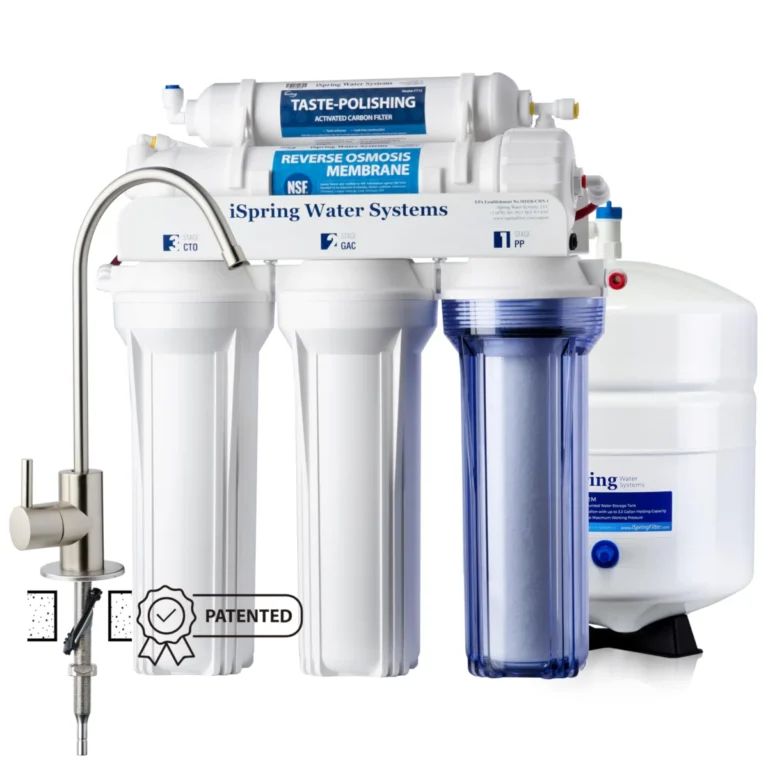
Waterdrop is a brand of water filtration systems that includes under sink reverse osmosis, countertop reverse osmosis, and gravity filters, typically using carbon block and RO membranes to reduce contaminants.
What is Berkey?
Berkey is a brand of stainless steel gravity-fed water purifiers that use activated carbon and ceramic elements to filter water without plumbing or electricity.
At a glance
Waterdrop vs Berkey at a glance
| Criterion | Waterdrop | Berkey |
|---|---|---|
| Contaminants reduced | Chlorine, lead, PFAS, fluoride, arsenic, microplastics, sediment, bacteria (with UV) | Chlorine, sediment, some bacteria and cysts, limited dissolved metals |
| Certifications | NSF/ANSI 42, 53, 58, 372, 401 on many models | NSF/ANSI 42 and 53 on some elements; not all claims certified |
| Filter type and installation | Under sink RO (plumbed) or countertop RO (plug-in); some gravity | Gravity purifier, no plumbing or electricity |
| Filter life | 6-24 months or 600-2,000 gallons depending on model | 2,000-6,000 gallons per set of elements (varies) |
| Flow rate | 0.5-1 GPM (under sink), 0.3-0.5 GPM (countertop) | 0.05-0.1 GPM (gravity) |
| Wastewater | Produces 1:1 to 3:1 wastewater ratio; remineralization often needed | No wastewater; no remineralization needed |
| Footprint | Under sink cabinet space or countertop area | Countertop space, taller unit |
| Renter friendliness | Countertop models are renter-friendly; under sink requires plumbing | Fully renter-friendly and portable |
| City vs well water | Effective on both; RO handles dissolved contaminants | Good for city water; well water may need pre-filtration or UV |
Key differences
7 key differences between Waterdrop and Berkey
1. What each one filters and how it is certified
Waterdrop reverse osmosis systems are certified to NSF/ANSI 58 for RO performance and often NSF/ANSI 53 for health effects like lead and cysts, plus NSF/ANSI 372 for lead-free materials. Some models also carry NSF/ANSI 401 for emerging contaminants.
Berkey gravity purifiers use activated carbon and ceramic elements; some are tested to NSF/ANSI 42 and 53, but certification is not universal across all models. The consequence: Waterdrop provides verified reduction for a broader list of dissolved contaminants, while Berkey's claims are more limited and vary by element.
For fluoride and PFAS, reverse osmosis is one of the few technologies that effectively reduces them. Waterdrop RO systems are typically certified for fluoride reduction and some for PFOA/PFOS. Berkey gravity filters generally do not remove fluoride and have limited PFAS reduction unless specifically tested. If these contaminants are your concern, Waterdrop is the more reliable choice.
2. Installation, space, and power needs
Waterdrop under sink systems require a cold water line connection and cabinet space, and tankless models need an electrical outlet. Countertop RO units need only a power outlet and counter space. Berkey purifiers need no plumbing or electricity; you simply fill the top chamber and let gravity do the work. This makes Berkey far easier to set up and use in apartments, cabins, or during power outages.
The tradeoff is that Waterdrop's installation effort buys you higher flow and automatic operation, while Berkey's simplicity means manual refilling and slower filtration. For renters or those with limited cabinet space, Berkey is often the only feasible option.
3. Filter life, replacement cost, and yearly running cost
Waterdrop filter life varies by model: under sink RO systems typically need sediment and carbon pre-filters every 6-12 months, and the RO membrane every 2-3 years. Countertop models often have combined cartridges lasting 6-12 months. Berkey elements last significantly longer, with some rated for 3,000 gallons or more, but replacement sets can be costly upfront. Over several years, Waterdrop's annual cost includes pre-filters, membrane, and possibly remineralization cartridges, while Berkey's cost is mostly the periodic element replacement.
Neither side is universally cheaper; it depends on your water usage and local prices. However, Berkey's longer filter life means fewer replacements, which can be advantageous for low-volume users, while Waterdrop's higher upfront cost may be offset by not needing bottled water.
4. Flow rate, refill effort, and wastewater
Waterdrop reverse osmosis systems deliver water on demand at 0.3 to 1 GPM, filling a glass in seconds, and under sink units replenish a tank automatically. Berkey purifiers flow at about 0.05 to 0.1 GPM, so filling a pitcher takes minutes, and you must manually refill the top chamber. Waterdrop RO produces wastewater (typically 1:1 to 3:1 ratio) and often requires remineralization for taste, while Berkey produces no wastewater and retains minerals naturally.
The consequence: Waterdrop is more convenient for high-volume use and cooking, but wastes some water and may need a remineralization stage. Berkey is slower and requires more user involvement but is more water-efficient and preserves minerals.
5. Footprint and fit in the kitchen
Waterdrop under sink systems hide in the cabinet, freeing counter space, but require a dedicated faucet hole (or a countertop model that occupies counter space). Berkey purifiers sit on the counter and are tall, needing vertical clearance. In a small kitchen, a countertop Waterdrop RO might take similar space to a Berkey, but Berkey's no-plumbing design means it can be placed anywhere.
If counter space is at a premium, an under sink Waterdrop is less obtrusive, but it requires cabinet space and installation. Berkey's footprint is visible but doesn't require modifications.
6. Renter friendliness and reversibility
Berkey is fully renter-friendly: no installation, no permanent changes, and easy to move. Waterdrop countertop RO models are also renter-friendly as they need only a power outlet, but under sink models require plumbing modifications that may not be allowed by landlords. For renters, Berkey or a Waterdrop countertop unit are the practical choices, with Berkey being more portable.
7. City water versus private well water
On city water, both sides can improve taste and reduce chlorine. If your consumer confidence report lists lead or PFAS, a Waterdrop RO system with NSF/ANSI 53 and 58 certification is more likely to address those contaminants. Berkey may reduce some but not all, and certification varies. On private well water, the first step is a lab test.
For bacteria, Berkey offers ceramic filters that can remove bacteria, while Waterdrop offers UV stages in some models. For dissolved contaminants like arsenic or nitrates, RO is more effective. Always base your choice on test results.
Waterdrop: strengths and limitations
Waterdrop provides reverse osmosis systems that reduce a wide range of contaminants, including fluoride and lead, with certification-backed claims. They require plumbing or a power outlet and produce wastewater, but offer higher flow and automatic operation.
Strengths
- Certified reduction of fluoride, lead, PFAS, and other dissolved contaminants
- Higher flow rates and on-demand water
- Automatic operation with minimal refilling
- Available in under sink and countertop configurations
Limitations
- Requires plumbing or electricity for most models
- Produces wastewater and may need remineralization
- Higher upfront cost and more frequent filter changes
Berkey: strengths and limitations
Berkey gravity purifiers need no plumbing or electricity and are portable, which suits renters and off-grid users who cannot modify plumbing. They are slower and have limited reduction of dissolved contaminants like fluoride.
Strengths
- No installation or power required
- Portable and renter-friendly
- No wastewater and retains minerals
- Long filter life in gallons
Limitations
- Slow flow rate and manual refilling
- Limited reduction of fluoride and PFAS
- Certification not universal across all models
- Takes up counter space
Decision guide
Which should you choose?
| If you… | Choose | Why |
|---|---|---|
| Renter with city water and no under sink space | Berkey | Berkey gravity purifiers sit on the counter and require no plumbing, so they are fully reversible. |
| Homeowner on city water with lead or PFAS listed in the consumer confidence report | Waterdrop | Waterdrop reverse osmosis systems are certified to NSF/ANSI 58 and often 53, covering lead and some PFAS, while Berkey's certification for these is less common. |
| Family on a private well with bacteria concerns | Either | Both sides offer options with UV or ceramic elements for bacteria, but a lab test should guide the choice; Berkey's ceramic filters can address bacteria, while Waterdrop offers UV stages in some models. |
| Household that wants fluoride reduction | Waterdrop | Waterdrop reverse osmosis systems reduce fluoride, whereas Berkey gravity filters typically do not. |
| Off-grid or emergency-preparedness buyer | Berkey | Berkey works without electricity or water pressure, making it suitable for cabins and emergencies. |
| Small-kitchen owner with no cabinet space | Berkey | Berkey takes up counter space but no under-sink area, while Waterdrop under sink models need cabinet room. |
Choose Waterdrop if
- You have a specific contaminant concern like fluoride, lead, or PFAS and want certified reduction.
- You can install an under sink system or have counter space for a countertop RO unit.
- You prefer on-demand water and higher flow for cooking and drinking.
- You are on a private well with dissolved contaminants that require RO.
Choose Berkey if
- You rent and cannot modify plumbing.
- You need a portable filter for off-grid, camping, or emergency use.
- You have limited counter space but no cabinet space for an under sink system.
- You want a filter that works without electricity and produces no wastewater.
See also: Waterdrop G2 vs G3: Which Tankless RO System Fits Your Sink and Water Use; Waterdrop Review: Who It Suits and Who Should Skip It.
Common questions
Frequently asked questions
Is there a better water filter than Berkey?
There is no universal better filter; it depends on your water. If you need fluoride or PFAS reduction, a Waterdrop reverse osmosis system is more effective. If you need portability and no installation, Berkey is a strong option.
Are Berkey water filters worth it?
Berkey filters are worth it for renters, off-grid users, and those who want a simple, no-plumbing solution. They are less suitable if you need certified reduction of dissolved contaminants like fluoride.
Is Waterdrop better than Brita?
Waterdrop and Brita serve different needs. Waterdrop reverse osmosis systems reduce more contaminants, including fluoride, while Brita pitchers are simpler and cheaper upfront but mainly improve taste and reduce chlorine.
Does Waterdrop remove fluoride?
Yes, Waterdrop reverse osmosis systems are typically certified to reduce fluoride. Check the specific model's performance data sheet for the reduction rate.
Does a Berkey filter remove fluoride and PFAS?
Berkey gravity filters generally do not remove fluoride. PFAS reduction is limited and not certified on all models. For these contaminants, reverse osmosis is more reliable.
Do I need a plumber to install a Waterdrop system?
Under sink Waterdrop systems require a cold water line connection, which may need a plumber if you are not comfortable with DIY. Countertop models need only a power outlet and no plumbing.
Bottom line
The verdict
Waterdrop and Berkey represent two different approaches to water filtration. Waterdrop's reverse osmosis systems are the more capable choice for reducing dissolved contaminants like fluoride and lead, and they offer higher flow and automation, but they require installation and produce wastewater. Berkey's gravity purifiers are the more portable and renter-friendly option, and they work without power, though they are slower and have limited reduction of certain chemicals.
Choose Waterdrop if your water report shows fluoride, lead, or PFAS and you can accommodate a plumbed or countertop system. Choose Berkey if you need a no-install, portable filter and your main concerns are chlorine, sediment, and bacteria. In either case, base your decision on a water test and the manufacturer's performance data.