Waterdrop G3P600 vs G3P800: Which Tankless RO Fits Your Kitchen
Published October 29, 2026
As an Amazon Associate we earn from qualifying purchases. This never changes which products we recommend.
The Waterdrop G3P600 vs G3P800 comparison comes down to one tradeoff: the G3P800 delivers more daily water and a faster flow rate, while the G3P600 fits in tighter cabinets and costs less to buy and maintain. Both are tankless reverse osmosis systems with smart display faucets and NSF/ANSI 58 certification for TDS reduction, so the choice depends on how much water your household uses and how much under-sink room you have.
The G3P600 is rated at 600 gallons per day and uses a 2:1 wastewater ratio, while the G3P800 is rated at 800 gallons per day and uses a 3:1 ratio. Both share the same 8-stage filtration platform and the same replacement filter family, so the decision is narrower than a spec sheet suggests. The sections below compare capacity, flow, certifications, filter life, wastewater, footprint and installation so you can pick the model that matches your daily routine and cabinet dimensions.
Quick verdict
The Waterdrop G3P600 suits households that want certified tankless RO in a compact footprint, while the G3P800 suits larger households that need more daily output and a faster flow rate.
Waterdrop g3p600
compact, certified, lower output
Choose Waterdrop G3P600 if your cabinet is tight and your daily drinking water needs are moderate, because it delivers 600 GPD and a 2:1 drain ratio in a smaller unit.

G3P800
higher output, faster flow
Choose G3P800 if you fill pots, pitchers and ice trays daily and have the cabinet space, because its 800 GPD rating and 3:1 wastewater ratio reduce refill waits and drain waste.
Key takeaways
- The G3P800 is rated at 800 GPD versus 600 GPD for the G3P600, a difference that matters mainly in households that draw water continuously.
- Both models share the same 8-stage filtration platform and the same replacement filter family, so cartridge shopping is similar.
- The G3P800 uses a 3:1 wastewater ratio compared with 2:1 on the G3P600, sending less water to drain per gallon produced.
- The G3P600's smaller cabinet footprint makes it the easier fit in tight under-sink spaces.
Table of contents9 sections · tap to expand
What is Waterdrop g3p600?
Waterdrop G3P600 is a tankless under-sink reverse osmosis system rated at 600 gallons per day with an 8-stage filtration platform and a smart display faucet.
What is G3P800?
G3P800 is a tankless under-sink reverse osmosis system rated at 800 gallons per day with the same 8-stage platform and a 3:1 wastewater ratio.
At a glance
Waterdrop g3p600 vs G3P800 at a glance
| Criterion | Waterdrop g3p600 | G3P800 |
|---|---|---|
| Daily capacity (GPD) | 600 GPD | 800 GPD |
| Flow rate | Rated for 600 GPD continuous output | Rated for 800 GPD continuous output |
| Filtration stages and membrane | 8 stages, carbon block and RO membrane | 8 stages, carbon block and RO membrane |
| Certifications | NSF/ANSI 42, 58, 372 | NSF/ANSI 58, 372 |
| Filter life | 600 gallons per filter set | Same filter family; check model-specific rating |
| Wastewater ratio | 2:1 | 3:1 |
| Under-sink footprint | 18.12"L x 5.67"W x 17.72"H | Larger than G3P600; measure cabinet |
| Installation requirements | Cold water line, dedicated faucet hole, power outlet | Cold water line, dedicated faucet hole, power outlet |
| Noise and power | Electric pump; noise typical of tankless RO | Electric pump; noise typical of tankless RO |
Key differences
7 key differences between Waterdrop g3p600 and G3P800
1. Daily capacity: 600 GPD vs 800 GPD
The G3P800 is rated at 800 gallons per day, while the G3P600 is rated at 600 gallons per day. That 200-gallon difference matters most in households that draw water continuously for cooking, pitchers and ice makers; a family of four drinking and cooking typically uses far less than 600 GPD, so the G3P600's rating is rarely the limiting factor.
For a large household or one that entertains often, the G3P800's extra capacity reduces recovery time between draws. If your current pitcher or faucet filter habit fills only a few glasses at a time, the G3P600's 600 GPD is unlikely to feel slow.
2. Flow rate and fill speed
Flow rate follows rated capacity: the G3P800's 800 GPD rating translates to a faster fill than the G3P600's 600 GPD rating. In practice, the G3P800 fills a pot or large pitcher in less time, which matters when you are cooking or filling multiple containers back to back.
The G3P600 is not slow by tankless RO standards, but its lower rated output means longer waits during heavy simultaneous use. If you routinely fill stockpots or several water bottles at once, the G3P800's higher flow is the clearer benefit.
3. Filtration stages and membrane
Both models use an 8-stage filtration platform with a carbon block pre-filter and an RO membrane. The shared platform means the contaminant reduction profile is similar: the G3P600 listing names chlorine, lead, PFAS, fluoride, arsenic, sediment and iron, and the G3P800 uses the same filter family.
Because the stages and membrane type match, the choice between these two models is not about what they filter but about how much water they can produce. Check the performance data sheet for the specific reduction claims you need, especially for lead and PFOA/PFOS.
4. Certifications: what each model carries
The G3P600 is certified to NSF/ANSI 42 for chlorine taste and odor reduction, NSF/ANSI 58 for TDS reduction and NSF/ANSI 372 for lead-free materials. The G3P800 carries NSF/ANSI 58 and 372 certifications; confirm any additional NSF/ANSI 53 or 401 claims on the specific model's performance data sheet.
Neither model's listing states NSF/ANSI 53 certification for lead or NSF/ANSI 401 for emerging contaminants, so if lead or PFAS reduction is your primary concern, verify the exact standard and reduction percentage on the manufacturer's data sheet before buying.
5. Filter life and replacement schedule
The G3P600's filter set is rated for 600 gallons, and the shared replacement filter (WD-G3-N1CF) is rated for six months or 550 gallons. The G3P800 uses the same filter family, so replacement intervals are similar: plan on changing the pre-filter and carbon block roughly every six months and the RO membrane every two to three years.
Because both models share cartridges, running cost is close; the G3P800's higher capacity may mean slightly more frequent changes in a heavy-use household. Flow can decline as filters age, so replace on the rated schedule rather than waiting for a noticeable slowdown.
6. Wastewater ratio and drain requirements
The G3P600 uses a 2:1 wastewater ratio, meaning two cups of waste water for every cup produced, while the G3P800 uses a 3:1 ratio, sending less water to drain per gallon of filtered water. The G3P800's lower waste ratio is a real advantage in households that produce several gallons a day.
Both models require a drain connection for the reject water, typically via the sink drain or a dedicated drain saddle. If you cannot tie into a drain line, neither tankless RO system is a good fit without plumbing work.
7. Under-sink footprint and installation
The G3P600 measures 18.12"L x 5.67"W x 17.72"H, a compact footprint that fits many standard cabinets. The G3P800 is larger, so measure your cabinet before ordering; Waterdrop advises checking that the cabinet is larger than the product dimensions.
Both models need a cold water line, a dedicated faucet hole for the smart display faucet and a power outlet for the pump. Installation is DIY-friendly for someone comfortable with basic plumbing, but a plumber is a reasonable choice if you lack a faucet hole or drain access.
Waterdrop g3p600: strengths and limitations
The Waterdrop G3P600 is a compact tankless RO system rated at 600 GPD with an 8-stage platform, NSF/ANSI 42, 58 and 372 certifications and a 2:1 drain ratio. It suits households with moderate water use and tight cabinet space.
Strengths
- Compact 18.12"L x 5.67"W x 17.72"H footprint fits tighter cabinets
- Certified to NSF/ANSI 42, 58 and 372
- 600 GPD capacity is ample for most families
- Shared filter family keeps cartridge shopping simple
Limitations
- Lower daily output and flow than the G3P800
- 2:1 wastewater ratio sends more water to drain than the G3P800's 3:1
- Requires a dedicated faucet hole and drain connection
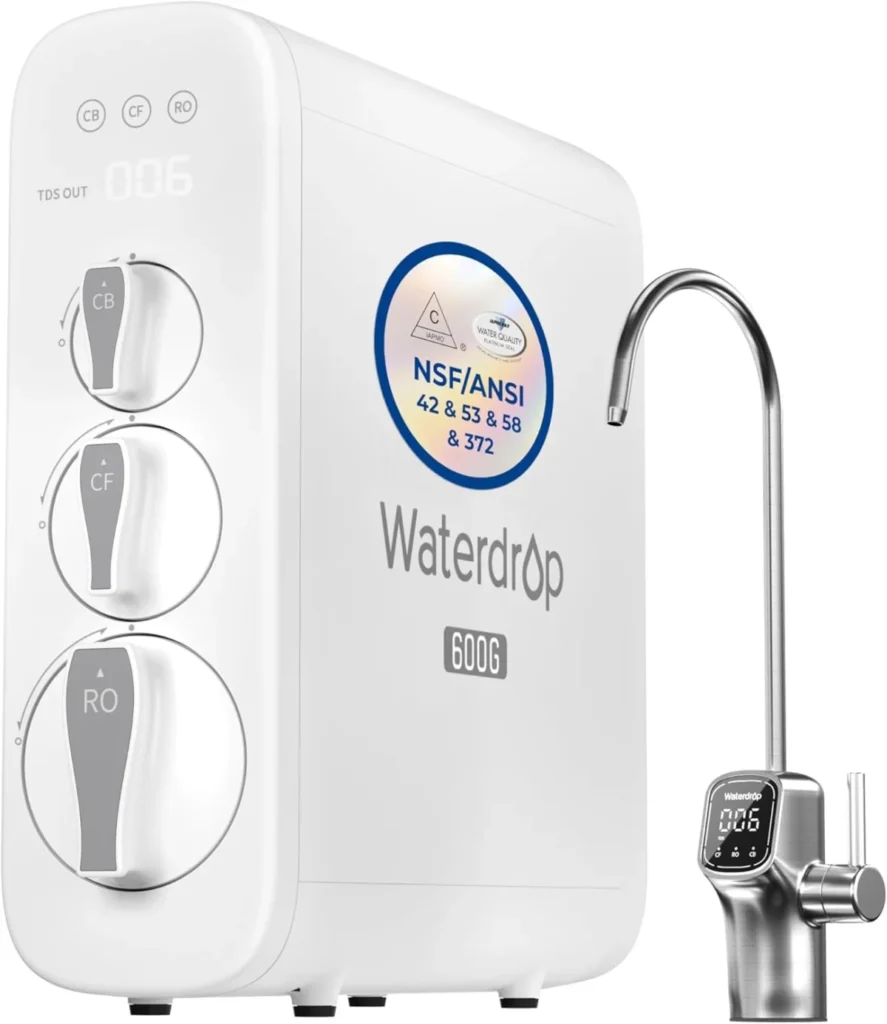
Waterdrop G3P600 Tankless RO System
This listing is the complete G3P600 system with three pre-installed filters, a silver smart display faucet and a 600 GPD rating. It suits buyers who want certified tankless RO in a compact footprint.
G3P800: strengths and limitations
The G3P800 is a higher-capacity tankless RO system rated at 800 GPD with the same 8-stage platform and a 3:1 wastewater ratio. It suits large households that need faster recovery and lower drain waste.
Strengths
- 800 GPD capacity and faster flow for heavy use
- 3:1 wastewater ratio reduces drain waste
- Shares the G3 filter family for easy replacement
- NSF/ANSI 58 and 372 certified
Limitations
- Larger footprint requires more cabinet space
- Higher purchase price than the G3P600
- Still requires a dedicated faucet hole and drain
Waterdrop G3-N1CF Replacement Filter
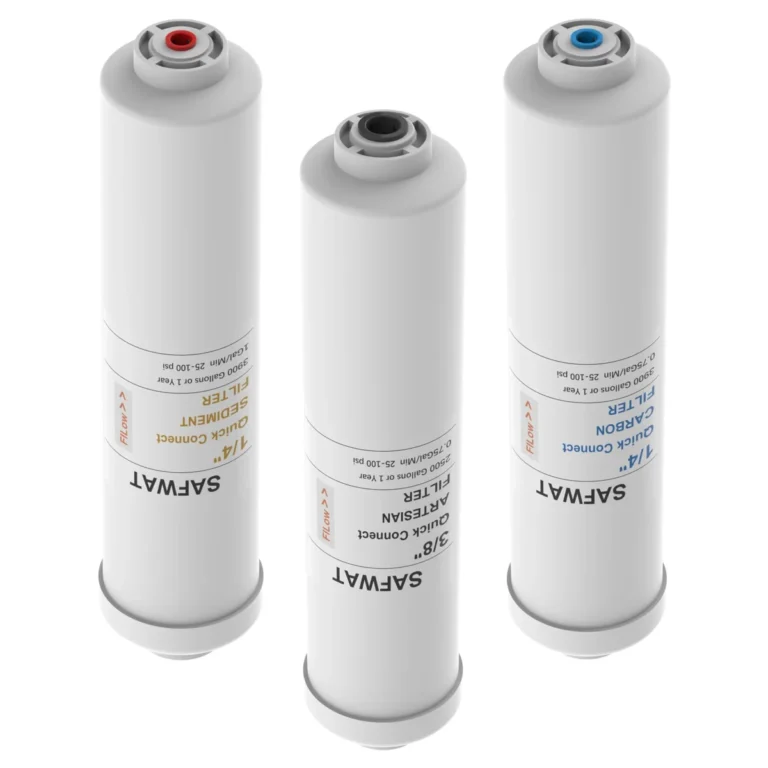
This listing is the shared replacement filter for the G3-W, G3P600 and G3P800 systems, rated for six months or 550 gallons. It keeps cartridge shopping identical across both models.
Decision guide
Which should you choose?
| If you… | Choose | Why |
|---|---|---|
| A family of four replacing bottled water at the kitchen tap | Either | Both models deliver certified RO water; the G3P600's 600 GPD is enough for typical drinking and cooking, while the G3P800 adds headroom for heavy simultaneous use. |
| A large household that fills pots, pitchers and ice trays daily and needs faster recovery | G3P800 | The G3P800's higher daily capacity and flow rate reduce wait time between draws. |
| A renter or condo owner who cannot cut a hole for a dedicated RO faucet | Either | Both are under-sink systems that typically require a dedicated faucet hole; check your lease and faucet setup before buying either. |
| Someone with lead or PFAS concerns in municipal water comparing certified RO options | Either | Both carry NSF/ANSI 58 for TDS reduction and list lead and PFAS reduction in their performance claims; confirm the specific contaminant on the performance data sheet. |
| A homeowner upgrading from a pitcher or faucet mount filter to under-sink reverse osmosis | Waterdrop g3p600 | The G3P600's smaller footprint and lower capacity match the output of a typical pitcher habit while adding certified RO filtration. |
Choose Waterdrop g3p600 if
- Your under-sink cabinet is tight and the G3P600's 18.12"L x 5.67"W x 17.72"H dimensions are the largest that will fit.
- Your household draws water mainly for drinking and cooking, so 600 GPD is more than enough.
- You want NSF/ANSI 42, 58 and 372 certifications at a lower upfront cost.
- You are upgrading from a pitcher and want certified RO without paying for capacity you will not use.
Choose G3P800 if
- You have a large household that fills pots, pitchers and ice trays daily and needs faster recovery.
- Your cabinet has room for a larger unit and you want the highest output in the G3 line.
- You frequently draw several gallons at once and notice waits with lower-capacity systems.
See also: Waterdrop vs ZeroWater: Matching the Right System to Your Water; Apec vs Waterdrop Reverse Osmosis: Tank or Tankless for Your Kitchen.
Common questions
Frequently asked questions
What is the difference between the Waterdrop G3P600 and G3P800?
The main differences are daily capacity, flow rate and wastewater ratio: the G3P800 is rated at 800 GPD with a 3:1 drain ratio, while the G3P600 is rated at 600 GPD with a 2:1 ratio. Both share the same 8-stage platform and filter family.
Is the G3P800 worth the extra cost over the G3P600?
The G3P800 is worth it if your household draws several gallons a day and you want faster fills and less drain waste. If your use is moderate, the G3P600 delivers the same filtration platform for less.
Do both Waterdrop G3 models remove lead and PFAS?
Both list lead and PFAS reduction among their performance claims, and both carry NSF/ANSI 58 for TDS reduction. Check the specific model's performance data sheet for the exact reduction percentages and standards.
How often do the filters need changing on the G3P600 and G3P800?
Plan on changing the pre-filter and carbon block about every six months and the RO membrane every two to three years.
Do I need a plumber to install either model?
A confident DIYer can install either, but a plumber is sensible if you lack a faucet hole or drain access.
Bottom line
The verdict
Choose the Waterdrop G3P600 if your cabinet is compact and your daily water use is moderate; it delivers certified tankless RO with NSF/ANSI 42, 58 and 372 in a smaller footprint. Choose the G3P800 if you have the space and need the higher 800 GPD output and 3:1 wastewater ratio for a busy household.
Neither model is universally better: the decision hinges on how much water you draw daily and how much under-sink room you have. Measure your cabinet and estimate your daily gallons before deciding, and confirm the contaminant reduction claims on the performance data sheet for your water concerns.