Berkey vs Brita: Gravity Dispenser or Pitcher, and What Each Really Reduces
Published October 29, 2026
As an Amazon Associate we earn from qualifying purchases. This never changes which products we recommend.
Choose the Royal Berkey if you want a large, no-electricity reservoir that filters thousands of gallons per pair of elements and suits off-grid or emergency use; choose the Brita Metro if you want a small, inexpensive pitcher that fits a fridge shelf and needs no setup at all. The deciding tradeoff is scale versus simplicity: the Berkey holds 3.25 gallons and rates its elements for 6,000 gallons, while the Brita holds 6 cups and its filter lasts 40 gallons.
Neither side is a treatment system for unsafe water. Both are carbon-based filters that mainly target taste and odor, and each states a different list of reductions. The comparison below applies the same criteria to both, including certifications, filter life, footprint and suitability for city versus private well water, so you can match one to your household rather than to a label.
Quick verdict
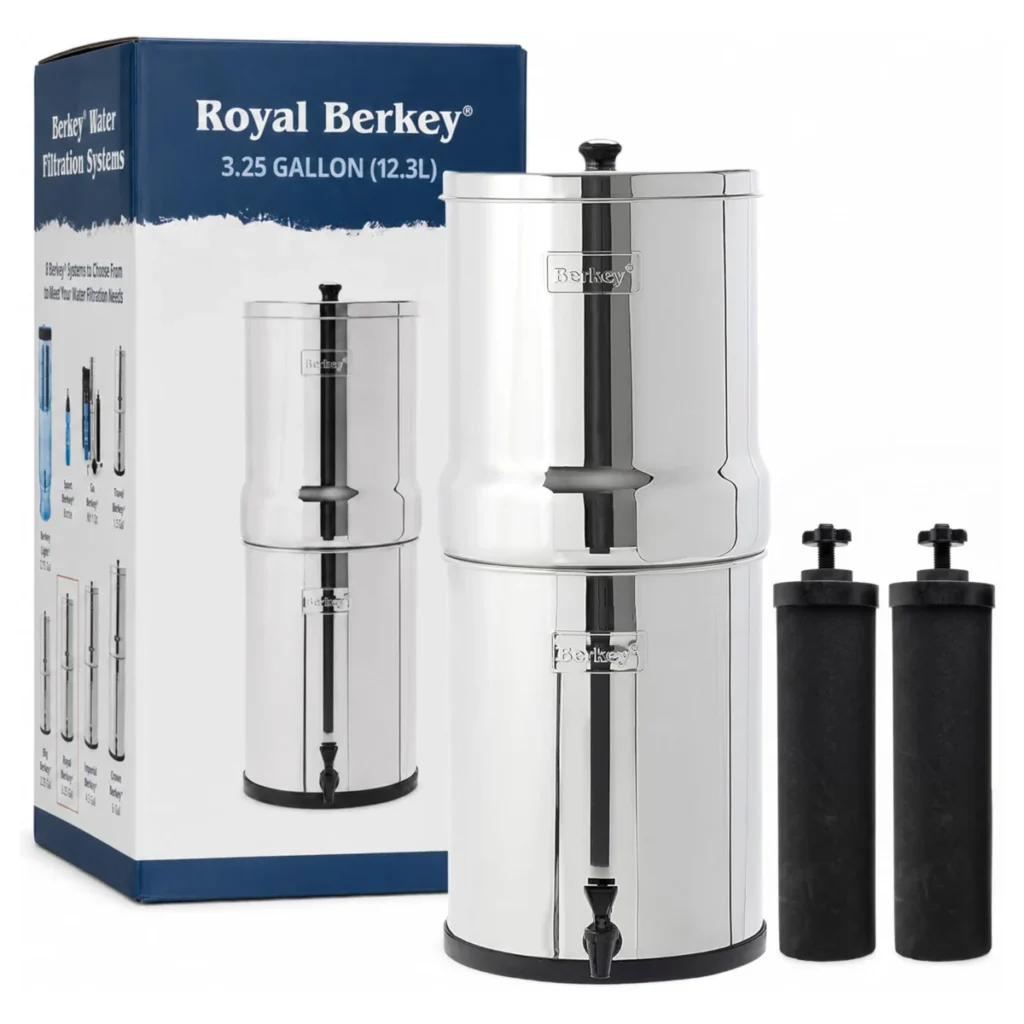
The Royal Berkey is a freestanding stainless steel gravity dispenser with two Black Berkey BB9-2 elements rated for 6,000 gallons per pair; the Brita Metro is a 6-cup BPA-free pitcher with a 40-gallon filter. They serve different jobs: bulk no-power filtration versus small-batch convenience.
Berkey
big gravity reservoir, long element life
Choose Berkey if you want a large gravity-fed reservoir that needs no electricity or plumbing and can run for years between element changes.

Brita
small fridge pitcher, quick refills
Choose Brita if you want a compact, low-commitment pitcher that sits in the fridge and is simple to refill and pour.
Key takeaways
- The Royal Berkey holds 3.25 gallons and its two included Black Berkey BB9-2 elements are rated for 6,000 gallons per pair, while the Brita Metro holds 6 cups and its filter is rated for 40 gallons.
- The Brita Metro listing names chlorine taste and odor, mercury, copper, zinc and cadmium; the Berkey listing describes a proprietary media and states 250+ contaminant types without naming them.
- Neither listing states NSF/ANSI 42, 53, 401 or 372 certification, so treat both as taste-and-odor filters until you confirm the performance data sheet.
- The Berkey suits bulk, no-power use and the Brita suits small-batch fridge convenience; neither is a substitute for reverse osmosis when fluoride or arsenic is the concern.
Table of contents9 sections · tap to expand
What is Berkey?
Berkey is a gravity-fed stainless steel countertop dispenser that pushes water through proprietary Black Berkey filter elements without electricity or plumbing.
What is Brita?
Brita is a brand of no-install pitcher and faucet water filters; the Metro pitcher here is a 6-cup BPA-free model using activated carbon.
At a glance
Berkey vs Brita at a glance
| Criterion | Berkey | Brita |
|---|---|---|
| Filter type and installation | Gravity-fed freestanding countertop dispenser, no plumbing or power | Countertop pitcher, no installation |
| Stated reductions | Proprietary media described as reducing 250+ contaminant types, none named individually | Chlorine taste and odor, mercury, copper, zinc, cadmium named in the listing |
| Certifications listed | None of NSF/ANSI 42, 53, 401 or 372 stated in the listing | None of NSF/ANSI 42, 53, 401 or 372 stated in the listing |
| Filter life | 6,000 gallons per pair of Black Berkey BB9-2 elements | 40 gallons per filter |
| Capacity | 3.25 gallons in the reservoir | 6 cups (40 fluid ounces) |
| Flow and refill routine | Gravity drip; refill the top chamber and let it drain through | Manual pour-through; refill the reservoir as you use it |
| Footprint and portability | 9.5 x 9.5 x 23 in, stainless steel, freestanding | 9.8 x 9.37 x 4.45 in, 1.39 pounds, fits fridge shelves |
| Element count | Two elements included, expandable to four | One filter included |
| City versus private well | City water taste and sediment-style polishing; not a well treatment | City water taste and odor; not a well treatment |
Key differences
6 key differences between Berkey and Brita
1. Gravity dispenser versus pitcher: how each one actually works
The Royal Berkey is a two-chamber stainless steel dispenser: you fill the upper chamber, water drips by gravity through two Black Berkey BB9-2 elements, and filtered water collects below for the spigot. The Brita Metro works the same way in miniature, with water poured into an upper reservoir and drawn through an activated carbon filter into a 6-cup body.
The practical consequence is batch size. A Berkey fill yields 3.25 gallons and can serve a family through a day of drinking and cooking, while the Brita Metro produces 6 cups at a time and is designed to live in the refrigerator. Neither needs a plumber, a drill or a power outlet, which is why both appear on renter shortlists.
2. What each side states it reduces, and what it leaves behind
The Brita Metro listing is specific: it names chlorine taste and odor, mercury, copper, zinc and cadmium as targets of its activated carbon filter. The Royal Berkey listing describes a proprietary multi-media blend and states reduction of 250+ contaminant types, but does not name them individually in the product information.
That asymmetry matters when you are shopping for a particular contaminant. If chlorine taste is the complaint, both are aimed at it. If you are worried about lead, PFAS (PFOA and PFOS) or fluoride, neither listing states those reductions, and a gravity carbon filter is not the type that addresses dissolved fluoride or arsenic; reverse osmosis is the category built for that. Check the manufacturer performance data sheet and your local water quality report before assuming either filter covers a named contaminant.
3. Certifications: what is and is not stated
Neither the Royal Berkey nor the Brita Metro listing states NSF/ANSI 42, 53, 401 or 372 certification. That is a meaningful gap, because those standards are how a buyer verifies a claim: NSF/ANSI 42 covers aesthetic effects such as chlorine taste and odor, NSF/ANSI 53 covers health effects such as lead and cysts, NSF/ANSI 401 covers some emerging contaminants, and NSF/ANSI 372 covers lead-free materials.
"Tested to" and "certified to" are not the same thing, and a listing that names a contaminant without naming a standard leaves you to confirm the details yourself. Before buying either side for a health-related concern, look up the model on the manufacturer's site and read the performance data sheet for the specific reduction you need.
4. Filter life and the yearly cartridge math
The Royal Berkey's two included Black Berkey BB9-2 elements are rated for 6,000 gallons per pair, and the system can take up to four elements for more throughput. The Brita Metro's filter is rated for 40 gallons, which the listing describes as lasting about two months.
Put in the same units, one Berkey element pair covers the rated life of 150 Brita filters. That does not make the Berkey cheaper in every household, because it is a larger upfront purchase and Berkey-style systems use more than one element at a time, but it does mean far fewer replacement purchases per year for a heavy-drinking family.
A light user who fills a pitcher a few times a week will take a long time to reach 40 gallons, so the Brita's short rated life is less of a burden than the number suggests.
5. Capacity, flow and counter footprint
Capacity is where the two diverge most: 3.25 gallons in the Royal Berkey against 6 cups in the Brita Metro. The Berkey stands 23 inches tall on a 9.5 by 9.5 inch base in polished AISI 304 stainless steel, so it needs dedicated counter or stand space. The Brita Metro is 9.8 inches tall, 4.45 inches wide and 1.39 pounds, built to slide onto a refrigerator shelf.
Flow follows the same pattern. Gravity drip is slow by design on the Berkey, but each fill serves many glasses; the Brita pours immediately from its small reservoir and needs frequent refills during meals. A small-kitchen household gains space with the Brita and loses batch size; a large household gains batch size with the Berkey and gives up counter room.
6. City water, private wells and when neither side is enough
On chlorinated city water, both sides are reasonable taste-and-odor tools, and your consumer confidence report tells you which contaminants are actually present. On a private well, neither is a treatment system: well water is not regulated, and the right equipment depends on a lab test for bacteria, nitrates, iron, hardness and pH.
If a test shows bacteria, a carbon pitcher or gravity dispenser is not the answer. If it shows dissolved fluoride, arsenic or high total dissolved solids, reverse osmosis is the type designed for that job. Treat both the Royal Berkey and the Brita Metro as everyday drinking water improvement, not as a safety net, and follow local authority guidance during any boil-water notice.
Berkey: strengths and limitations
It needs no electricity or plumbing and can be expanded to four elements for higher throughput.
Strengths
- Large 3.25 gallon reservoir serves a family for drinking and cooking
- 6,000 gallon element life per pair means few replacements over the years
- Runs on gravity with no power or plumbing, which suits off-grid and emergency use
- Stainless steel body and expandable design up to four elements
Limitations
- Stands 23 inches tall and needs dedicated counter space
- Listing states 250+ contaminant types without naming them or a certification standard
- Gravity flow is slow, and it is not a treatment for unsafe or well water
Royal Berkey 3.25 Gal Gravity System
This listing pairs the stainless steel Royal Berkey body with two Black Berkey BB9-2 elements rated for 6,000 gallons per pair. It is the bulk, no-power option in this comparison and can be expanded to four elements.
Brita: strengths and limitations
The Brita Metro is a 6-cup BPA-free pitcher with an activated carbon filter rated for 40 gallons, sized to fit refrigerator shelves. It names chlorine taste and odor, mercury, copper, zinc and cadmium as reductions and includes a filter change indicator.
Strengths
- No installation and a 1.39 pound body that fits fridge shelves
- Names specific reductions including chlorine taste and odor, mercury, copper and cadmium
- Electronic indicator takes the guesswork out of filter changes
- Low-commitment entry point for a single person or small household
Limitations
- 6-cup capacity needs frequent refills for more than one or two people
- 40-gallon filter life means several replacements a year for heavy use
- No certification standard stated, and no lead, PFAS or fluoride reduction claimed
Brita Metro 6-Cup Pitcher
This listing is the 6-cup BPA-free Metro pitcher with one activated carbon filter rated for 40 gallons and a filter change indicator. It is the compact, fridge-ready option in this comparison.
Decision guide
Which should you choose?
| If you… | Choose | Why |
|---|---|---|
| Renter with city water who wants better taste and cannot touch the plumbing | Either | Both are freestanding and need no installation, so the choice comes down to counter space and how much water you use. |
| Household on chlorinated city water that dislikes the taste and smell | Either | Both are carbon-based filters aimed at chlorine taste and odor; the Brita Metro names chlorine explicitly in its listing. |
| Family in an older home worried about lead | Either | Neither listing states lead reduction, so check the manufacturer performance data sheet before relying on either for lead. |
| Camper, off-grid user or emergency-preparedness buyer | Berkey | |
| Small kitchen or single person who wants cold water in the fridge | Brita | The Brita Metro is 9.8 inches tall and 4.45 inches wide, sized to fit refrigerator shelves. |
| Someone on a private well with bacteria, nitrate or arsenic concerns | Either | A pitcher or gravity carbon filter is not a well water treatment; test the water first and size a system to the results. |
Choose Berkey if
- You want a large no-power reservoir for a family, off-grid cabin or emergency kit.
- You prefer to change filter elements rarely rather than every couple of months.
- You have counter or stand space for a 23 inch tall stainless steel dispenser.
- You want the option to expand from two to four elements for more daily output.
Choose Brita if
- You rent and want better-tasting water with zero installation and minimal space.
- You are a single person or couple who drinks a few glasses a day and wants cold water in the fridge.
- You want a filter change indicator rather than tracking gallons yourself.
- You want a low-commitment first step before deciding on a larger system.
See also: Berkey Water Filter Review: What the Gravity System Removes and Who It Suits; Lifestraw vs Brita: One Filters Untrusted Water, the Other Fixes Tap Taste.
Common questions
Frequently asked questions
Is Berkey better than Brita?
Neither is better in every case. The Royal Berkey wins on capacity and element life, with 3.25 gallons and 6,000 gallons per element pair, while the Brita Metro wins on footprint and simplicity at 6 cups and 1.39 pounds. Match the choice to your household size and space.
Does a Berkey filter remove fluoride?
The Royal Berkey listing does not state fluoride reduction, and gravity carbon media is not the type that removes dissolved fluoride. If fluoride is your concern, look at a reverse osmosis system and confirm the claim on its performance data sheet.
Does Brita remove lead from tap water?
The Brita Metro listing does not state lead reduction; it names chlorine taste and odor, mercury, copper, zinc and cadmium. Check the specific model's performance data sheet before relying on it for lead.
How often do you replace Berkey filters versus Brita filters?
Black Berkey BB9-2 elements are rated for 6,000 gallons per pair, while the Brita Metro filter is rated for 40 gallons, or about two months in the listing's terms. A heavy-drinking household will replace Brita filters many times before the Berkey elements need changing.
Is there a better water filter than Berkey?
It depends on the contaminant. For dissolved fluoride, arsenic or high total dissolved solids, a reverse osmosis system is the type built for the job, which a gravity carbon filter is not. For taste and odor with no plumbing, the Royal Berkey remains a strong fit.
Can I use either one on private well water?
Neither the Royal Berkey nor the Brita Metro is a well water treatment system. Have the well tested by a certified lab for bacteria, nitrates, iron, hardness and pH, then choose equipment that matches the results.
Bottom line
The verdict
Choose the Royal Berkey when you need volume, long element life and no dependence on power or plumbing, and you can give up counter space for a 23 inch tall dispenser. Choose the Brita Metro when you want a small, light pitcher that lives in the fridge and asks nothing of your kitchen or your landlord.
If your goal is taste and odor on city water, either side works and the decision is capacity versus convenience. If your goal is a named contaminant such as lead, PFAS or fluoride, neither listing states that reduction, so confirm the performance data sheet and your local water report first, and consider reverse osmosis if the answer is dissolved fluoride or arsenic.