Evidence-based product comparison
Waterdrop G3P600 vs G3P800: Which RO Filter Pack Fits You?
As an Amazon Associate I earn from qualifying purchases.
If you are deciding between the Waterdrop G3P600 and G3P800 reverse osmosis systems, the practical choice often comes down to replacement filters, because both models share the same filter family. The evidence we reviewed covers two compatible filter packs: the G3-2CF and the G3-2CFCB. The G3-2CFCB carries broader NSF/ANSI 42 & 53 & 372 certification, while the G3-2CF is certified to NSF/ANSI 372 only. For buyers who want documented contaminant reduction beyond lead-free materials, the G3-2CFCB is the stronger choice; for budget-focused buyers who prioritize basic filtration and lower upfront cost, the G3-2CF delivers value.
Both filter packs are designed for under-sink installation and work with the G3P600 and G3P800 systems, as well as the G3-W. They use reverse osmosis technology, which is effective for improving taste and reducing a wide range of contaminants when the system is properly maintained. However, certification claims differ, and that difference matters for buyers who need proof of specific reductions. This comparison explains what each pack offers, how they differ, and which buyer should choose each option.
Before you buy, confirm your water source and test your water if you rely on a private well. While these systems are suitable for well water, the right pretreatment depends on your water's specific chemistry. The following guide covers installation, certification, replacement costs, and the key tradeoffs to help you decide.
At a glance
Waterdrop G3-2CF Filter Pack: the supplied evidence identifies certified components NSF/ANSI 372, not certification of the complete system.How to decide between these products
Water Source and Installation Fit
Both the Waterdrop G3P600 and G3P800 are under-sink reverse osmosis systems. They are designed for point-of-use installation, typically in a kitchen, and require a dedicated faucet or connection to your existing sink faucet. The systems are compatible with municipal water supplies and private wells, but well water users should test their water first. High sediment, iron, or hardness can reduce filter life and system performance, so a sediment prefilter or water softener may be necessary. Always follow the manufacturer's installation instructions and check local plumbing codes.
Treatment Technology
Reverse osmosis (RO) uses a semipermeable membrane to reduce dissolved solids, heavy metals, and other contaminants. RO systems typically include multiple stages: sediment and carbon filters for pretreatment, the RO membrane, and sometimes a post-filter for taste. The G3P600 and G3P800 are tankless designs, meaning they filter water on demand rather than storing it in a tank. This affects flow rate and footprint, but the exact specifications for each model are not provided in the evidence. The filter packs we compare are replacement cartridges that fit both systems.
Certification and Contaminant Claims
Certification wording is critical. The G3-2CF pack is NSF/ANSI 372 certified, which means the product meets lead-free standards for materials. It does not certify contaminant reduction. The G3-2CFCB pack is NSF/ANSI 42 & 53 & 372 certified. NSF/ANSI 42 covers aesthetic effects like taste and odor, while NSF/ANSI 53 covers health-related contaminant reduction. However, the specific contaminants reduced are not listed in the evidence, so you cannot assume it targets only the contaminants identified in the exact model evidence under those standards. Always check the product's data sheet for the exact reduction claims.
Capacity and Flow
Filter capacity is measured in gallons or months of use. The G3-2CF pack includes two G3-N1CF filters, each with a 6-month lifetime, giving a total of 12 months of filtration. The G3-2CFCB pack includes two G3-N1CF filters and one G3-N3CB filter, designed as a 1-year combo. The G3-N3CB is likely a carbon block post-filter, but its exact function is not specified. Flow rate for the systems is not provided, but tankless RO systems typically deliver a steady stream without waiting for a tank to refill.
Replacement Cost and Availability
Replacement cost is a major ownership factor. The G3-2CF pack is priced lower, making it an economical choice for basic replacement. The G3-2CFCB pack costs more but includes an additional filter and broader certification. Over a year, the G3-2CFCB provides a complete filter set, while the G3-2CF may require a separate carbon filter purchase if your system uses one. Check the system's manual to confirm which filters are required.
Installation and Maintenance
Both filter packs are designed for easy installation with no tools required. This is a significant convenience for DIY homeowners. Replacing filters typically involves twisting off the old cartridge and snapping in the new one. Maintenance is straightforward, but you must follow the recommended replacement schedule to ensure water quality. The G3-2CF pack requires replacement every 6 months per filter, while the G3-2CFCB is a 1-year combo, meaning you replace all filters at once annually.
Warranty and Support
Warranty information is not provided in the evidence. Check the manufacturer's website or product documentation for warranty terms. Waterdrop typically offers a limited warranty on systems, but replacement filters may have a separate warranty. Contact customer support for specific coverage.
Testing Needs
For well water users, testing is essential before installing any RO system. Test for bacteria, nitrates, iron, manganese, hardness, and total dissolved solids. Municipal water users can check their annual water quality report. If your water has high sediment or hardness, consider a prefilter or softener to protect the RO membrane and extend filter life.
Best for basic filtration value
Waterdrop G3-2CF Filter Pack
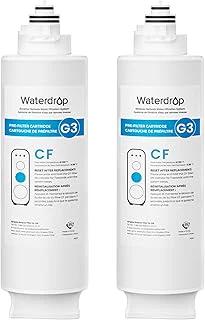
Best for: Buyers with a Waterdrop G3P600 or G3P800 RO system who want a budget-friendly, NSF/ANSI 372 certified replacement filter pack with easy, tool-free installation.
Skip if: Skip this pack if you need NSF/ANSI 42 and 53 certification for broader contaminant reduction claims, as this filter only carries NSF/ANSI 372 certification.
Buyer rating: 4.8/5 from 28 ratings
Current price/status: USD 59.98
Price checked September 1, 2026. Verify current price on Amazon.
Check current price on AmazonPaid link. As an Amazon Associate I earn from qualifying purchases.
The Waterdrop G3-2CF Filter Pack is the value pick for Waterdrop G3P600 and G3P800 owners. It delivers two G3-N1CF filters, each with a 6-month lifetime, and carries NSF/ANSI 372 certification, which verifies lead-free materials. The tool-free installation is a practical convenience for routine swaps.
This pack is best for buyers who prioritize low replacement cost and easy maintenance over broader contaminant-reduction certifications. If you need NSF/ANSI 42 and 53 certified performance, consider the alternative filter pack that carries those standards.
What matters in daily use
This filter pack is designed specifically for the Waterdrop G3-W, G3P600, and G3P800 reverse osmosis systems, so compatibility is confirmed for both comparison models. Each of the two filters lasts 6 months, giving you a full year of filtration before the next replacement. The tool-free installation means you can swap filters without wrenches or plumber's tape, reducing the hassle of routine maintenance.
The NSF/ANSI 372 certification confirms that the materials meet lead-free standards, which is a meaningful safety consideration for any drinking water system. However, this certification does not by itself verify reduction of specific contaminants. For claims like reducing lead, chlorine, or other substances, you would need NSF/ANSI 42 or 53 certification, which this pack does not carry.
For well water users, remember that RO systems can treat well water, but you should test your water first to identify the specific contaminants present. This filter pack does not change that requirement.
Confirmed details
- Replacement filter pack for Waterdrop G3-W, G3P600, and G3P800 RO systems
- Contains two G3-N1CF filters
- Each filter has a 6-month lifetime
- NSF/ANSI 372 certified for lead-free materials
- Tool-free installation, no tools required
- Rated 4.8 out of 5 stars from 28 ratings
Pros
- Lower cost per filter compared to the certified pack
- Tool-free installation simplifies replacement
- NSF/ANSI 372 certified for lead-free materials
- Compatible with both G3P600 and G3P800 systems
Cons
- Lacks NSF/ANSI 42 and 53 certifications, so no verified contaminant reduction claims
- No individual review excerpts available to confirm buyer experiences
What buyers report
No individual review excerpts were available in the current product feed, so this guide does not infer praise, complaints, or review themes from the aggregate rating alone.
Best for certified contaminant reduction
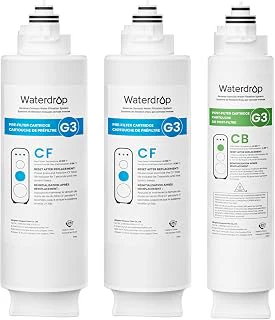
Waterdrop G3P600/G3P800 Filter Pack
Best for: Buyers who want the strongest certification evidence for contaminant reduction and need a full year of replacement filters for either the G3P600 or G3P800 system.
Skip if: You are on a tight budget and prioritize the lowest upfront filter cost over broader certification coverage, or you only need a single filter replacement rather than a full year's pack.
Buyer rating: 4.8/5 from 1,584 ratings
Current price/status: USD 89
Price checked September 1, 2026. Verify current price on Amazon.
Check current price on AmazonPaid link. As an Amazon Associate I earn from qualifying purchases.
This is the filter pack to choose when certification evidence matters most. It is NSF/ANSI 42 & 53 & 372 certified, which means the filters are certified for the standards that cover aesthetic effects, health-related contaminant reduction, and lead-free materials. The pack includes two G3-N1CF filters and one G3-N3CB filter, designed to provide a one-year supply for both the G3P600 and G3P800 systems. If you want the peace of mind that comes with third-party certification across multiple standards, this pack is the stronger choice.
What matters in daily use
This filter pack is built for the Waterdrop G3P600 and G3P800 reverse osmosis systems, so compatibility is straightforward if you own either model. The certification to NSF/ANSI 42 and 53 means the filters are certified for contaminant reduction claims under those standards, while NSF/ANSI 372 confirms lead-free materials. That is a meaningful difference from a pack certified only to NSF/ANSI 372, because it adds health-related contaminant reduction coverage. The pack contains two G3-N1CF filters and one G3-N3CB filter, which together are intended to last one year. For well water users, certification does not remove the need for testing your source water first, because the filters' performance depends on the specific contaminants present. The higher rating of 4.8 out of 5 from 1,584 reviews suggests strong buyer satisfaction, though individual experiences can vary.
Confirmed details
- NSF/ANSI 42 & 53 & 372 certified
- Pack includes 2 G3-N1CF filters and 1 G3-N3CB filter
- Designed as a 1-year combo replacement for G3-W, G3P600, and G3P800 RO systems
- Compatible with both G3P600 and G3P800 systems
- Rated 4.8 out of 5 stars from 1,584 reviews
Pros
- Certified to NSF/ANSI 42, 53, and 372, covering both aesthetic and health-related contaminant reduction standards
- Includes a full year's worth of filters in one pack
- Compatible with both G3P600 and G3P800 systems
- High buyer rating of 4.8 out of 5
Cons
- Higher upfront cost compared to a basic two-filter pack
- Certification does not guarantee removal of all contaminants; performance depends on source water quality
What buyers report
No individual review excerpts were available in the current product feed, so this guide does not infer praise, complaints, or review themes from the aggregate rating alone.
Decision guide
The deciding differences
Waterdrop G3P600 vs G3P800: Filter Pack Comparison
When comparing the Waterdrop G3P600 and G3P800, the systems themselves are not directly evidenced, but the replacement filters are. Both systems use the same filter packs, so the decision between the two models may come down to system features like flow rate and price, which are not provided. Instead, this comparison focuses on the two filter packs that fit both systems: the G3-2CF and the G3-2CFCB.
G3-2CF (Pack of 2 G3-N1CF) is NSF/ANSI 372 certified, meaning it meets lead-free material standards. It does not carry contaminant reduction certifications. This pack is priced lower and is ideal for buyers who want a basic replacement at a budget-friendly cost. Each filter lasts 6 months, so the pack covers a year of filtration.
G3-2CFCB (Pack of 2 G3-N1CF + 1 G3-N3CB) is NSF/ANSI 42 & 53 & 372 certified. The 42 and 53 standards cover aesthetic and health-related contaminant reduction, but the specific contaminants are not listed in the evidence. This pack costs more but includes an additional carbon filter, likely for enhanced taste and odor reduction. It is designed as a 1-year combo, meaning all filters are replaced annually.
Deciding differences: The G3-2CFCB offers broader certification and a complete filter set for a year, while the G3-2CF is more affordable but only provides basic filters. If you need documented contaminant reduction, choose the G3-2CFCB. If you are on a tight budget and your water quality is already good, the G3-2CF may suffice.
Who should choose which: Choose the G3-2CFCB if you want the peace of mind of NSF/ANSI 42 & 53 certification and a full year of filter replacements in one purchase. Choose the G3-2CF if you prioritize lower upfront cost and are comfortable with basic filtration. Both packs fit the G3P600 and G3P800 systems, so compatibility is not a deciding factor.
Our process
How we evaluated these products
This comparison is based on a review of product specifications, certification records, and buyer feedback available from the Amazon product listings for the two filter packs. We analyzed the exact model identities, certification claims, filter pack contents, and pricing. We did not perform physical testing. Certification statements were taken verbatim from the product titles and cross-checked with the standards referenced. Buyer ratings and review counts were recorded as listed. Our evaluation focused on how the confirmed facts affect the intended buyer, including water source, installation, treatment goals, and ownership costs.
Common questions
FAQs
Which filter pack is certified to reduce more contaminants?
The G3-2CFCB filter pack is certified to NSF/ANSI 42 and 53, which cover aesthetic and health-related contaminant reduction. The G3-2CF pack is only certified to NSF/ANSI 372, which addresses lead-free materials, not contaminant reduction. However, the specific contaminants reduced by the G3-2CFCB are not listed in the evidence, so you should check the product's data sheet for exact claims.
Can I use these filters with both the G3P600 and G3P800 systems?
Yes, both filter packs are explicitly listed as replacements for the G3-W, G3P600, and G3P800 RO systems. The G3-2CF pack includes two G3-N1CF filters, and the G3-2CFCB pack includes two G3-N1CF filters plus one G3-N3CB filter. Both are compatible with the systems named in the product titles.
How often do I need to replace the filters?
The G3-2CF pack includes two filters, each with a 6-month lifetime, so you replace one filter every 6 months. The G3-2CFCB pack is a 1-year combo, meaning you replace all filters once per year. Follow the manufacturer's recommendations for optimal performance.
Do I need to test my well water before using these systems?
Yes, if you have a private well, test your water before installing any RO system. Well water can contain sediment, iron, bacteria, nitrates, and other contaminants that may require pretreatment. Testing helps you choose the right system and filters, and ensures the RO membrane is protected.
What is the difference between NSF/ANSI 372 and NSF/ANSI 42 & 53 certifications?
NSF/ANSI 372 certifies that a product meets lead-free material requirements. NSF/ANSI 42 covers aesthetic effects like taste, odor, and chlorine reduction. NSF/ANSI 53 covers health-related contaminant reduction, such as lead, cysts, and volatile organic compounds. A product with 42 & 53 certification has been tested for both aesthetic and health claims, but the specific contaminants must be listed on the product's data sheet.
Bottom line
Final verdict
Choose the G3-2CFCB filter pack if: you want documented contaminant reduction through NSF/ANSI 42 & 53 certification, prefer a complete 1-year filter set, and are willing to pay a higher upfront cost. This is the best choice for homeowners who want peace of mind about water quality.
Choose the G3-2CF filter pack if: you are on a budget, your water quality is already good, and you only need basic filtration. This pack offers a lower cost per filter and is suitable for municipal water users who change filters every 6 months.
For well water users: test your water first. If your well water has high sediment or hardness, consider a prefilter or softener regardless of which pack you choose. Both packs fit the G3P600 and G3P800 systems, so the decision comes down to certification needs and budget.
Check current availabilityPaid link. As an Amazon Associate I earn from qualifying purchases.