7 Best Under Sink Water Filter for Well Water (2026), Matched to How You Use Them
Published October 29, 2026
As an Amazon Associate we earn from qualifying purchases. This never changes which products we recommend.
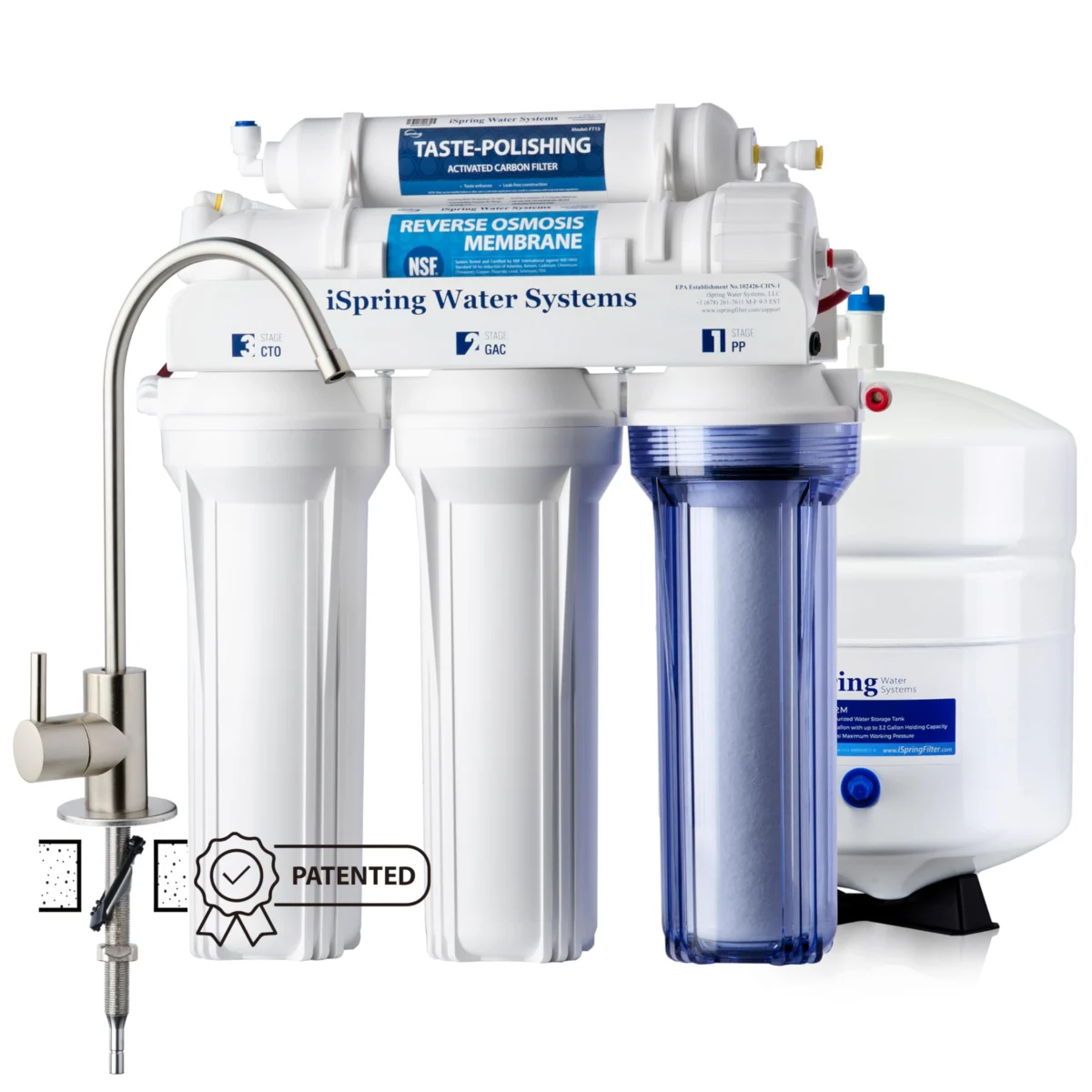
The iSpring RCC7-BN is the closest match for most well owners who need dissolved contaminants handled, because its five-stage reverse osmosis design is certified to NSF/ANSI 58 and the listing names fluoride, lead and PFAS among the reductions. A carbon-only under sink filter cannot touch nitrate or arsenic, and that gap decides most well purchases.
The real dividing line is what your water carries. Sediment, rust and sulfur foul cartridges and belong upstream of the kitchen sink; dissolved nitrate, arsenic and fluoride need a membrane. Every pick below is judged on how much pretreatment it demands and how fast heavy sediment will end its filter life.
 Best OveralliSpring RCC7-BNWells with dissolved contaminants on the lab report8.7/10
 Best Reverse Osmosis with RemineralizationiSpring RCC7AK-BNRO buyers who want minerals and pH restored8.6/10
 Longest Cartridge LifeCuZn UC-200Clean-tasting wells with light sediment8.6/10
 Best Budget-Friendly OptionWaterdrop 10UATight budgets and small cabinets8.5/10
Table of contents9 sections · tap to expand
At a glance
Our top picks compared
| Product | Best for | Type and size | Key features | Where to buy |
|---|---|---|---|---|
| 1. iSpring RCC7-BN Best Overall 8.7/10 | Wells with dissolved contaminants on the lab report | Reverse osmosis system, 75 gallons, 75 GPD | NSF certifiedLead reductionPFAS reductionFluoride | Mid-range Check price |
| 2. iSpring RCC7AK-BN Best Reverse Osmosis with Remineralization 8.6/10 | RO buyers who want minerals and pH restored | Reverse osmosis system, 75 gallons, 75 GPD | NSF certifiedLead reductionPFAS reductionFluoride | Premium Check price |
| 3. CuZn UC-200 Longest Cartridge Life 8.6/10 | Clean-tasting wells with light sediment | Under sink filter, 6 months | NSF certifiedLead reductionPFAS reductionInstallation | Mid-range Check price |
| 4. Waterdrop 10UA Best Budget-Friendly Option 8.5/10 | Tight budgets and small cabinets | Under sink filter, 11,000 gallons | NSF certifiedLead reductionPFAS reductionFilter life listed | Budget Check price |
 5. Waterdrop 10UB Best with a Dedicated Faucet 8.4/10 | Kitchen taps shared with unfiltered water | Under sink filter, 11,000 gallons | NSF certifiedLead reductionPFAS reductionInstallation | Budget Check price |
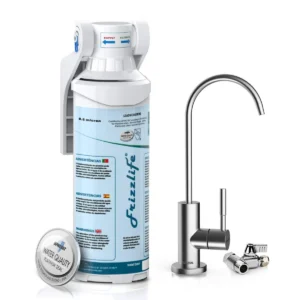 6. Frizzlife MP99 Best for Lead and Fine Sediment 8.4/10 | 0.5 micron filtration at high flow | Under sink filter, 800 gallons, 1.5 GPM | NSF certifiedLead reductionEasy installFilter life listed | Budget Check price |
 7. Frizzlife PD600-TAM3 Best Tankless RO for Renters 8.3/10 | No-tank installs with low wastewater | Reverse osmosis system, 600 gallons, 600 GPD | NSF certifiedPFAS reductionRemineralizingFilter life listed | Premium Check price |
Score: our 0-10 rating from fit for this use, buyer ratings, review volume, completeness of the product details and availability. It is not a lab test.
Buying advice
How to choose an under sink filter for well water
Start with the lab result, not the cartridge
The contaminant on your report decides the technology. Chlorine taste, odor and sediment are carbon and sediment work; nitrate, arsenic and fluoride are dissolved and need a reverse osmosis membrane certified to NSF/ANSI 58. Buying a carbon block for a nitrate problem leaves the problem in the glass, so match the named contaminant to the certification before comparing prices.
Check the micron rating and plan for sediment
A well with visible grit or rust will blind a carbon cartridge quickly, so the first stage matters as much as the last. A 0.5 micron rating, as on the Frizzlife MP99, catches finer particles than a nominal carbon block, but any under sink cartridge still benefits from a sediment prefilter upstream. Without one, rated filter life is a city-water number, not a well-water one.
Weigh filter life against flow and pressure
Long rated life means little if the cartridge clogs in two months, and high flow means little if your well pump cannot supply it. Compare gallons or months of rated life with the flow figure and the pressure the unit needs, then decide whether a booster pump or a larger prefilter is the cheaper fix. Reverse osmosis also adds wastewater and a drain connection to the plan.
Confirm the certification covers your contaminant
NSF/ANSI 42 covers aesthetic effects such as chlorine taste and odor, NSF/ANSI 53 covers health effects such as lead and cysts, NSF/ANSI 58 covers reverse osmosis systems, NSF/ANSI 372 covers lead-free materials and NSF/ANSI 401 covers some emerging contaminants. A listing that says NSF/ANSI 42 only is not evidence of lead or PFAS reduction, so read which standard is named and which contaminant it covers.
Our picks
The best under sink filters for well water, ranked
Best Overall
iSpring RCC7-BN
- Reverse osmosis system
- NSF/ANSI 58
- 75 gallons
- 75 GPD
- Chlorine, Lead, PFAS
- DIY install
Best for: Wells with dissolved contaminants on the lab report
Skip if: Your well report shows bacteria or nitrates that need whole house treatment first.
Price range: Mid-range
Check price on AmazonPaid link. We may earn a commission.
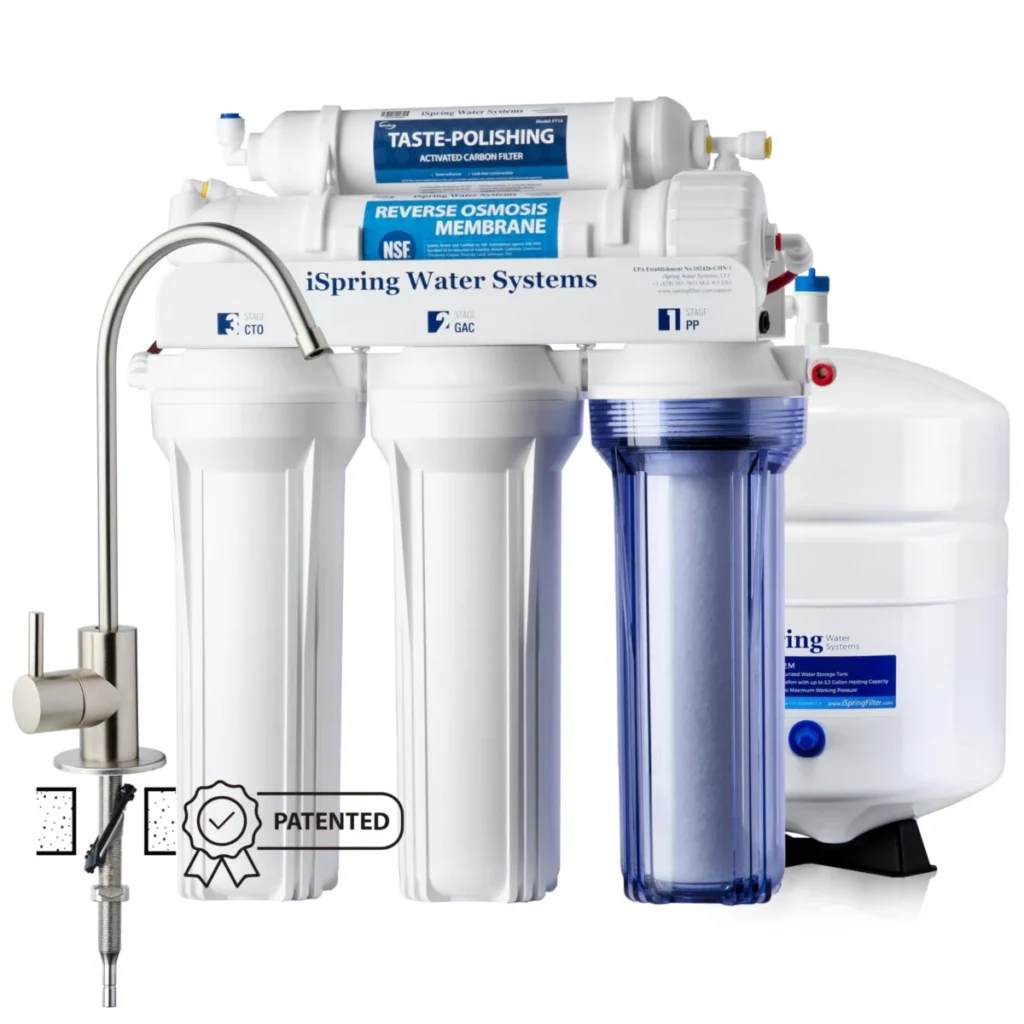
Best Overall for well water because its NSF/ANSI 58 certification and 5-stage reverse osmosis design target the dissolved contaminants a lab test most often flags on private wells.
What matters in daily use
A 75 GPD rating means roughly three gallons an hour of stored, filtered water, which suits drinking and cooking for a household rather than filling a bathtub. The five stages pair a reverse osmosis membrane with activated carbon and carbon block, so chlorine taste and dissolved contaminants are addressed in one under sink unit. NSF/ANSI 58 certification covers the reverse osmosis system itself, which is the standard to look for when a well report shows fluoride, arsenic or lead.
The tradeoff is that reverse osmosis needs a cold supply line, a drain connection and cabinet space for the tank, and it discards some water as concentrate. For a well with bacteria or nitrates, no under sink filter substitutes for treatment at the point of entry, so test first. Compared with the iSpring RCC7AK-BN, this model stops at five stages and skips the mineral stage, which matters if you dislike flat-tasting RO water.
Specifications
| Type | Reverse osmosis system |
|---|---|
| Certifications | NSF/ANSI 58 |
| Reduces | Chlorine, Lead, PFAS, Fluoride (named in listing) |
| Filter life | 75 gallons |
| Flow rate | 75 GPD |
| Stages | 5 stages |
| Installation | DIY install |
Pros
- NSF/ANSI 58 certification covers the full RO system
- Five stages handle dissolved contaminants and taste
- Top-mounted faucet design simplifies countertop installation
- No electricity required to operate
Cons
- Needs a drain line and cabinet space for the tank
- Produces wastewater concentrate during operation
- No remineralization stage, so taste may seem flat
Best Reverse Osmosis with Remineralization
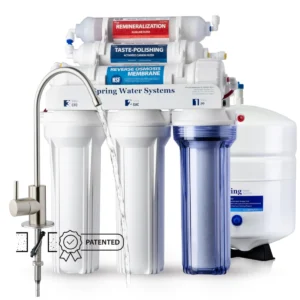
iSpring RCC7AK-BN
- Reverse osmosis system
- NSF/ANSI 58
- 75 gallons
- 75 GPD
- Chlorine, Lead, PFAS
- DIY install
Best for: RO buyers who want minerals and pH restored
Skip if: You have limited under sink height or want a tankless layout.
Price range: Premium
Check price on AmazonPaid link. We may earn a commission.
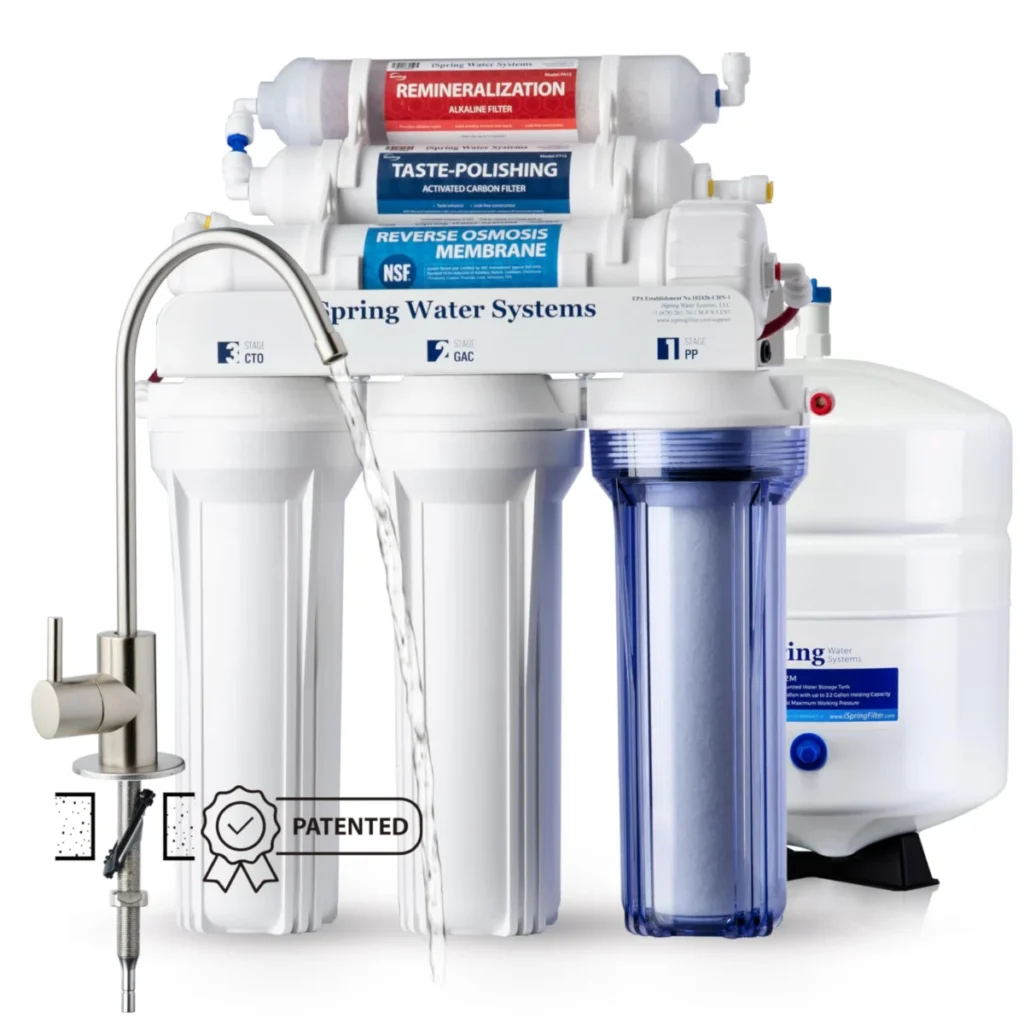
Best Reverse Osmosis With Remineralization: the sixth alkaline stage restores minerals and pH that the RO membrane strips out, while NSF/ANSI 58 certification still covers the system.
What matters in daily use
The extra stage is the whole point. A reverse osmosis membrane removes dissolved solids, and that includes the minerals that give water its body, so the RCC7AK-BN adds a mineral stage after the membrane to bring pH and taste back toward neutral. It keeps the same 75 GPD output and 75 gallon capacity as the iSpring RCC7-BN, so the flow and storage behavior are unchanged; what differs is what happens to the water after it leaves the membrane.
Installation is DIY with quick-fitting connections and the same top-mounted faucet design, but the sixth housing adds height and another cartridge to the replacement schedule. Compare it with the Frizzlife PD600-TAM3 if cabinet space is tight: that unit is tankless and rated 600 GPD, while this iSpring relies on a storage tank. Choose this one when taste and mineral content matter more than footprint.
Specifications
| Type | Reverse osmosis system |
|---|---|
| Certifications | NSF/ANSI 58 |
| Reduces | Chlorine, Lead, PFAS, Fluoride, Copper (named in listing) |
| Filter life | 75 gallons |
| Flow rate | 75 GPD |
| Stages | 6 stages |
| Installation | DIY install |
| Remineralization | Yes |
Pros
- Remineralization stage restores pH and minerals
- Full-system NSF/ANSI 58 certification
- Same 75 GPD output as the standard RCC7-BN
- Quick-fitting connections and step-by-step setup guidance
Cons
- Sixth housing adds height under the sink
- One more cartridge to replace on schedule
- Storage tank still occupies cabinet space
Longest Cartridge Life
CuZn UC-200
- Under sink filter
- NSF/ANSI 42, NSF/ANSI
- 6 months
- Chlorine, Lead, PFAS
- DIY install

Best for: Clean-tasting wells with light sediment
Skip if: Your lab test shows high TDS, fluoride or arsenic that need reverse osmosis.
Price range: Mid-range
Check price on AmazonPaid link. We may earn a commission.
Longest Cartridge Life goes to the CuZn UC-200 because its 3-stage KDF-55 and coconut carbon design is rated for a 5-year service life, far beyond the 6-month cycles typical of under sink filters.
What matters in daily use
KDF-55 media plus coconut shell carbon and micro sediment membranes handle chlorine, sediment and the metals the listing names, and the unit is built as an inline filter that connects to the existing faucet without drilling. That makes it the least invasive option here for a renter or anyone who does not want a second tap.
The published dimensions of 5.5 inches deep by 14 inches wide by 5.5 inches high and a 7.02 lb weight describe the whole unit, which is compact enough for most cabinets.
The limit is scope. The listing states plainly that the UC-200 does not reduce TDS, so it is not a substitute for reverse osmosis when a well report shows fluoride, arsenic or high dissolved solids; the iSpring RCC7-BN is the pick for that job. Its certifications are NSF/ANSI 42 and NSF/ANSI 372, which cover aesthetic effects and lead-free materials rather than the health-effect claims of NSF/ANSI 53.
Specifications
| Type | Under sink filter |
|---|---|
| Certifications | NSF/ANSI 42, NSF/ANSI 372 |
| Reduces | Chlorine, Lead, PFAS, Sediment (named in listing) |
| Filter life | 6 months |
| Stages | 3 stages |
| Installation | DIY install |
| Weight | 7.02 lb |
Pros
- Five-year rated life cuts replacement frequency sharply
- No drilling and no extra faucet needed
- Compact inline body fits tight cabinets
- Retains beneficial minerals rather than stripping them
Cons
- Does not reduce TDS, fluoride or arsenic
- Certified for aesthetic effects and lead-free materials, not health-effect reduction claims
- Not a substitute for RO on high-solids well water
Best Budget-Friendly Option
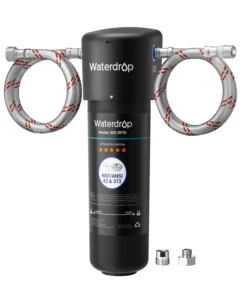
Waterdrop 10UA
- Under sink filter
- NSF/ANSI 42
- 11,000 gallons
- Chlorine, Lead, PFAS

Best for: Tight budgets and small cabinets
Skip if: Your lab test shows nitrates, arsenic or hardness that carbon media cannot reduce.
Price range: Budget
Check price on AmazonPaid link. We may earn a commission.
The Waterdrop 10UA earns Best Budget-Friendly Option because its 11,000 gallon capacity and compact 12.3 inch housing deliver long service life in the smallest under sink footprint here.
What matters in daily use
The twist-and-lock design and push-to-connect fittings keep installation to minutes on a cold line.
The tradeoff is scope. This is an NSF/ANSI 42 carbon block system aimed at chlorine, taste and odor, with lead and PFAS named in the listing, so it does not touch the dissolved minerals, nitrates or hardness a well lab test often flags. If your report shows those, the iSpring RCC7-BN is the pick; the 10UA suits wells whose main complaint is taste and sediment.
The 20X dirt adhesion area upgrade in the filtration design is meant to resist clogging on sediment-heavy well water, which matters because a loaded cartridge slows flow long before its rated life ends. It also accepts UF or MZ replacement filters, so buyers can adjust the media to their water rather than replace the whole system.
Specifications
| Type | Under sink filter |
|---|---|
| Certifications | NSF/ANSI 42 |
| Reduces | Chlorine, Lead, PFAS (named in listing) |
| Filter life | 11,000 gallons |
Pros
- 11,000 gallon rating spreads replacement cost over years
- Slim 12.3 inch housing fits tight cabinets
- Twist-and-lock changes take seconds
- Accepts UF or MZ filters for different water
Cons
- NSF/ANSI 42 covers aesthetic claims, not health claims
- No reduction of dissolved minerals or nitrates
- Cold water supply only
Best with a Dedicated Faucet
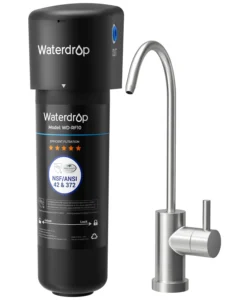
Waterdrop 10UB
- Under sink filter
- NSF/ANSI 42, NSF/ANSI
- 11,000 gallons
- Chlorine, Lead, PFAS
- DIY install
Best for: Kitchen taps shared with unfiltered water
Skip if: You want the lowest possible cost and already have a spare faucet hole.
Price range: Budget
Check price on AmazonPaid link. We may earn a commission.
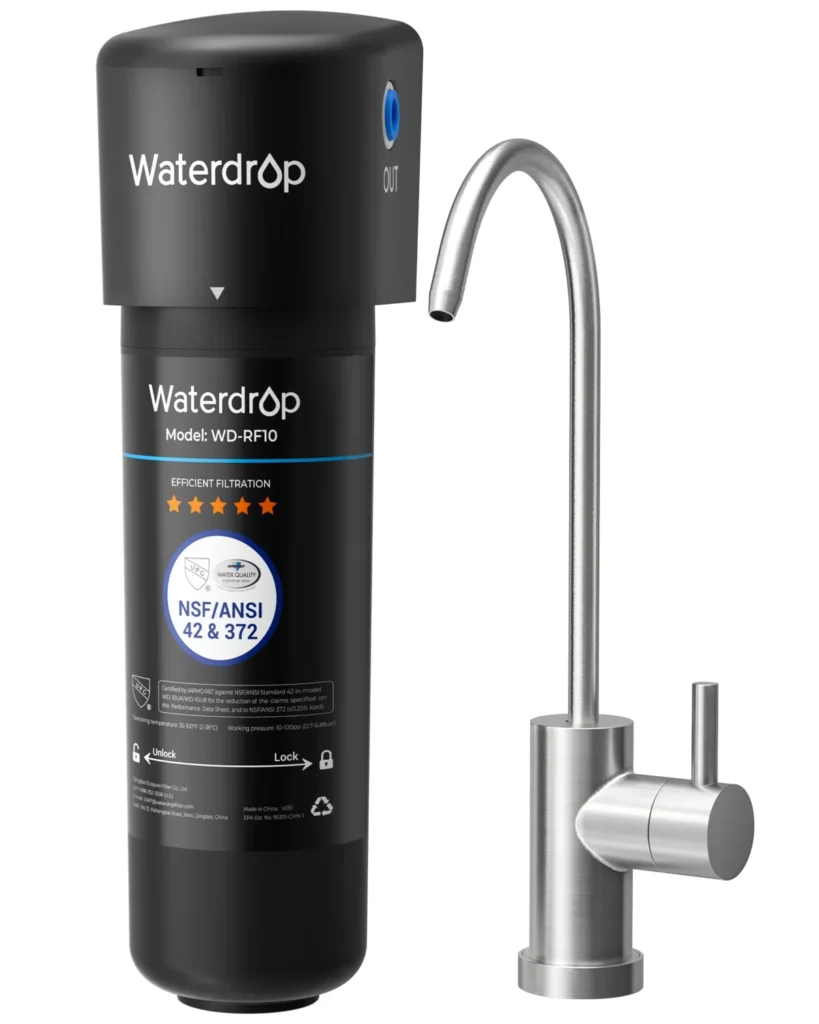
The Waterdrop 10UB takes Best With a Dedicated Faucet because the included lead-free brushed stainless steel faucet separates filtered drinking water from the unfiltered kitchen tap.
What matters in daily use
Well owners who still wash dishes and cook with tap water get a clean split here: the 10UB sends filtered water to its own SS304 faucet while the main tap runs untreated, so cartridge life is not burned on rinse water. The 11,000 gallon capacity matches the Waterdrop 10UA, and the same 3.9 by 3.6 by 12.3 inch body keeps the cabinet usable.
Certification is the differentiator against the 10UA. This system carries NSF/ANSI 42 and NSF/ANSI 372, the latter covering lead-free materials from the fittings through the faucet, which matters on older well plumbing where lead solder or brass can contribute. It still does not reduce dissolved contaminants, so a lab report showing nitrates or arsenic points to the iSpring RCC7-BN instead.
Specifications
| Type | Under sink filter |
|---|---|
| Certifications | NSF/ANSI 42, NSF/ANSI 372 |
| Reduces | Chlorine, Lead, PFAS (named in listing) |
| Filter life | 11,000 gallons |
| Installation | DIY install |
Pros
- Dedicated faucet keeps unfiltered water off the cartridge
- NSF/ANSI 372 covers lead-free wetted materials
- Same long 11,000 gallon life as the 10UA
- Three-minute install with push-to-connect fittings
Cons
- Requires a spare faucet hole in the sink
- Does not reduce dissolved well contaminants
- Cold water source only
Best for Lead and Fine Sediment
Frizzlife MP99
- Under sink filter
- NSF/ANSI 42, NSF/ANSI 53
- 800 gallons
- 1.5 GPM
- Chlorine, Lead
- No installation
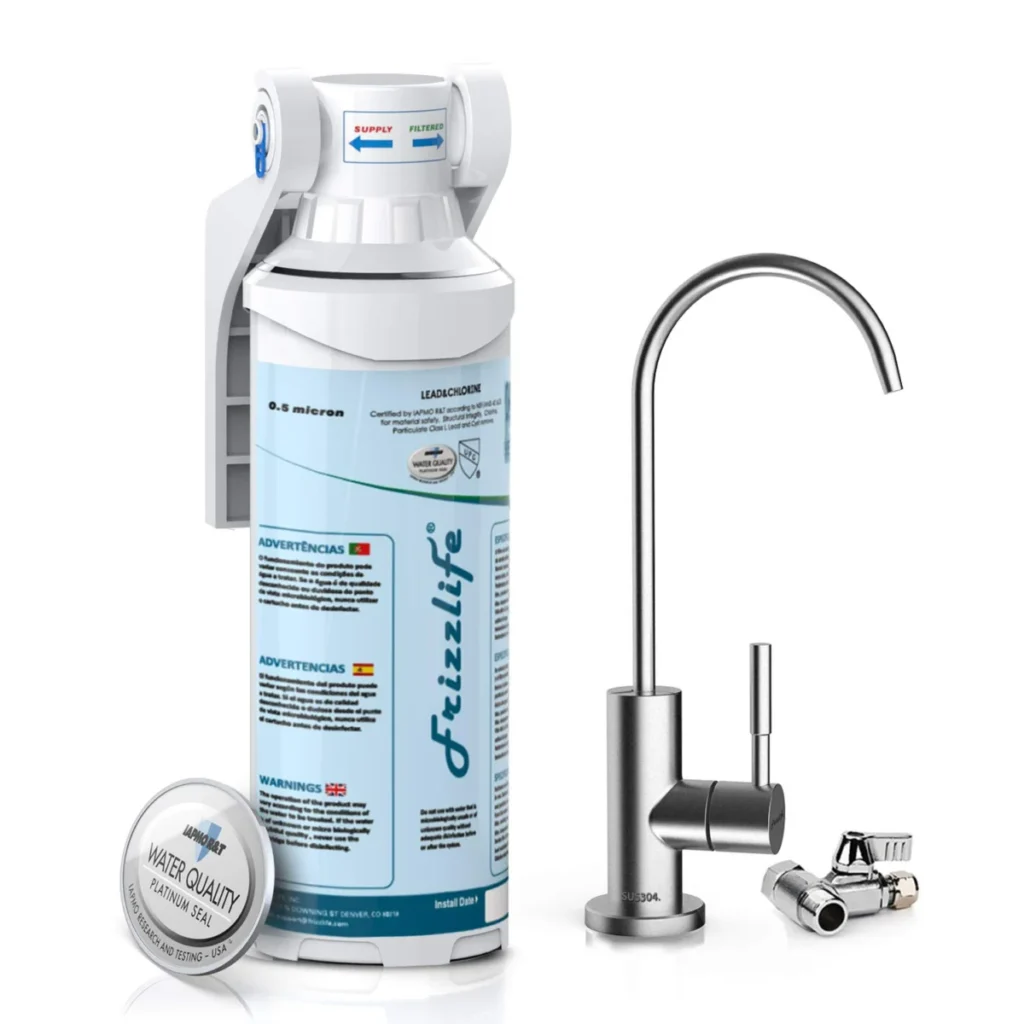
Best for: 0.5 micron filtration at high flow
Skip if: You want years between cartridge changes rather than frequent swaps.
Price range: Budget
Check price on AmazonPaid link. We may earn a commission.
The Frizzlife MP99 earns Best for Lead and Fine Sediment because its 0.5 micron two-stage filter is certified to NSF/ANSI 53 for lead while flowing 1.5 GPM.
What matters in daily use
A 0.5 micron rating is the tightest in this lineup, and on a well it means fine sediment, rust and cysts are physically held back rather than just chemically treated. The NSF/ANSI 53 listing covers lead reduction, a health claim the NSF/ANSI 42 systems here cannot make, and 1.5 GPM at 80 psi fills a glass in about five seconds, so the fine media does not cost you flow.
The compromise is cartridge life. At 800 gallons, the MP99 needs changing far more often than the 11,000 gallon Waterdrop 10UA, so a household using several gallons a day should weigh yearly cartridge cost before choosing it. It also leaves dissolved minerals, nitrates and hardness untouched, which is the iSpring RCC7-BN's territory.
Specifications
| Type | Under sink filter |
|---|---|
| Certifications | NSF/ANSI 42, NSF/ANSI 53 |
| Reduces | Chlorine, Lead (named in listing) |
| Filter life | 800 gallons |
| Flow rate | 1.5 GPM |
| Micron rating | 0.5 micron |
| Stages | 2 stages |
| Installation | No installation |
Pros
- 0.5 micron rating catches fine well sediment
- NSF/ANSI 53 certification for lead reduction
- 1.5 GPM flow fills a glass in seconds
- Tool-free twist-in cartridge replacement
Cons
- 800 gallon life means frequent cartridge changes
- No reduction of dissolved minerals or nitrates
- Full flow depends on adequate line pressure
Best Tankless RO for Renters
Frizzlife PD600-TAM3
- Reverse osmosis system
- NSF/ANSI 42, NSF/ANSI
- 600 gallons
- 600 GPD
- PFAS
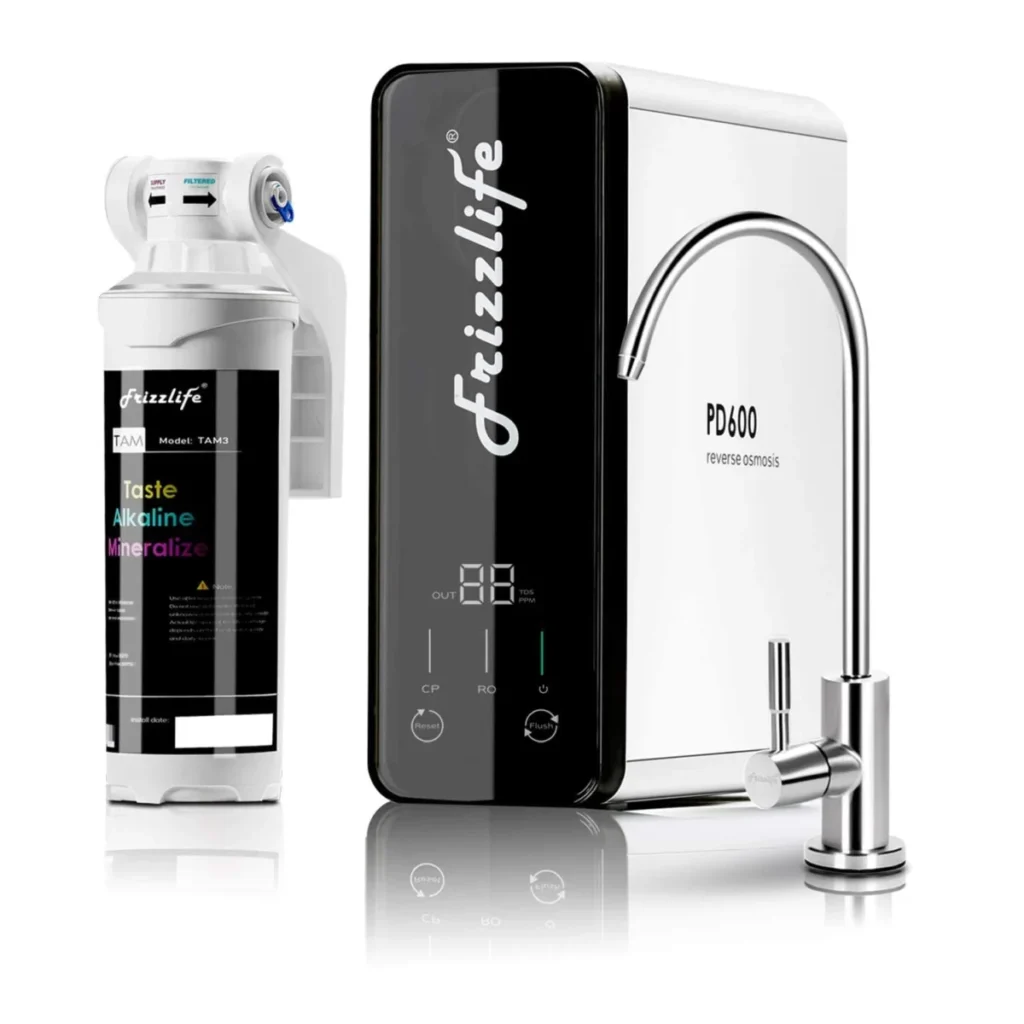
Best for: No-tank installs with low wastewater
Skip if: Your well test shows iron, sulfur or bacteria rather than dissolved contaminants.
Price range: Premium
Check price on AmazonPaid link. We may earn a commission.
Earns Best Tankless RO for Renters because it delivers 600 GPD from a tankless body with a 2:1 pure-to-drain ratio, so it fits small cabinets and wastes less water than a tank-style system.
What matters in daily use
The PD600-TAM3 is a tankless reverse osmosis system rated at 600 GPD, so it produces water on demand instead of drawing from a storage tank. That matters under a kitchen sink where floor space is contested: the published dimensions of 14.7 by 5.3 by 15.5 inches describe a slim unit that mounts against a cabinet wall.
The 2:1 pure-to-drain ratio means roughly two gallons of filtered water for every gallon sent to the drain, a meaningful figure for a well household watching pump and pressure-tank drawdown.
Because reverse osmosis strips dissolved minerals along with contaminants, the TAM3 alkaline stage is included to restore minerals and balance pH, which addresses the flat taste many people notice from RO water. The tradeoff is that RO is the wrong tool for every well: it targets dissolved contaminants such as PFAS, not iron, sulfur odor or bacteria, so the lab report decides whether it fits.
Specifications
| Type | Reverse osmosis system |
|---|---|
| Certifications | NSF/ANSI 42, NSF/ANSI 53, NSF/ANSI 58, NSF/ANSI 372 |
| Reduces | PFAS (named in listing) |
| Filter life | 600 gallons |
| Flow rate | 600 GPD |
| Tank | Tankless |
| Wastewater ratio | 2:1 pure |
| Remineralization | Yes |
Pros
- Tankless body frees cabinet floor space
- 600 GPD output suits larger households
- 2:1 ratio wastes less water than older RO designs
- Remineralization stage restores minerals and pH
Cons
- RO does not address iron, sulfur or bacteria
- Needs electricity, unlike the tank-style iSpring systems
- Higher upfront cost than carbon-only under sink filters
Should you test your well water before buying a filter?
Yes. Private well water is not regulated the way city water is, so the EPA and CDC both recommend testing, and the result should pick the filter rather than the other way around. A useful baseline panel covers bacteria (total coliform and E. coli), nitrate, arsenic, iron, manganese, hardness, pH and sulfate, since each one points to a different treatment.
Read the numbers as a shopping list. Iron and manganese above trace levels stain fixtures and foul carbon, nitrate and arsenic are dissolved and need reverse osmosis or a dedicated media, hardness drives scale, and a positive bacteria result means disinfection comes before any drinking water cartridge. Retest annually and after any change in taste, color or flow.
Do you need a whole house prefilter ahead of an under sink unit?
Often yes. A sediment prefilter or whole house stage ahead of the kitchen cartridge catches rust, grit and oxidized iron before they reach the carbon block or membrane, and that single addition can be the difference between a cartridge lasting its rated life and one that clogs in weeks. Visible sediment, staining or a rotten-egg odor are the signals to treat upstream first.
Hydrogen sulfide and dissolved iron are the harder cases. Sulfur odor is best handled with aeration or catalytic carbon at the point of entry, and dissolved iron usually needs oxidation and filtration before a softener. An under sink filter can polish taste after those steps, but it is not the right tool for the raw problem.
Decision guide
Which under sink filter fits your well test result?
The two iSpring systems share a 75 GPD rating and NSF/ANSI 58 certification, so the choice between them is about taste rather than treatment. The RCC7AK-BN adds a sixth remineralization stage that restores minerals and pH after the membrane, which matters if you find RO water flat; the RCC7-BN keeps the simpler five-stage path and a lower stage count to maintain.
Among the carbon options, the CuZn UC-200 claims a five-year life while the Waterdrop 10UA and 10UB are rated at 11,000 gallons, and both figures assume reasonably clean feed water. On a well with sediment, the Frizzlife MP99's 0.5 micron rating and 1.5 GPM flow make it the more forgiving choice, while the Frizzlife PD600-TAM3 is the pick when you want tankless RO with a 2:1 pure-to-drain ratio and no storage tank under the cabinet.
Our process
How we chose our Under Sink Water Filter for Well Water picks
Products were shortlisted from under sink systems whose published specifications address well water conditions: sediment handling, dissolved contaminant reduction, certification to a named NSF/ANSI standard, rated filter life and flow. Ranking weighed how well each unit matches a real well test result, how much pretreatment it needs to reach its rated life, installation demands such as drain lines and cabinet space, and buyer feedback. No unit was tested; the assessment rests on specifications, materials, design and reported owner experience.
Common questions
Frequently asked questions
Will an under sink filter remove iron and sulfur smell from well water?
Usually not on its own. Carbon can polish low-level taste and odor, but dissolved iron fouls cartridges and hydrogen sulfide overwhelms them, so both are normally treated at the point of entry with oxidation, aeration or catalytic carbon before the kitchen unit. Test first, then treat upstream.
Does reverse osmosis work on well water?
Yes, provided the water is pretreated. An RO membrane reduces dissolved contaminants such as nitrate, arsenic and fluoride, but sediment, iron and hardness scale can clog or tear it, so a sediment prefilter and often a softener come first. The iSpring and Frizzlife RO systems here assume that upstream protection.
Do I need a sediment filter before an under sink water filter on a well?
A sediment prefilter is strongly advised on any well with visible grit, rust or turbidity. It catches particles before they reach the carbon block or membrane, which protects rated filter life. Without it, a cartridge rated for a year of municipal water may clog in weeks on a gritty well.
How often do I change filters on well water?
More often than the box suggests until you know your water. Start with the manufacturer interval, inspect the first-stage housing monthly if it is transparent, and shorten the schedule after any sediment event, pump work or heavy rain. A lab retest and a look at the cartridge tell you more than the calendar.
Is under sink filtration enough for a well with bacteria?
No. A positive coliform or E. coli result calls for disinfection of the well and plumbing, typically shock chlorination followed by retesting, and often UV treatment at the point of entry. Under sink carbon and RO cartridges are not a substitute for fixing a bacteriological problem, so follow local authority guidance.
Bottom line
Final verdict
- Well owners with dissolved contaminants such as arsenic, nitrate or fluoride: iSpring RCC7-BN. Its NSF/ANSI 58 five-stage reverse osmosis design is the only kind here that targets dissolved contaminants, at the cost of a drain line, tank space and wastewater.
- Households that dislike the flat taste of RO water: iSpring RCC7AK-BN. The same 75 GPD RO platform with a remineralization stage that restores minerals and pH, trading one more cartridge to maintain for better-tasting water.
- Renters and small cabinets with low wastewater tolerance: Frizzlife PD600-TAM3. A tankless 600 GPD design with a 2:1 pure-to-drain ratio frees under-sink space and wastes less water, though it still needs a drain connection and pretreatment.
- Wells with only taste, odor and light sediment problems: CuZn UC-200. A three-stage carbon and KDF design with a long rated life keeps the install simple and the cost low, as long as a sediment prefilter protects it.
Final decision
Compare two finalists
Choose the two picks you narrowed down to see who each one suits and the main reason to skip it.