Dirty Sediment Filter: What the Color Means and Which Cartridge to Buy
Published October 29, 2026
As an Amazon Associate we earn from qualifying purchases. This never changes which products we recommend.
A Dirty Sediment Filter is usually doing its job, not failing: it has captured rust, silt or iron that would otherwise reach your fixtures and downstream filters. The iSpring WSP-50 leads this guide because its 50 micron stainless steel mesh is flushable and reusable, so heavy sediment gets shed instead of ending a cartridge's life in weeks.
The real decision is whether you need a washable screen that handles a heavy load or a disposable cartridge that polishes water to a finer rating. Micron rating, housing size, flow rate and what your water actually carries decide that, and the picks below split along exactly those lines.
 Best OveralliSpring WSP-50 Spin DownWell owners with heavy sediment who want to flush and reuse7.7/10
 Best Fine Micron CartridgePentair Pentek DGD-5005Protecting a downstream carbon or drinking water filter7.4/10
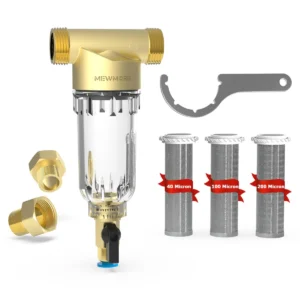 Best Micron FlexibilityMewMore WHC40 Spin DownWater of unknown or changing quality7.2/10
 Best Scale-Aware PrefilteriSpring WSP-50SL Spin DownHard well water with both sediment and scale7.0/10
Table of contents9 sections · tap to expand
At a glance
Our top picks compared
| Product | Best for | Type and size | Key features | Where to buy |
|---|---|---|---|---|
| 1. iSpring WSP-50 Spin Down Best Overall 7.7/10 | Well owners with heavy sediment who want to flush and reuse | Whole house filter | Lead reductionInstallation | Mid-range Check price |
| 2. Pentair Pentek DGD-5005 Best Fine Micron Cartridge 7.4/10 | Protecting a downstream carbon or drinking water filter | Whole house filter, 6 months, 10 GPM | NSF certifiedFilter life listed | Budget Check price |
| 3. MewMore WHC40 Spin Down Best Micron Flexibility 7.2/10 | Water of unknown or changing quality | Whole house filter | Lead reductionInstallation | Budget Check price |
| 4. iSpring WSP-50SL Spin Down Best Scale-Aware Prefilter 7.0/10 | Hard well water with both sediment and scale | Whole house filter | Lead reductionInstallation | Premium Check price |
 5. SimPure DB10P Housing Best Housing Kit 7.0/10 | A first sediment stage built from scratch | Whole house filter | NSF certifiedInstallation | Budget Check price |
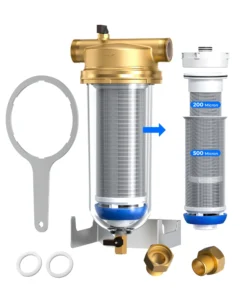 6. Waterdrop BG103 Mega Spin Down Best for Muddy Well Water 6.9/10 | Coarse, heavy debris at high household flow | Whole house filter, 25 GPM | Premium Check price | |
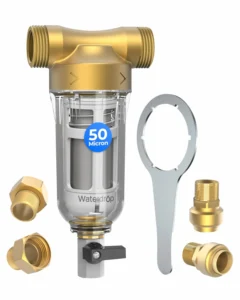 7. Waterdrop RPFK Spin Down Best Compact Reusable Option 6.9/10 | Tight installs needing a certified lead-free housing | Whole house filter, 20 GPM | NSF certifiedLead reductionInstallation | Mid-range Check price |
Score: our 0-10 rating from fit for this use, buyer ratings, review volume, completeness of the product details and availability. It is not a lab test.
Buying advice
How to choose a sediment filter that stops clogging quickly
Match the micron rating to your sediment, not to a number you saw online
Micron rating sets the smallest particle a cartridge is rated to capture, and finer is not automatically better. A 50 micron screen handles sand, rust flakes and grit and clogs slowly; a 5 micron cartridge catches far more but loads faster on the same water. The practical pattern is coarse first, fine second, so the cheap washable stage absorbs the load and the finer cartridge lasts its rated interval.
Decide whether you want to flush a screen or replace a cartridge
Washable spin down units use a stainless steel mesh that you flush through a valve, so the recurring cost is water and a few minutes rather than a new element. Disposable cartridges, whether pleated, spun polypropylene or string-wound, must be replaced once loaded, and rinsing them is a stopgap at best. If your sediment load is heavy and constant, the reusable screen changes the economics; if you need fine polishing, a disposable cartridge is the only option.
Check housing size, connection and flow before you buy
A cartridge only fits the housing it is made for, so confirm the standard size (10 inch by 2.5 inch, 10 inch by 4.5 inch Big Blue, or 20 inch) and the port thread before ordering. Flow rate matters too: a cartridge rated at 10 GPM in a housing fed by a household drawing less will hold sediment longer, while one pushed past its rating sheds dirt and drops pressure.
Connection sizes here run 1 inch MNPT with 3/4 inch FNPT on the spin down units.
Know what the sediment stage protects downstream
A sediment filter is a sacrificial first stage, not a drinking water filter. It protects the carbon block, reverse osmosis membrane or softener resin behind it from fouling, which is why a clogging prefilter often signals that the downstream cartridge is next. If you need chlorine, lead or PFAS reduction, that comes from a carbon or reverse osmosis stage after the sediment filter, with its own NSF/ANSI 42 or 53 listing.
Our picks
Our 7 Dirty Sediment Filter picks
Best Overall
iSpring WSP-50 Spin Down
- Whole house filter
- Lead, Sediment
- DIY install
Best for: Well owners with heavy sediment who want to flush and reuse
Skip if: Your water carries fine silt that passes a 50 micron screen and needs a 5 micron cartridge instead.
Price range: Mid-range
Check price on AmazonPaid link. We may earn a commission.
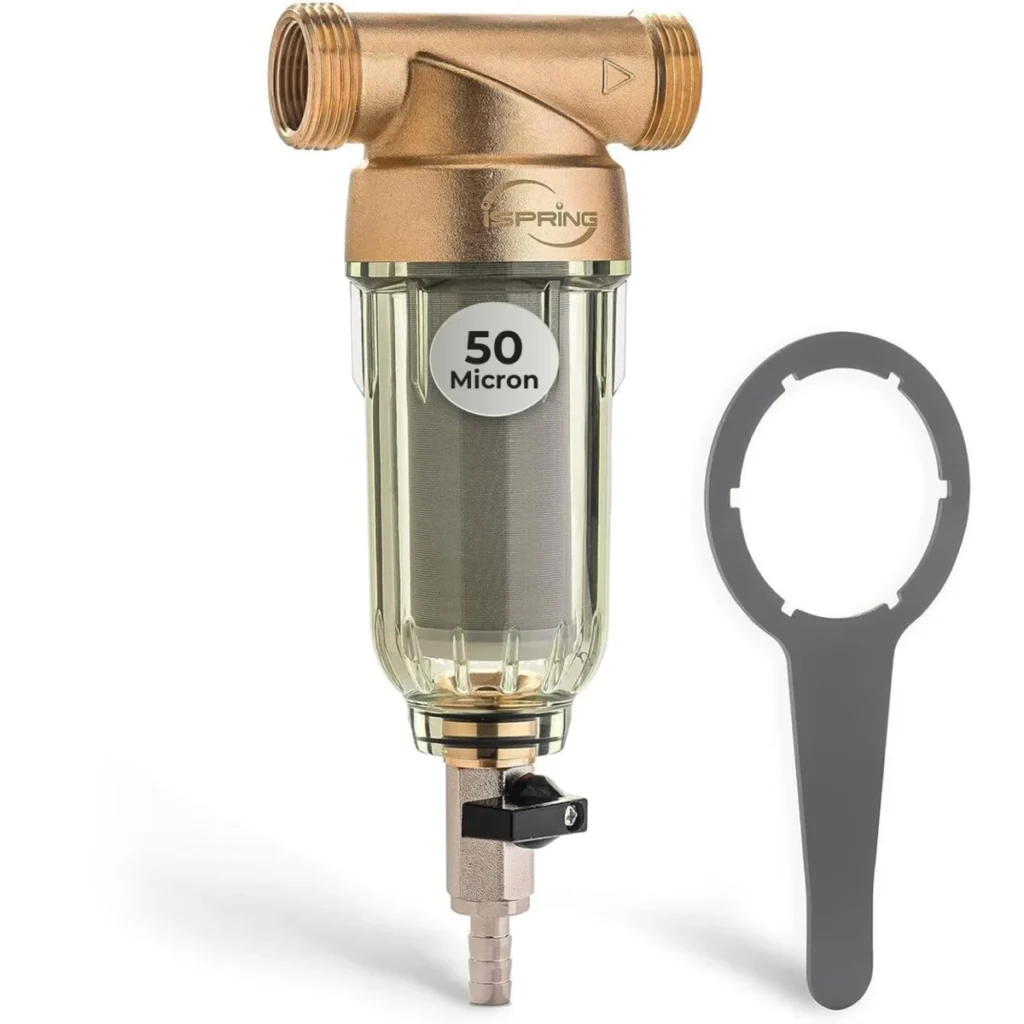
Earns Best Overall because a 50 micron stainless steel mesh, 1 inch connections and a flush-out valve let a household trap sediment and reuse the screen instead of buying cartridges.
What matters in daily use
The iSpring WSP-50 is a whole house spin down filter rated at 50 micron, so it catches sand, rust flakes and larger particles before they reach finer cartridges, appliances and fixtures. Its stainless steel mesh is flushable rather than disposable, which is why the screen is rated to last 1 to 2 years instead of a six month cartridge cycle. The see-through housing lets a homeowner watch buildup and decide when to flush.
Connections are 1 inch MNPT and 3/4 inch FNPT on both ends, with a garden hose barb on the flush valve, so it fits common main lines without adapters. The published limits matter: 15-115 psi and 40-100F, indoor use only, and a 1 lb unit that hangs on the pipe. Compared with the Pentair Pentek DGD-5005, this iSpring captures coarser particles but never needs a replacement cartridge; compared with the MewMore WHC40 Spin Down, it offers one mesh rating instead of three.
Specifications
| Type | Whole house filter |
|---|---|
| Reduces | Lead, Sediment (named in listing) |
| Micron rating | 50 micron |
| Connection | 1 in |
| Water pressure | 15-115 psi |
| Installation | DIY install |
| Material | Stainless steel |
| Weight | 1 lb |
Pros
- Reusable screen avoids repeated cartridge purchases
- See-through housing shows when flushing is needed
- Dual threads fit 1 inch or 3/4 inch plumbing
- Protects downstream filters and appliances from grit
Cons
- 50 micron rating lets fine silt through
- Indoor only, with a 115 psi pressure ceiling
- No certification listed for material safety
Best Fine Micron Cartridge
Pentair Pentek DGD-5005
- Whole house filter
- NSF/ANSI 42
- 6 months
- 10 GPM
- Sediment

Best for: Protecting a downstream carbon or drinking water filter
Skip if: You want a reusable screen with no cartridge changes, or your housing is not a 10 inch Big Blue size.
Price range: Budget
Check price on AmazonPaid link. We may earn a commission.
Takes Best Fine Micron Cartridge because a nominal 5 micron rating, NSF/ANSI 42 certification and under 1 psi pressure drop at 10 GPM make it a strong final sediment stage.
What matters in daily use
The Pentek DGD-5005 is a 10 inch by 4.5 inch sediment cartridge rather than a housing, spun from 100% polypropylene with a dual-gradient density that gets tighter toward the core. That construction holds more dirt before the surface loads up, and the nominal 5 micron rating catches particles a 50 micron spin down screen passes. It is certified to NSF/ANSI 42 for material requirements, which covers the cartridge itself, not a reduction claim for health contaminants.
Flow is the practical argument: the listing puts pressure drop under 1 psi at 10 GPM, so a whole house line keeps its pressure while sediment is removed. The tradeoff is consumable cost and attention, since the cartridge is rated for about 6 months and should be changed sooner if pressure falls. The iSpring WSP-50 Spin Down never needs replacing but stops at 50 micron; this Pentek is the finer stage that follows it, and it drops into any 10 inch Big Blue housing.
Specifications
| Type | Whole house filter |
|---|---|
| Certifications | NSF/ANSI 42 |
| Reduces | Sediment (named in listing) |
| Filter life | 6 months |
| Flow rate | 10 GPM |
| Micron rating | 5 micron |
| Weight | 2.23 lb |
Pros
- 5 micron rating catches fine silt and rust
- Dual-gradient design holds more dirt before clogging
- Certified to NSF/ANSI 42
- Low pressure loss keeps whole house flow steady
Cons
- Consumable cartridge, not reusable
- Needs a separate housing to install
- Shorter life when sediment loads are heavy
Best Micron Flexibility
MewMore WHC40 Spin Down
- Whole house filter
- Lead, Sediment
- DIY install

Best for: Water of unknown or changing quality
Skip if: You want a single fixed screen and the least possible maintenance, or your water is extremely muddy.
Price range: Budget
Check price on AmazonPaid link. We may earn a commission.
Wins Best Micron Flexibility because the kit ships 40, 100 and 200 micron stainless steel mesh screens, letting a household match the screen to water that changes with the season.
What matters in daily use
The MewMore WHC40 is a whole house spin down filter supplied with three interchangeable stainless steel mesh elements at 40, 100 and 200 micron. A well that runs clear most of the year and muddy after storms can start at 200 micron to keep flow, then move to 40 micron when the water settles. The brass valve head and transparent housing allow visual checks, and the unit is flushable and reusable, so the screens are cleaned rather than bought.
Both ends carry 1 inch MNPT and 3/4 inch FNPT threads plus 3/4 inch NPT connectors, which covers most residential main lines. The main tradeoff is maintenance rhythm: the manufacturer asks for flushing every 15-30 days, and weekly on well water or poor quality. Against the iSpring WSP-50 Spin Down, which fixes one 50 micron screen, this kit trades simplicity for adaptability; against the Waterdrop BG103 Mega Spin Down, it handles ordinary sediment rather than very heavy debris at high flow.
Specifications
| Type | Whole house filter |
|---|---|
| Reduces | Lead, Sediment (named in listing) |
| Connection | 1 in |
| Installation | DIY install |
| Material | Stainless steel |
Pros
- Three mesh ratings adapt to changing water quality
- Reusable screens cut long-term cartridge spending
- Clear housing makes buildup easy to see
- Dual thread sizes simplify fitting to the main line
Cons
- Frequent flushing required, weekly on well water
- No micron rating or flow rate stated for the assembled unit
- Not built for very heavy debris loads
Best Scale-Aware Prefilter
iSpring WSP-50SL Spin Down
- Whole house filter
- Lead, Sediment
- DIY install

Best for: Hard well water with both sediment and scale
Skip if: Your water has no scale problem, since a plain spin down screen costs less for sediment alone.
Price range: Premium
Check price on AmazonPaid link. We may earn a commission.
Earns Best Scale-Aware Prefilter because it pairs 50 micron sediment capture with a Siliphos scale inhibitor in one lead-free brass head, so hard well water gets two problems handled at the first stage.
What matters in daily use
The WSP-50SL is a whole house spin down filter rated at 50 micron, with 1 inch MNPT and 3/4 inch FNPT connections and a 15.98 oz body, so it installs on the main line ahead of finer cartridges. What separates it from the iSpring WSP-50 Spin Down is the Siliphos component, which the manufacturer describes as helping prevent scale and corrosion downstream.
That combination suits a well with both grit and hardness, where a plain sediment screen would leave scale untouched. The tradeoff is that a 50 micron screen only stops larger particles, so a 5 micron cartridge such as the Pentair Pentek DGD-5005 is still needed before drinking water stages. Flushing keeps the screen working, and the manufacturer lists a one year warranty.
Specifications
| Type | Whole house filter |
|---|---|
| Reduces | Lead, Sediment (named in listing) |
| Micron rating | 50 micron |
| Connection | 1 in |
| Installation | DIY install |
| Weight | 15.98 oz |
Pros
- Adds scale inhibition to sediment capture in one housing
- Dual thread sizes simplify connection to existing pipework
- Reusable screen avoids frequent cartridge purchases
- Lead-free brass construction suits potable water lines
Cons
- 50 micron mesh passes fine silt and clay
- Siliphos does not soften water or remove hardness minerals
- No NSF certification stated for contaminant reduction
Best Housing Kit
SimPure DB10P Housing
- Whole house filter
- NSF certified
- Sediment
- DIY install
Best for: A first sediment stage built from scratch
Skip if: You want a filter that works out of the box without choosing a cartridge separately.
Price range: Budget
Check price on AmazonPaid link. We may earn a commission.
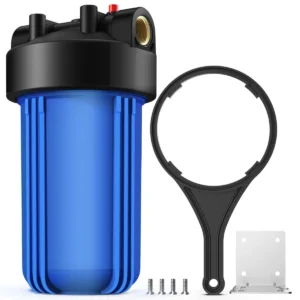
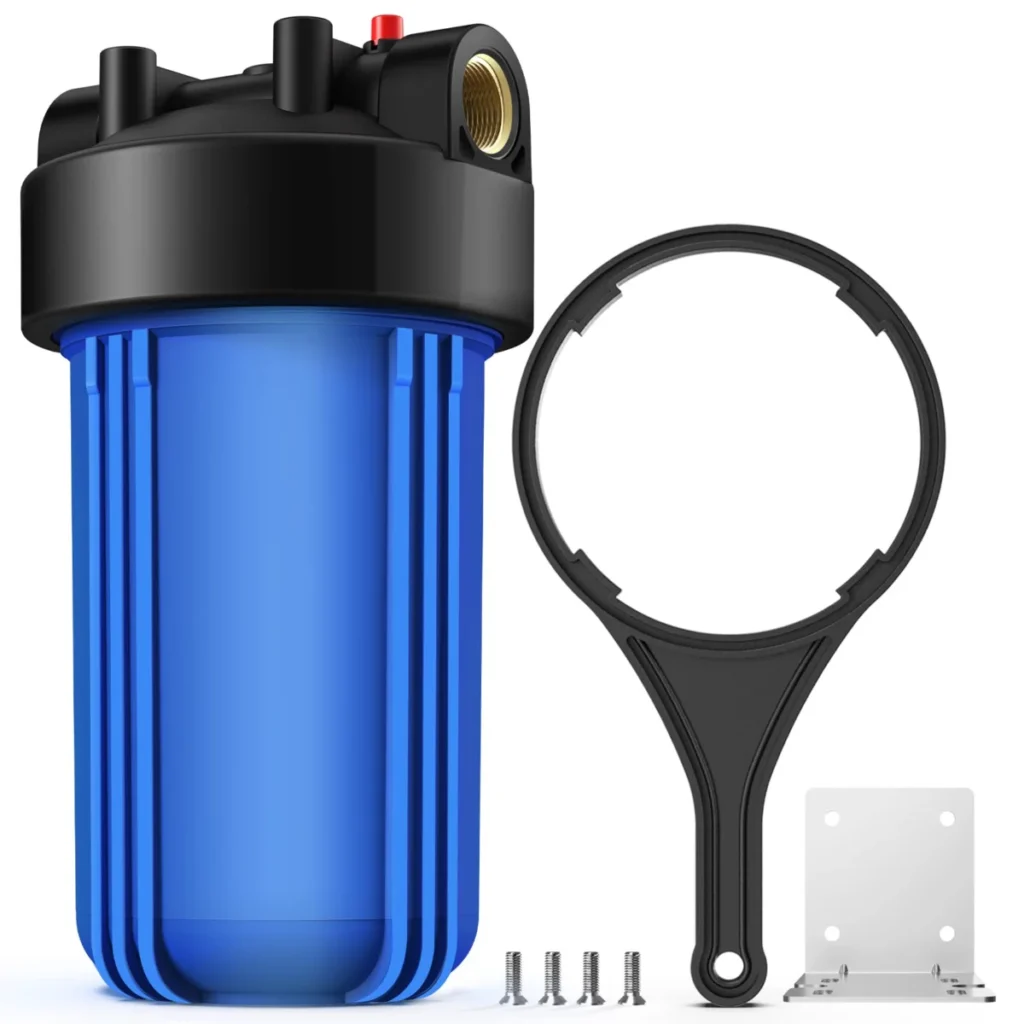
Takes Best Housing Kit because it supplies the 10 inch Big Blue housing, wrench, steel bracket and 1 inch NPT brass ports, letting a household build a sediment stage around cartridges it chooses.
What matters in daily use
The DB10P is a 10 inch by 4.5 inch housing rather than a filter, made of reinforced polypropylene with 1 inch NPT brass ports and a built-in pressure relief button. It accepts universal 4.5 by 10 inch cartridges, so the micron rating and media come from whatever you load, and the 7 lb unit mounts on the included bracket.
That flexibility is the point: a 5 micron cartridge inside this housing covers finer sediment than the fixed 50 micron screen on the iSpring WSP-50SL Spin Down, and you can swap media as water quality changes. The tradeoff is that the housing alone does not filter anything, and the listing's NSF claim does not name a standard, so confirm the certification on the cartridge you pair with it.
Specifications
| Type | Whole house filter |
|---|---|
| Certifications | NSF certified (per listing; standard not stated) |
| Reduces | Sediment (named in listing) |
| Connection | 1 in |
| Installation | DIY install |
| Weight | 7 lb |
Pros
- Accepts many 4.5 by 10 inch cartridges, including carbon blocks
- Brass ports and raised threads reduce leak complaints
- Mounting hardware included for a straightforward DIY install
- Pressure relief button simplifies cartridge changes
Cons
- No cartridge included, so filtration depends on your choice
- NSF claim does not state which standard applies
- Adds a bulky housing that needs mounting space
Best for Muddy Well Water
Waterdrop BG103 Mega Spin Down
- Whole house filter
- 25 GPM
- Sediment, Hardness

Best for: Coarse, heavy debris at high household flow
Skip if: Your sediment is fine silt rather than coarse debris, where a finer screen suits better.
Price range: Premium
Check price on AmazonPaid link. We may earn a commission.
Wins Best for Muddy Well Water because its 500 and 200 micron mesh, oversized chamber and 25 GPM flow handle coarse debris at full household demand without constant clogging.
What matters in daily use
The BG103 uses 500 and 200 micron mesh in a chamber the manufacturer describes as 20 times larger than standard, rated at 25 GPM through 1 inch connections. That flow matters in a house drawing several taps at once, and the coarse mesh is built for pebbles, coarse sand and rust flakes rather than the fine silt a 50 micron screen like the iSpring WSP-50 Spin Down targets.
A 7.1 lb forged brass head with nano-coating and a 360 degree power flush valve support the muddy water role, and the listing states magnetic scale prevention. The tradeoff is coarseness: 200 micron mesh leaves fine sediment for a downstream cartridge, and the manufacturer asks for cleaning every two weeks with a monthly deep clean, so dirty water means regular attention.
Specifications
| Type | Whole house filter |
|---|---|
| Reduces | Sediment, Hardness (named in listing) |
| Flow rate | 25 GPM |
| Connection | 1 in |
| Material | Stainless steel |
| Weight | 7.1 lb |
Pros
- High 25 GPM flow keeps up with whole house demand
- Large chamber resists clogging on heavy debris
- Power flush scours the screen in both directions
- Brass head tested for water hammer and freezing
Cons
- Coarse mesh passes fine silt downstream
- Frequent flushing needed on dirty water
- Magnetic scale prevention is not a softener
Best Compact Reusable Option
Waterdrop RPFK Spin Down
- Whole house filter
- NSF/ANSI 372
- 20 GPM
- Lead, Copper, Sediment
- DIY install

Best for: Tight installs needing a certified lead-free housing
Skip if: Your well water carries heavy coarse debris or you need the highest flow, so the Waterdrop BG103 Mega Spin Down fits better.
Price range: Mid-range
Check price on AmazonPaid link. We may earn a commission.
The Waterdrop RPFK earns Best Compact Reusable Option because its NSF/ANSI 372 lead-free housing and 50 micron screen fit tight installs where a full-size prefilter will not.
What matters in daily use
At roughly 3.78 by 2.56 by 7.9 inches, the Waterdrop RPFK takes up little room on a main line, which suits a crowded utility closet or a short run of pipe before a softener. The 50 micron stainless steel screen catches rust flakes and grit, and the backwash function flushes them out instead of costing you a new cartridge.
The 20 GPM rating is the honest limit: it trails the Waterdrop BG103 Mega Spin Down at 25 GPM, so a large household running several fixtures at once may see more pressure loss here. NSF/ANSI 372 covers lead-free materials, not contaminant reduction, so treat this as plumbing protection ahead of a finer filter, not a drinking water treatment step.
Specifications
| Type | Whole house filter |
|---|---|
| Certifications | NSF/ANSI 372 |
| Reduces | Lead, Copper, Sediment (named in listing) |
| Flow rate | 20 GPM |
| Micron rating | 50 micron |
| Connection | 1 in |
| Installation | DIY install |
| Material | Stainless steel |
Pros
- Compact body fits tight utility spaces
- Backwash cleaning avoids cartridge purchases
- Lead-free NSF/ANSI 372 certified housing
- Multiple fitting types simplify hookup
Cons
- 20 GPM flow trails the 25 GPM Waterdrop BG103
- 50 micron screen passes fine silt to downstream filters
- Certification covers materials, not contaminant reduction
What does the color of a Dirty Sediment Filter tell you?
Brown or orange-brown coating usually points to rust and iron particles, common on well water or after city main repairs; gray or gritty buildup reads as silt, sand and fine sediment; a slick greenish or dark film suggests organic matter or bacterial growth in the line. Color is a clue, not a diagnosis. If the pattern is unclear or repeats, test the water: a certified lab test for private wells, the local water quality report for city supply, as the EPA and CDC advise.
Texture matters as much as color. Grit that rinses off a stainless mesh screen is loose sediment; a coating that stains the screen or the housing and returns within days points to dissolved iron that oxidizes in the filter, which a sediment stage alone will not solve. Slimy film on a cartridge that has sat too long means the cartridge became a growth surface, and the fix is a shorter change interval, not a finer micron rating.
Why does my sediment filter keep clogging quickly?
A filter clogs quickly when the micron rating is finer than the sediment load justifies, when the housing is too small for the flow drawn through it, or when both happen at once. A 5 micron cartridge in a 10 inch housing on a well with heavy silt can load in weeks, while a 50 micron spin down screen ahead of it sheds most of that load by flushing. Coarse prefiltration first, finer filtration second, is the pattern that restores pressure and stretches cartridge life.
Flow rate and pressure drop belong in the same decision. A cartridge rated near the flow your household actually uses will hold sediment longer than one pushed past its rating, and a clogged element shows up as falling pressure at fixtures before it looks full. If a cartridge still loads in weeks after you add coarse prefiltration and match the housing to the flow, the sediment load itself needs a lab test rather than a finer filter.
Decision guide
Spin down screen or disposable cartridge: which fits your sediment problem?
The iSpring WSP-50 and the Pentair Pentek DGD-5005 solve different halves of the same problem. The iSpring is a reusable 50 micron screen that flushes clean and never needs a cartridge purchase, which suits a well with visible grit; the Pentek is a 5 micron disposable cartridge certified to NSF/ANSI 42, rated 10 GPM and about six months, which suits a household that wants fine protection for a downstream filter. Many well systems use both, coarse first.
Among the spin down units, the Waterdrop BG103 is built for the heaviest load with 500 and 200 micron screens and a 25 GPM rating, while the Waterdrop RPFK is the compact choice at 50 micron, 20 GPM and NSF/ANSI 372 certification for lead-free materials. The MewMore WHC40 sits between them by shipping 40, 100 and 200 micron screens so you can change the mesh as your water changes.
Our process
How we chose our Dirty Sediment Filter picks
Products were shortlisted from whole house sediment filters and cartridges that state a micron rating, connection size and either a flow rate or filter life, then ranked on how well each handles a heavy or fast-clogging sediment load. Specifications, materials, certifications, design (flushable versus disposable, housing compatibility) and buyer feedback carried the most weight, with value per year of use deciding close calls.
Common questions
Frequently asked questions
Can you clean a sediment filter instead of replacing it?
Only washable stainless steel mesh screens are meant to be cleaned and reused; pleated, spun and string-wound cartridges are disposable and lose integrity when rinsed. Flush a spin down screen every two to four weeks, more often on dirty well water, and replace disposable cartridges on schedule or when pressure drops.
Will a Dirty Sediment Filter cause low water pressure?
Yes. A loaded cartridge or clogged screen restricts flow, so pressure falls at fixtures before the filter looks full. Replacing or flushing the element usually restores pressure; if it does not, check for a kinked line, a closed valve or a housing that is undersized for your flow.
How often should a sediment filter be changed on well water?
There is no single interval, because sediment load varies by well. A disposable cartridge is commonly changed around every six months or sooner when pressure drops, while a flushable screen may need flushing weekly on dirty water. Track your own pressure and appearance to set a schedule.
Do I need a sediment filter before a carbon or reverse osmosis system?
A sediment stage ahead of carbon or reverse osmosis is worth adding because it keeps silt and rust from fouling the finer, more expensive elements. Choose a coarse rating for the prefilter and let the carbon block or membrane do the fine work, then check each product's own certification for what it reduces.
Is a sediment filter enough to make well water safe to drink?
No. A sediment filter reduces particles such as sand, silt and rust but does not address bacteria, nitrates or dissolved contaminants. Have private well water tested by a certified lab, as the CDC recommends, and choose drinking water treatment based on those results rather than on the prefilter alone.
Bottom line
Final verdict
- Well owner with heavy, fast-clogging sediment: iSpring WSP-50 Spin Down. The flushable 50 micron stainless mesh sheds the load instead of ending a cartridge's life, so pressure comes back without a recurring purchase.
- Household protecting a downstream carbon or RO stage: Pentair Pentek DGD-5005. The 5 micron NSF/ANSI 42 cartridge rated at 10 GPM and about six months gives fine protection where a coarse screen alone is not enough.
- First-time installer starting from no sediment stage: SimPure DB10P Housing. The SimPure DB10P supplies the 10 inch by 4.5 inch housing, bracket and wrench so a standard Big Blue cartridge has somewhere to go.
Final decision
Compare two finalists
Choose the two picks you narrowed down to see who each one suits and the main reason to skip it.
Keep reading

Whole House Water Filter Replacements: Match the Cartridge to Your Housing
The iSpring WGB32B is our top pick among 7 whole house water filter replacements, compared on correct fit, filtration type and certification…

Best RV Water Filters: 7 Picks Ranked by What They Remove and the Flow They Cost
The Camco Tastepure leads our RV water filter picks on NSF/ANSI 42, 53 and 372 listings. Compare 7 options by what they…
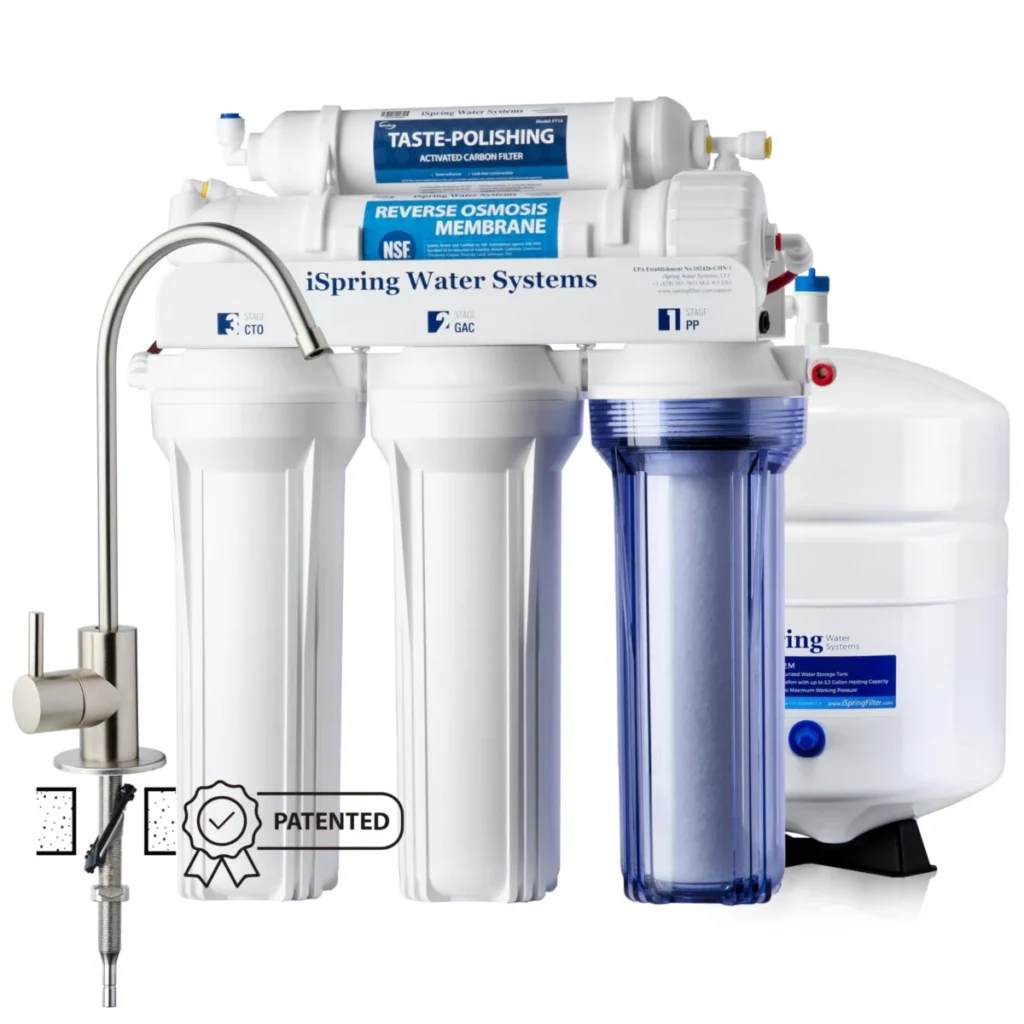
7 Well Water Systems Ranked by What They Remove, From Prefilter to Reverse Osmosis
Seven well water systems compared on certification, flow, filter life and yearly cost, with the iSpring RCC7-BN as the drinking water stage…